
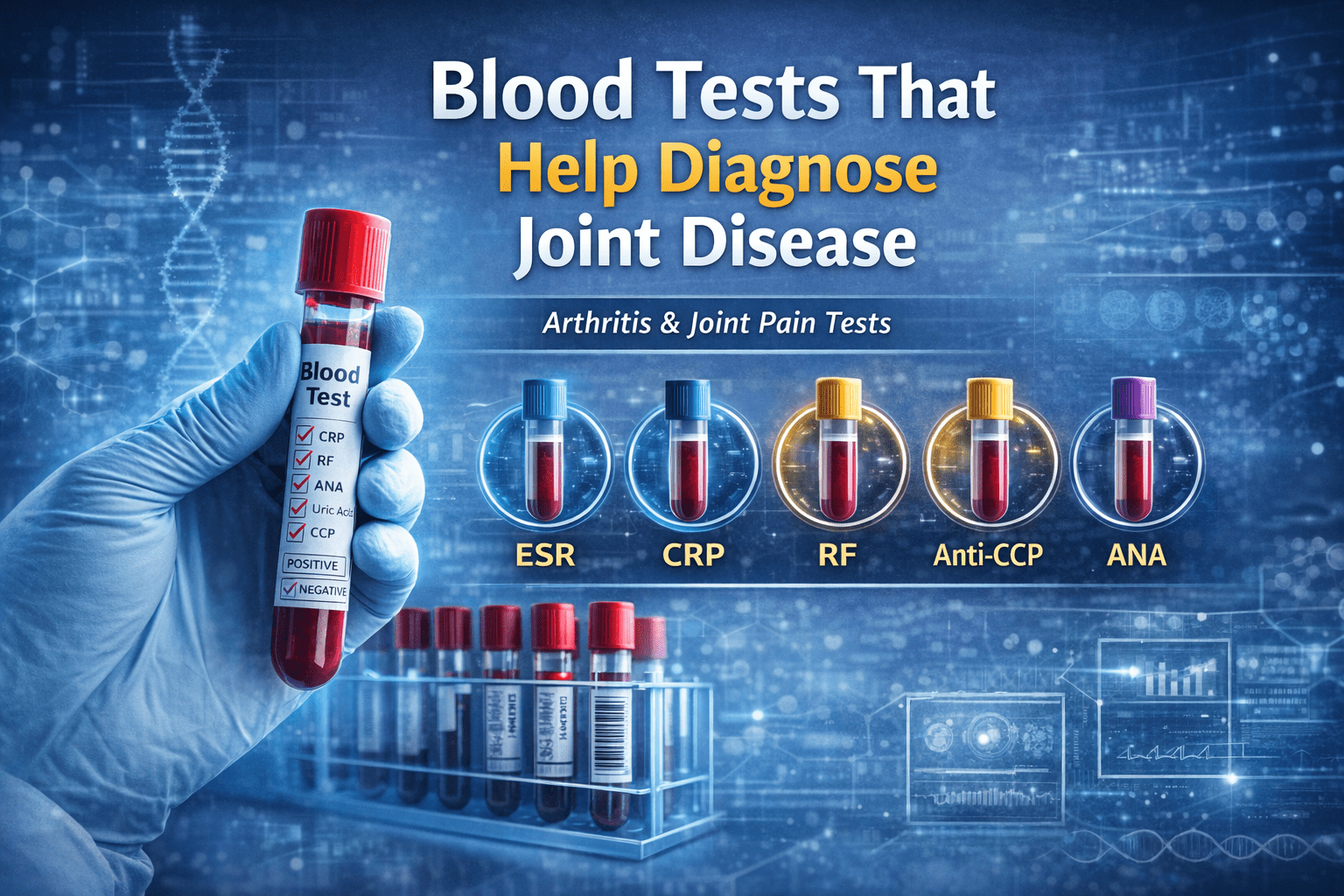
Joint pain is a common health concern affecting people of all ages. While some joint problems occur due to injury or age-related wear and tear, others may be caused by inflammation, autoimmune diseases, or infections.
In such cases, blood tests play an important role in diagnosing the underlying cause of joint disease. These tests provide valuable clues that help doctors understand what is happening inside the body and guide the right treatment plan.
Why Blood Tests Are Important in Joint Disease
When patients experience persistent joint pain, swelling, stiffness, or unexplained fatigue, doctors may suspect an inflammatory or autoimmune condition.
Imaging tests such as X-rays can show structural changes in joints, but they may not reveal inflammation or immune system activity. This is where blood tests become extremely useful.
Blood tests help doctors:
-
Detect inflammation in the body
-
Identify autoimmune diseases
-
Rule out infections
-
Monitor disease activity
-
Evaluate how well treatment is working
These tests provide important information that complements clinical examination and imaging studies.
Common Blood Tests Used in Joint Disease Diagnosis
Several blood tests are commonly ordered when doctors evaluate patients with joint pain or suspected inflammatory arthritis.
ESR (Erythrocyte Sedimentation Rate)
The ESR test measures how quickly red blood cells settle at the bottom of a test tube. A faster rate often indicates the presence of inflammation in the body.
This test is commonly used when doctors suspect conditions such as:
-
Rheumatoid arthritis
-
Polymyalgia rheumatica
-
Inflammatory arthritis
Although ESR cannot diagnose a specific disease on its own, it helps doctors determine whether inflammation is present.
CRP (C-Reactive Protein)
C-Reactive Protein (CRP) is another important marker of inflammation.
CRP levels tend to rise quickly during active inflammation and infection, making it a sensitive indicator of inflammatory activity.
Elevated CRP levels may suggest:
-
Active inflammatory arthritis
-
Infection
-
Autoimmune diseases
CRP testing is also useful for monitoring how well treatment is controlling inflammation.
Rheumatoid Factor (RF)
Rheumatoid Factor (RF) is an antibody that may be present in people with rheumatoid arthritis.
A positive RF test can support the diagnosis of rheumatoid arthritis, although not every patient with the condition will have a positive result.
RF may also appear in some other autoimmune or inflammatory disorders, which is why doctors interpret this test carefully.
Anti-CCP Antibody Test
The Anti-CCP (Anti-Cyclic Citrullinated Peptide) test is one of the most specific blood tests used to diagnose rheumatoid arthritis.
If Anti-CCP antibodies are detected along with joint symptoms, the likelihood of rheumatoid arthritis is significantly higher.
This test is especially valuable for detecting rheumatoid arthritis in its early stages, when treatment can prevent joint damage.
Uric Acid Test
The uric acid test helps diagnose gout, a type of arthritis caused by the buildup of uric acid crystals inside joints.
Gout often causes sudden episodes of severe joint pain, redness, and swelling, most commonly affecting the big toe joint.
Measuring uric acid levels helps doctors guide treatment and lifestyle changes to prevent future attacks.
ANA (Antinuclear Antibody Test)
The ANA test is commonly used when doctors suspect autoimmune diseases such as lupus.
A positive ANA test does not necessarily confirm lupus, but it indicates that the immune system may be producing antibodies against the body’s own tissues.
Additional tests are often needed to confirm the exact diagnosis.
Complete Blood Count (CBC)
A Complete Blood Count (CBC) provides valuable information about overall health and immune system activity.
It can help detect:
-
Anemia associated with chronic inflammatory disease
-
Signs of infection
-
Abnormal immune responses
These findings may support the diagnosis of inflammatory or autoimmune joint conditions.
How Doctors Interpret Blood Test Results
Blood tests are never interpreted in isolation.
Doctors analyze test results together with:
-
Patient symptoms
-
Physical examination findings
-
Imaging studies such as X-rays or MRI
For example, a mildly elevated inflammatory marker may not be significant without symptoms. On the other hand, certain patterns of abnormal results may strongly suggest a specific disease.
This is why interpretation by experienced clinicians is essential.
When Blood Tests Are Recommended
Doctors may recommend blood tests when patients experience symptoms such as:
-
Persistent joint swelling
-
Morning stiffness lasting more than 30 minutes
-
Pain affecting multiple joints
-
Unexplained fatigue
-
Recurrent joint inflammation
These symptoms may indicate inflammatory or autoimmune joint disease, rather than simple mechanical joint problems.
Why Early Diagnosis Matters
Many autoimmune joint diseases can cause progressive joint damage if left untreated.
Early diagnosis allows doctors to begin treatment sooner, helping prevent long-term complications and preserve joint function.
Modern treatments for conditions such as rheumatoid arthritis have improved significantly, especially when therapy begins early.
The Take-Home Message
Blood tests play an essential role in diagnosing inflammatory and autoimmune joint diseases. They help doctors detect inflammation, identify immune system activity, and guide treatment decisions.
However, test results must always be interpreted alongside clinical evaluation and patient symptoms.
Anyone experiencing persistent joint pain, swelling, or prolonged stiffness should seek professional medical advice rather than relying on test results alone.
At StepUp Joints in Lajpat Nagar, Delhi, laboratory testing works closely with orthopaedic evaluation, physiotherapy, and rheumatology care to ensure accurate diagnosis and comprehensive treatment for musculoskeletal conditions.