
Understanding the Direct Anterior Approach (DAA)
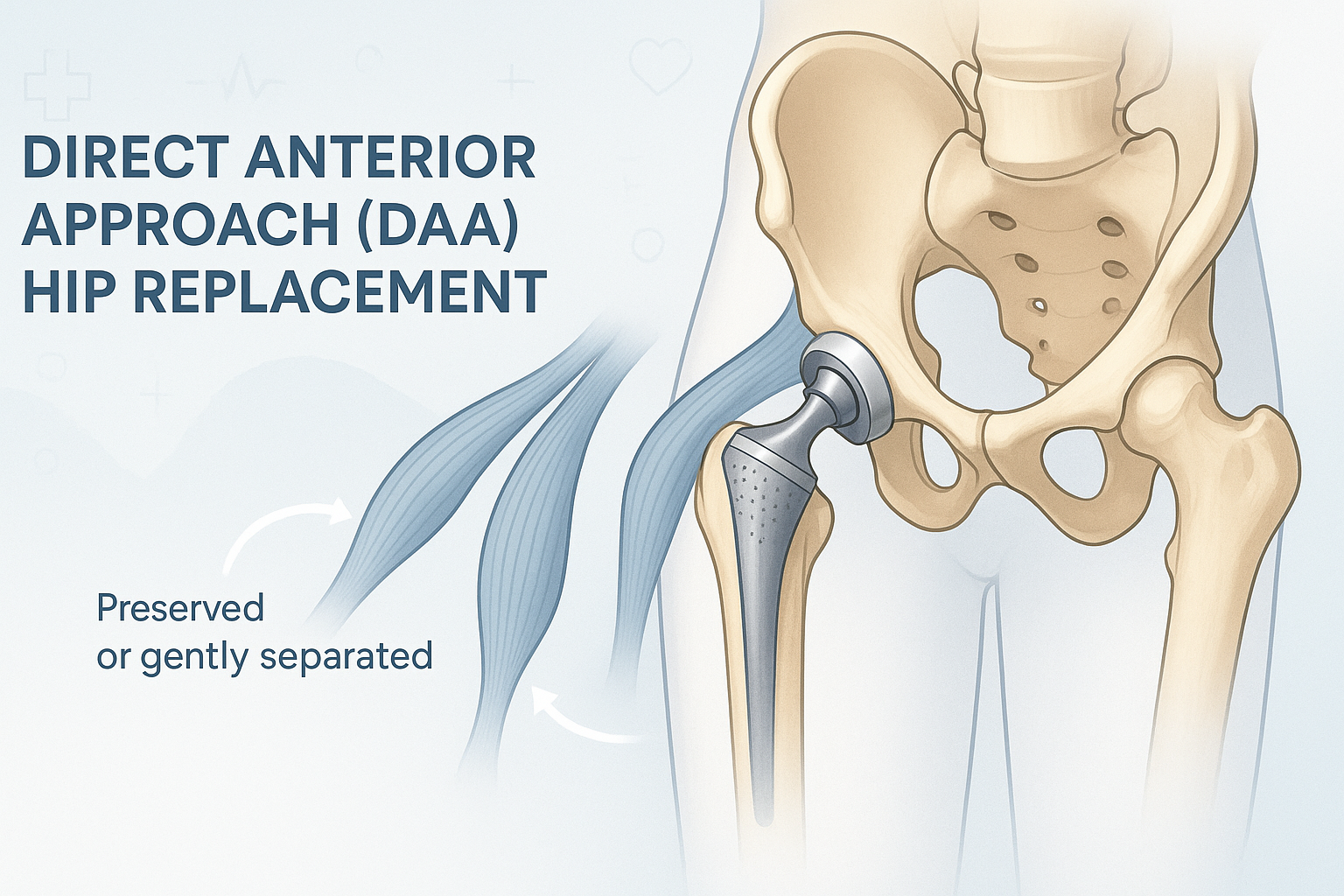
The Direct Anterior Approach (DAA) is one of the most advanced and minimally invasive surgical techniques used in total hip replacement today. Unlike traditional posterior or lateral approaches, the DAA allows orthopedic surgeons to access the hip joint from the front (anterior) of the body — passing between natural muscle planes rather than cutting through them.
This innovative muscle-sparing technique leads to less pain, faster recovery, and improved joint stability. By preserving key muscles and tendons that control hip movement, patients regain mobility more naturally and quickly after surgery.
Why the Direct Anterior Approach Is Different
In traditional hip replacement surgery, surgeons typically need to cut or detach certain muscles to expose the hip joint. These muscles are then repaired after the implant is placed, which can result in longer healing time and more postoperative discomfort.
In contrast, the Direct Anterior Approach uses a natural gap between two muscles — the tensor fascia lata and the sartorius — to reach the hip joint. This eliminates the need to cut major muscles, reduces tissue trauma, and minimizes the risk of muscle weakness after surgery.
As a result, DAA is considered one of the most patient-friendly surgical options for total hip replacement, especially for those who want to return to normal life as quickly as possible.
Who Can Benefit from the DAA Hip Replacement?
While the Direct Anterior Approach offers many advantages, it’s not suitable for everyone. The ideal candidates include:
-
Patients with primary osteoarthritis of the hip
-
Those with good bone quality and normal hip anatomy
-
Individuals with moderate body weight (since severe obesity can limit access)
-
Patients who are motivated and committed to early rehabilitation
However, individuals with complex hip deformities, prior hip surgeries, or certain bone conditions may not be ideal candidates. A skilled orthopedic surgeon will carefully evaluate each patient’s case, considering factors such as bone structure, joint stiffness, and overall health before recommending this approach.
How the DAA Procedure Works
During a Direct Anterior Approach Hip Replacement, the patient lies on their back (supine position) on a specially designed operating table. The surgeon makes a small incision — typically around 8 to 10 centimeters — at the front of the hip. Through this incision, the surgeon gently moves muscles aside rather than cutting them, to reach the hip joint.
The damaged femoral head (the “ball” of the joint) is removed, and the hip socket (acetabulum) is cleaned and prepared to receive a new artificial cup. Then, a precisely fitted metal or ceramic ball is attached to a stem that is inserted into the femur (thigh bone).
Advanced surgical tools and imaging technology allow for precise implant placement and leg length restoration. Because the muscles are preserved, the hip remains more stable after surgery, and patients often experience fewer restrictions during recovery.
Benefits of the Direct Anterior Approach
The DAA Hip Replacement offers several key benefits compared to traditional surgical approaches:
-
Muscle Preservation: No cutting of major muscles, leading to faster functional recovery.
-
Less Post-Operative Pain: Reduced muscle trauma means less discomfort after surgery.
-
Faster Recovery: Many patients are able to walk within 6–12 hours after the operation.
-
Lower Dislocation Risk: Preserving the posterior soft tissues reduces instability and dislocation chances.
-
Smaller Scar: The incision at the front of the hip is usually smaller and more cosmetically appealing.
-
Earlier Discharge: Most patients go home within 2–3 days of surgery.
-
Improved Natural Movement: Because muscle function is maintained, patients report that the hip feels more natural.
In fact, many individuals find they can sit cross-legged, climb stairs, and resume daily routines much sooner than they expected.
Modern Innovations Enhancing the DAA
Recent advancements in surgical technology have made the Direct Anterior Approach even safer and more precise. Intraoperative fluoroscopy, navigation systems, and robotic-assisted tools help surgeons achieve accurate implant positioning and alignment, which are critical for long-term success.
Moreover, the use of muscle-sparing retractors, specialized operating tables, and customized instruments has made it possible to perform the procedure with minimal soft tissue disruption. Enhanced pain management protocols — including nerve blocks, multimodal analgesia, and early rehabilitation — further contribute to a smoother and faster recovery.
Recovery and Rehabilitation After DAA
One of the biggest advantages of the Direct Anterior Approach Hip Replacement is the accelerated recovery timeline. Since no major muscles are cut, patients can begin standing and walking with assistance within hours after surgery.
Day 1–2: Patients start gentle walking using a walker or crutches. Most report surprisingly little discomfort compared to older surgical methods.
Week 1–2: Patients regain confidence walking independently and begin light exercises to improve range of motion and muscle strength.
Week 3–6: Most can resume normal household activities and low-impact exercises such as cycling or swimming.
Week 6 onwards: Patients typically return to their normal routines, including sitting cross-legged, climbing stairs, and even driving (after surgeon approval).
Physiotherapy plays a crucial role throughout the recovery process. Your physiotherapist will design a personalized exercise program to help rebuild strength, improve flexibility, and ensure a stable gait pattern.
Longevity and Outcomes
When performed by an experienced orthopedic surgeon, the Direct Anterior Approach Hip Replacement has excellent long-term outcomes. The implants used are typically made from high-quality materials such as titanium, cobalt-chrome, and ceramic, offering durability of 20 years or more in most cases.
Because this approach allows for precise implant placement and reduces muscle trauma, the risk of dislocation and leg length discrepancy is significantly lower compared to other methods. Patients also tend to experience a more natural hip motion and higher satisfaction rates.
Potential Risks and Considerations
Although DAA offers many advantages, it also comes with certain challenges. The procedure has a steeper learning curve and requires specialized training and surgical expertise. In inexperienced hands, there is a slightly higher risk of temporary numbness or injury to nearby nerves or soft tissues.
Additionally, the anterior incision may be more difficult in patients with high body mass index (BMI) due to limited exposure. This is why surgeon experience and careful patient selection are key to achieving the best possible outcomes.
Frequently Asked Questions (FAQs)
Q1. Is DAA better than other approaches?
A: The Direct Anterior Approach offers faster recovery and less post-operative pain for appropriately selected patients. However, the choice of approach should always depend on the surgeon’s expertise and the patient’s anatomy.
Q2. When can I walk after DAA Hip Replacement?
A: Most patients can begin walking within 6–12 hours after surgery, under supervision.
Q3. Is DAA suitable for all patients?
A: No. While it’s ideal for many patients, those with complex hip deformities, obesity, or prior hip surgeries may be better suited for other surgical approaches.
Q4. How long does recovery take after DAA?
A: Most patients return to normal activities within 3–6 weeks, though complete recovery can take a few months.
Q5. What is the risk of dislocation after DAA?
A: Because major hip muscles are preserved, the risk of dislocation is lower compared to traditional approaches.
Conclusion
The Direct Anterior Approach (DAA) Hip Replacement represents a modern evolution in orthopedic surgery — a minimally invasive, muscle-sparing technique that prioritizes patient comfort and rapid recovery. By preserving key muscle structures and improving surgical precision, this approach enables patients to stand, walk, and return to normal life much sooner.
However, achieving the best results with DAA requires the skill and experience of a trained orthopedic surgeon. For suitable candidates, it offers a combination of faster recovery, reduced pain, greater joint stability, and natural movement, making it one of the most sought-after advancements in hip replacement surgery today.
If hip pain or arthritis is affecting your mobility, consult an experienced orthopedic specialist to determine whether the Direct Anterior Approach Hip Replacement is right for you — and take the first step toward pain-free, active living.