Understanding Navigation-Assisted Hip Replacement
Navigation-Assisted Hip Replacement, also known as Virtual Alignment Navigation (VAN) Hip Replacement, is an advanced, technology-driven surgical technique that combines orthopedic expertise with computer-guided precision. The goal is simple yet critical — to achieve perfect implant positioning and alignment, which directly influences the hip’s stability, function, and longevity.
In conventional hip replacement surgeries, surgeons rely primarily on visual estimation and anatomical landmarks for implant placement. While experienced surgeons can achieve excellent results, there is always a small margin for error. Navigation-assisted technology eliminates this uncertainty by providing real-time, computer-guided feedback during surgery, ensuring unparalleled accuracy.
Why Implant Positioning Matters
Proper implant alignment is one of the most important factors determining the success and lifespan of a hip replacement. Even minor deviations in the angle or depth of placement can lead to complications such as leg length discrepancies, implant loosening, impingement, or dislocation over time.
With VAN technology, the surgeon uses computer sensors and digital imaging to continuously track the position of surgical instruments and the patient’s anatomy throughout the procedure. This real-time data helps achieve millimeter-level precision in implant orientation — something that’s nearly impossible with the naked eye alone.
How Navigation-Assisted Hip Replacement Works
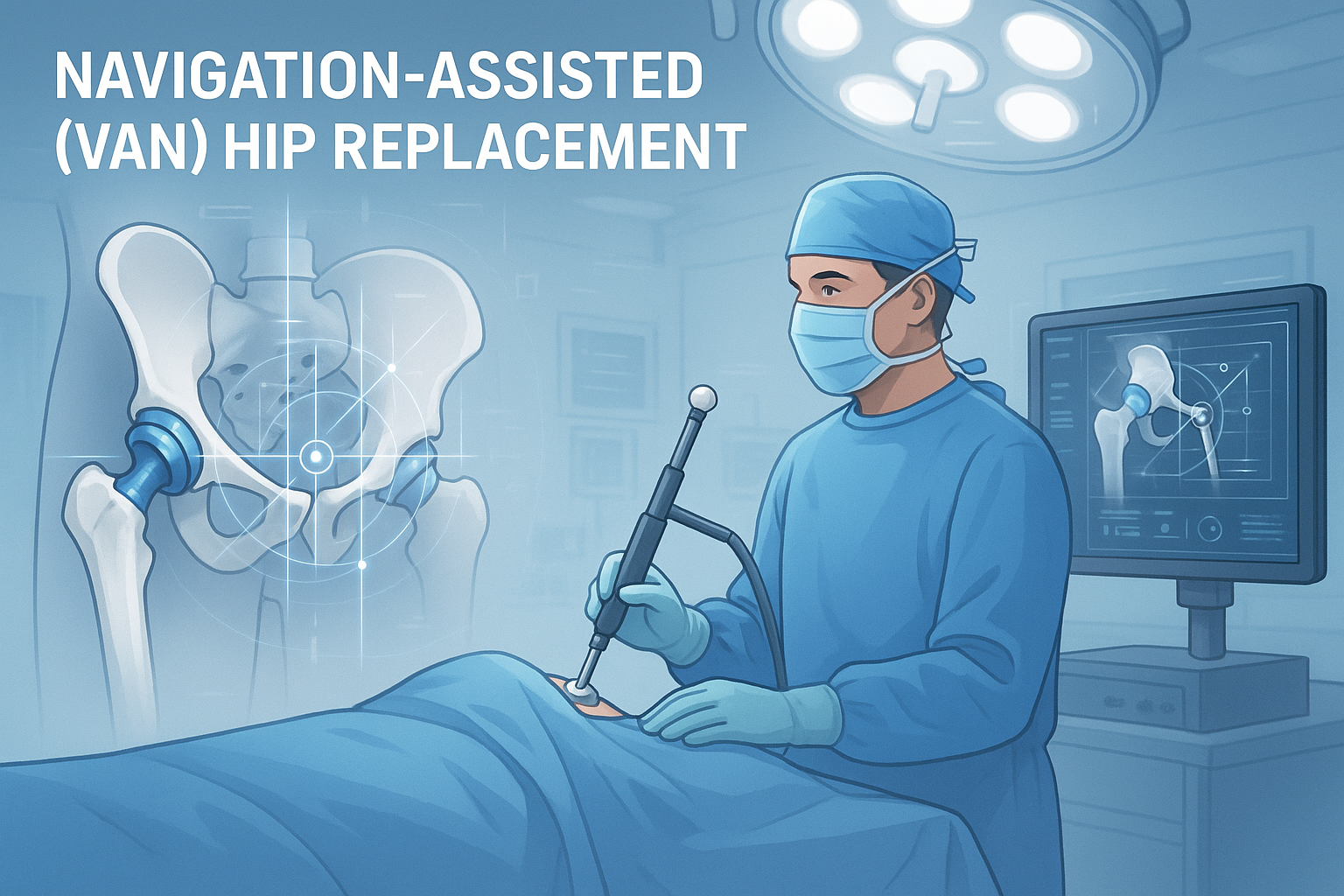
In a Navigation-Assisted Hip Replacement, small, sterile sensors (trackers) are temporarily attached to the patient’s pelvic and femoral bones. These trackers communicate with an infrared camera system connected to a specialized computer.
As the surgeon performs the procedure, the navigation system creates a three-dimensional (3D) virtual map of the hip joint. It displays precise information about angles, depths, and alignment, allowing the surgeon to visualize every movement in real time.
This enables exact placement of both the acetabular (socket) and femoral (stem) components, ensuring:
-
Perfect orientation of the implant
-
Correct leg length balance
-
Symmetrical hip rotation and stability
Once the surgeon confirms the accuracy of the implant position on the navigation screen, the sensors are removed, and the incision is closed as usual.
Benefits of Navigation-Assisted Hip Replacement
The use of navigation technology in hip replacement provides a number of significant advantages over conventional surgery:
-
Unmatched Accuracy:
VAN systems guide surgeons to achieve precise implant angles, minimizing human error. -
Improved Stability:
Accurate alignment reduces the risk of joint dislocation and enhances hip joint stability during movement. -
Better Leg Length Balance:
One of the common issues after hip replacement is a slight difference in leg length. Navigation helps equalize this perfectly. -
Enhanced Implant Longevity:
Proper positioning reduces uneven wear, extending the lifespan of the hip implant — often lasting 20–25 years or more. -
Ideal for Complex Cases:
Especially beneficial for patients with abnormal anatomy, deformities, or those undergoing revision hip replacement (a second or corrective surgery). -
Smooth Recovery:
Though recovery speed is similar to standard procedures, the improved implant positioning often results in smoother joint movement and better long-term function.
With navigation-assisted surgery, the surgeon can perform the procedure with a higher level of confidence, ensuring that every implant fits perfectly and performs optimally for years to come.
Who Can Benefit from VAN Hip Replacement?
Navigation-Assisted Hip Replacement is suitable for most patients requiring a total hip replacement, but it is particularly beneficial for:
-
Individuals with severe or complex hip arthritis
-
Patients with previous hip surgeries or deformities
-
Those undergoing revision hip replacement
-
Cases where precise alignment is critical to success
-
Patients seeking maximum implant longevity and stability
Even for standard hip arthritis cases, many surgeons now prefer navigation assistance because of the accuracy and reproducibility it offers.
Surgical Process: Step-by-Step Overview
-
Preoperative Planning:
Before surgery, advanced imaging (X-rays or CT scans) is used to analyze the patient’s anatomy and plan implant size and orientation. -
Positioning and Incision:
The patient is positioned on a specialized table. A small incision is made to expose the hip joint. -
Attachment of Sensors:
Navigation trackers are temporarily fixed to the bone. These devices send data to the navigation computer. -
3D Mapping:
The system generates a 3D model of the hip joint, showing real-time movements and spatial orientation. -
Implant Placement:
Guided by the navigation data, the surgeon prepares the bone and positions the implant components with high precision. -
Verification and Closure:
The system confirms that the implants are optimally aligned before the incision is closed and the trackers are removed.
This combination of human expertise and digital precision ensures superior surgical outcomes and faster patient recovery.
Recovery and Rehabilitation
Recovery following a Navigation-Assisted Hip Replacement is typically smooth and progressive. Since the implant is positioned with near-perfect alignment, patients often experience more balanced movement and fewer complications during rehabilitation.
Early Mobilization:
Most patients begin standing and walking within 24 hours after surgery under physiotherapy supervision.
Weeks 1–3:
Walking aids such as crutches or a walker are used. Pain and swelling steadily decrease, and range-of-motion exercises begin.
Weeks 4–6:
Patients regain confidence, balance, and muscle strength. Many can resume light activities and drive again (if advised by the surgeon).
Weeks 8–12:
Most individuals return to normal daily activities, including climbing stairs and moderate exercise.
Physiotherapy remains essential during this phase to maintain flexibility, strengthen hip muscles, and ensure symmetrical walking patterns.
Is Navigation-Assisted Surgery Safe?
Yes, Navigation-Assisted Hip Replacement is extremely safe when performed by a trained orthopedic surgeon familiar with the technology. It does not replace the surgeon’s skill but enhances it by providing data-driven precision.
Although the navigation setup may increase surgical time by 10–15 minutes, this small investment of time yields substantial benefits — improved accuracy, fewer complications, and better long-term outcomes.
The technology has been proven to reduce dislocation rates, improve functional results, and enhance patient satisfaction.
Frequently Asked Questions (FAQs)
Q1. Is Navigation-Assisted Hip Replacement safer?
A: Yes. By improving implant accuracy and alignment, navigation-assisted surgery enhances safety, stability, and overall outcomes.
Q2. Does navigation increase the duration of surgery?
A: It may add 10–15 minutes, but this extra time ensures optimal precision and implant longevity.
Q3. Is recovery faster after VAN Hip Replacement?
A: Recovery time is generally comparable to standard hip replacement, but smoother and more comfortable due to precise implant placement.
Q4. Who benefits most from navigation technology?
A: Patients with difficult anatomy, deformities, or revision surgeries benefit the most, but all patients can enjoy improved accuracy.
Q5. Does navigation replace the surgeon?
A: Not at all. The system acts as a guide, providing data and visual feedback, while the surgeon makes all key decisions.
Conclusion
The Navigation-Assisted (VAN) Hip Replacement represents the perfect blend of human expertise and technological innovation. By leveraging computer-guided precision, it allows surgeons to achieve flawless implant positioning, superior joint stability, and longer implant lifespan.
For patients, this means better movement, less risk of complications, and greater long-term satisfaction. Whether it’s a primary hip replacement or a complex revision case, navigation-assisted surgery offers a level of precision and reliability unmatched by traditional methods.
If you are considering hip replacement surgery, consult an experienced orthopedic surgeon trained in Navigation-Assisted Hip Replacement to learn how this advanced technique can deliver safer, more accurate, and long-lasting results.