Understanding Partial Knee Replacement
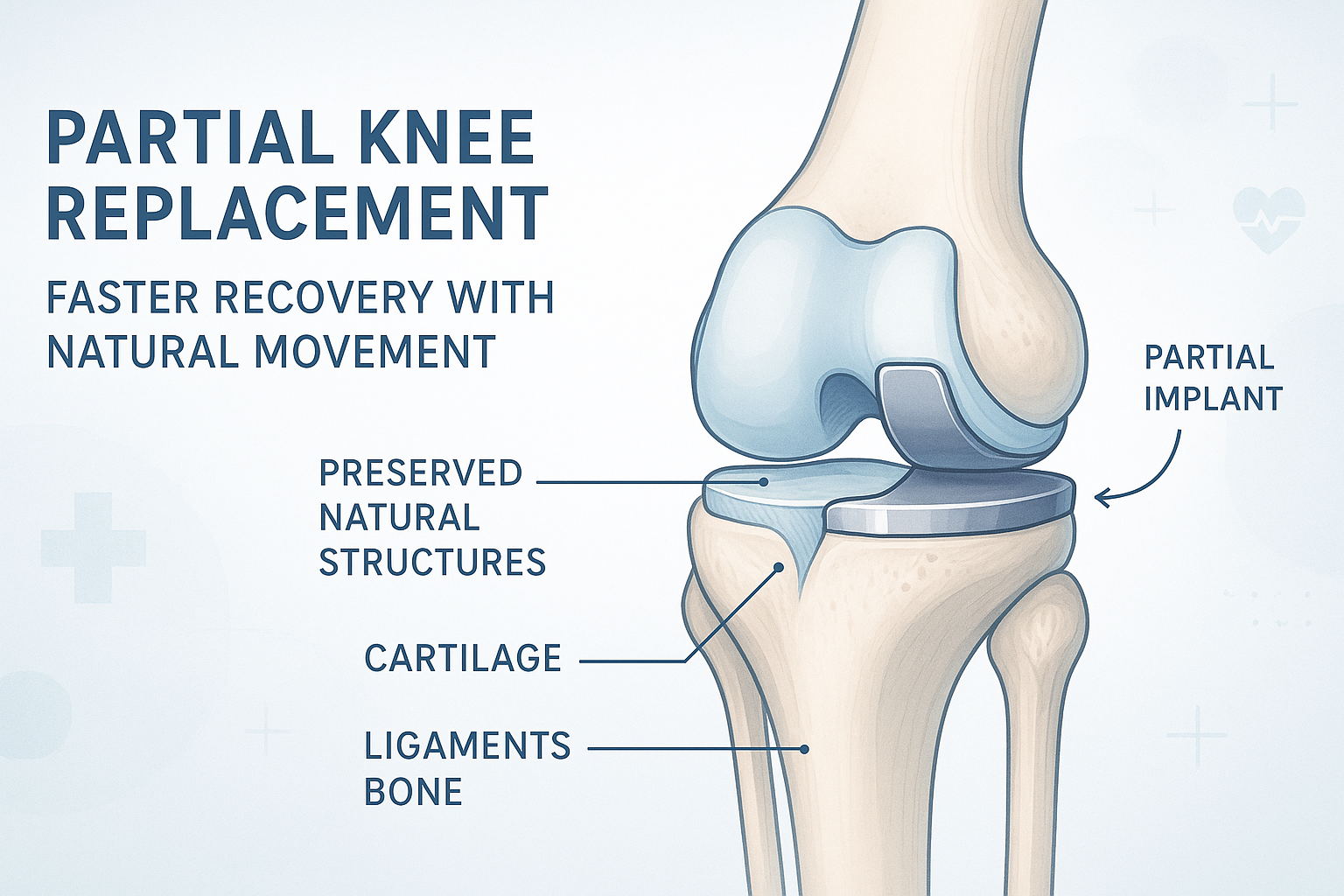
Partial Knee Replacement (PKR), also known as Unicompartmental Knee Replacement, is a highly effective surgical procedure for patients whose arthritis affects only one compartment of the knee—either the inner (medial), outer (lateral), or kneecap (patellofemoral) region. Unlike a Total Knee Replacement (TKR), where the entire joint surface is replaced, PKR selectively targets only the damaged area while preserving healthy cartilage, bone, and ligaments.
This approach maintains the knee’s natural structure and movement, resulting in a joint that feels and functions more like a natural knee. For appropriately selected patients, Partial Knee Replacement offers faster recovery, reduced post-operative discomfort, and excellent long-term results.
Who Is an Ideal Candidate for Partial Knee Replacement?
Not all patients with knee arthritis need a full replacement. Partial Knee Replacement is ideal for individuals who have:
-
Arthritis limited to a single part of the knee
-
Intact ligaments, especially the anterior cruciate ligament (ACL) and medial collateral ligament (MCL)
-
Good knee motion and alignment
-
Moderate activity levels (not involved in heavy labor or high-impact sports)
Your orthopedic surgeon will perform a detailed clinical evaluation and imaging (X-rays or MRI scans) to assess whether your arthritis is confined to one compartment. If the damage extends to multiple areas or the ligaments are unstable, Total Knee Replacement may be a better option.
How the Procedure Works
During a Partial Knee Replacement, only the damaged portion of the knee joint is resurfaced. The surgeon removes the worn-out cartilage and a thin layer of underlying bone from the affected area and replaces it with a small, anatomically designed metal and polyethylene implant.
Since most of the natural joint and all major ligaments are preserved, the knee retains its original stability and mechanics. The operation is usually performed through a smaller incision than total replacement, resulting in less tissue trauma, minimal blood loss, and quicker healing.
Typically, the surgery takes around 45 minutes to 1 hour, and patients can start walking—often with assistance—within a day after the operation.
Advantages of Partial Knee Replacement
One of the key benefits of Partial Knee Replacement is how closely the post-surgical knee resembles a natural joint. Because healthy tissue and ligaments remain intact, patients often report that the knee feels more “normal” compared to those who undergo total replacement.
Here are some major advantages:
-
Smaller Incision and Scar: Minimal surgical exposure means reduced scarring and faster healing.
-
Less Blood Loss: Since only one part of the joint is treated, blood loss during surgery is significantly less.
-
Faster Recovery: Many patients return to daily activities within 2–4 weeks.
-
Better Range of Motion: Preserving the natural ligaments allows for smoother and more natural knee bending.
-
Less Post-Operative Pain: Limited soft tissue disruption leads to a more comfortable recovery.
-
Improved Functionality: Patients often describe a more stable, natural-feeling knee with improved walking patterns.
Because it maintains the native knee’s biomechanics, Partial Knee Replacement can be an excellent long-term solution for suitable patients.
Modern Advances in Partial Knee Replacement
Technological advancements have made PKR more precise and predictable than ever before. With robotic-assisted surgery, surgeons can map the patient’s knee anatomy in three dimensions, ensuring perfect implant alignment and fit. This reduces human error and enhances the implant’s longevity and performance.
Modern materials—such as highly cross-linked polyethylene and titanium-based components—offer greater durability and wear resistance. Minimally invasive approaches combined with enhanced pain management protocols (like nerve blocks and multimodal analgesia) allow patients to recover comfortably and quickly.
Thanks to these innovations, many patients are now discharged within 24–48 hours after surgery.
Recovery and Rehabilitation
The recovery process after Partial Knee Replacement is typically much faster than that after Total Knee Replacement. Early mobilization is encouraged, and patients often begin gentle walking and physiotherapy within the first day.
In the first few weeks, the focus is on:
-
Restoring knee flexibility and range of motion
-
Reducing swelling through ice and elevation
-
Strengthening surrounding muscles for stability
By 2–4 weeks, most individuals can resume light daily activities, including driving (if comfortable and safe). Full recovery with complete muscle strength and coordination usually takes about 6–8 weeks.
Adhering to a structured physiotherapy program is critical to achieving optimal results. Regular follow-up appointments ensure that the implant is functioning properly and that your recovery is on track.
Longevity of Partial Knee Implants
A common question patients ask is how long a Partial Knee Replacement lasts. With current technology and improved materials, modern implants can last 15–20 years or longer, depending on patient activity levels, weight, and adherence to post-operative guidelines.
However, in some cases, arthritis may gradually progress to other compartments of the knee. When this happens, a conversion to Total Knee Replacement might be required in the future. The good news is that such conversions are generally straightforward and yield excellent results, especially if the initial surgery was done with proper alignment and technique.
Potential Risks and Considerations
Although Partial Knee Replacement is highly successful, it’s important to understand potential risks, which are similar to other joint replacement surgeries. These may include infection, stiffness, implant loosening, or disease progression in the untreated compartments.
However, with modern surgical protocols, sterile techniques, and improved implant design, these complications are rare. The key to long-term success lies in careful patient selection, precise surgical execution, and regular follow-up care.
Frequently Asked Questions (FAQs)
Q1. Is Partial Knee Replacement permanent?
A: Yes, the implant is designed to be permanent. However, if arthritis progresses in other compartments, it may eventually require conversion to a Total Knee Replacement.
Q2. Is recovery faster than Total Knee Replacement?
A: Absolutely. Recovery after Partial Knee Replacement is significantly faster, with many patients resuming daily activities within 2–4 weeks.
Q3. Can arthritis spread to other parts of the knee?
A: Yes. Over time, arthritis can affect the remaining healthy compartments, which may necessitate additional treatment or conversion to a total replacement in the future.
Q4. How soon can I return to normal activities?
A: Most patients can walk independently within a few days and return to light activities within 2–3 weeks, depending on individual progress.
Q5. How natural will my knee feel after surgery?
A: Because the natural ligaments are preserved, patients often describe their new knee as feeling more “real” and natural compared to a total replacement.
Conclusion
Partial Knee Replacement (PKR) offers an excellent balance between surgical precision, faster recovery, and natural knee movement. For patients with arthritis limited to one part of the knee, it provides pain relief and restores mobility without the need for a full joint replacement.
With minimally invasive techniques, modern implants, and advanced rehabilitation protocols, PKR has become a trusted solution for active individuals seeking long-term relief and near-normal knee function.
If knee pain is restricting your mobility but imaging shows arthritis confined to one compartment, consult an experienced orthopedic surgeon to discuss whether Partial Knee Replacement is the right choice for you. The right diagnosis and timely intervention can help you return to an active, pain-free life—naturally.