Medically guided Dr. Aditya Jain (MBBS, MS Orthopaedics, DNB, MNAMS) says:
Doctor Statement – Dr . Aditya Jain
“Not every meniscus tear requires surgery. Treatment should be based on the tear pattern, location, symptoms, knee stability, activity level, and the patient’s response to conservative management. Our priority is to preserve healthy meniscal tissue whenever possible while restoring knee function and helping patients return safely to their daily activities or sport.”
A torn meniscus is one of the most prevalent knee injuries among athletes, active adults, and elderly individuals with degenerative changes affecting the knee joint. The diagnostic finding might be distressing if an MRI report mentions any of the following: “meniscal tear,” “complex tear,” or “meniscal extrusion.”
The first concern of every patient is a logical question:
Summary : –
A torn meniscus does not always require surgery. The appropriate treatment depends on factors such as the type, size, and location of the tear, symptoms, knee stability, activity level, and the presence of other knee problems. Some tears may improve with rest, activity modification, physiotherapy, and other non-surgical treatments. However, persistent pain, locking, instability, or certain types of tears may require arthroscopic treatment. Early evaluation by an experienced orthopaedic specialist can help determine whether conservative care or meniscus surgery is appropriate and support a safe return to daily activities and sports.
Can a torn meniscus heal on its own?
Sometimes, a meniscal injury does not require any surgical intervention. In particular, the conservative treatment option is adequate for tears of minor range, those associated with excellent tissue quality and vascularity, and tears that are non-displaced or minimally displaced. In addition, some tears can be managed by non-surgical measures, including modification of activities, physiotherapy, and knee strengthening exercises. Pain and inflammation are controlled using anti-inflammatory medications and knee pain creams. Nevertheless, complex tears, unstable tears, tears associated with mechanical complications (e.g., recurrent locking), and those with poor tissue quality may require arthroscopic repair. Thus, the decision is made on a case-by-case basis. In general, not all meniscal tears require arthroscopy, and a competent physician would identify whether the injury could be left alone or not.
For residents seeking the best meniscus tear repair surgeon in Lajpat Nagar Arthroscopic treatment of meniscal injuries can be avoided in selected cases.
What Is the Meniscus?
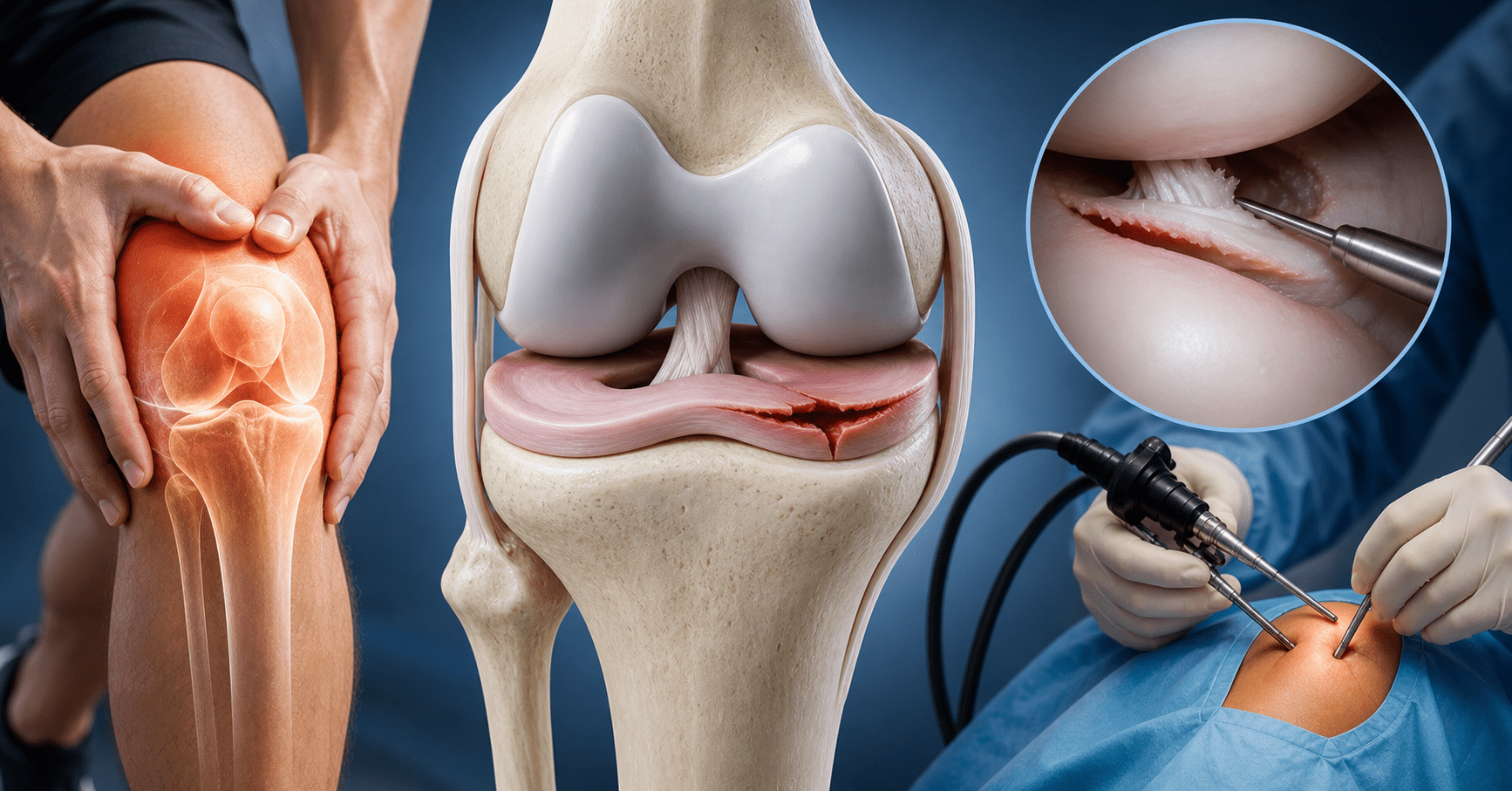
Each knee contains two crescent-shaped pieces of fibrocartilage called menisci — the medial and lateral menisci.
They are located between the thigh bone (femur) and shin bone (tibia) and serve various functions, including distributing load, stabilizing the joint, cushioning, and facilitating movement.
As indicated, the menisci are considered to make a significant contribution to the normal function of the knee, which underscores the importance of preserving their viability whenever possible. Basically, it can be said that a meniscus can be damaged as a result of twisting the knee, often during sports, which usually leads to the development of a tear. In addition, tears can also occur as the menisci age and degenerate.
It means that the ability of the meniscus to heal is not always possible, and the success of the treatment depends on the nature of the injury and how long it has existed.
Can a Torn Meniscus Heal Without Surgery?
Yes, some meniscus tears may improve without surgery.
The ability or inability of a tear to heal or cease being a problem is based on several factors:
- the location of the tear
- vascular supply to the injured area
- the tear pattern
- tear size
- whether the tear is stable or displaced
- the age of the patient
- the presence of arthritis
- associated ligament injuries
- the activity level of the patient
- the duration and severity of the symptoms
Avascular tissue does not heal. The outer edge of the meniscus has a better blood supply than the inner part. Thus tears that occur in a vascular region of the meniscus have a better capacity for healing than those that occur in an avascular region. However, resolution of symptoms and biomechanical healing are not the same thing. It is entirely possible for a patient to stop having symptoms of a meniscal tear while an MRI still demonstrates a tear. Or for even a small tear to cause excruciating mechanical symptoms in some patients.
Types of Meniscus Tears
Understanding the type of tear is essential when it comes to deciding between rehabilitation and surgery.
Radial tears
are tears that go from the inner edge of the meniscus towards the outer region. The importance is related to the particular area and the severity of the damage.
Horizontal tears
are tears that divide the meniscus into upper and lower parts and are usually related to degenerative conditions.
Longitudinal tears
run along the meniscus and can sometimes be repaired, especially with good tissue integrity.
The bucket-handle tears
can cause a part of the meniscus to be displaced towards the knee centre; these tears often need arthroscopic treatment and can be very restricting. And, complex tears usually imply more than one type of tear and can have unpredictable healing patterns.
With all of the types and severity, the question Can a torn meniscus heal without surgery? is not always applicable to every case.
What Symptoms Does a Meniscus Tear Cause?
Symptoms may range from mild discomfort to significant mechanical dysfunction.
Common symptoms include:
- Knee pain
- Swelling
- Stiffness
- Clicking or catching
- Painful twisting
- Inability to squat
- Pain when climbing stairs
- A feeling that the knee is unstable
- Inability to fully bend or straighten the knee
- Locking or restricted movement.
A patient may have an acute injury during sports, in which they hear or feel a “pop.” In other cases, symptoms develop gradually with no recollection of injury.
Persistent symptoms should be evaluated rather than simply assuming that the problem will resolve on its own.
When Can Conservative Treatment Work?
Non-surgical treatment may be considered for stable tears with minimal mechanical interference.
Conservative treatment options for the knee include:
Activity modification
Avoiding or limiting activities that exacerbate pain, such as twisting, deep squatting, pivoting, or impact exercises, can allow the knee to settle and reduce symptoms.
Physiotherapy
A rehabilitation program can help to improve muscle control, strength, balance, and overall knee function.
Strengthening
Quadriceps, hamstring, hip and calf muscle strengthening can improve knee loading capacity for day-to-day and sporting activities.
Mobility exercises
Restoring normal joint range of motion can help to improve knee function.
Gradual return to activity
Rather than jumping back into pre-injury activity levels, it is often better to build up slowly to avoid re-injury based on a patient’s symptoms and function.
Pain relief
The treating doctor or physiotherapist can discuss the most appropriate pain relief options, based on the individual’s medical history.
It is not simply about avoiding surgery. It is about returning to a fully functioning knee, safely.
The Role of Physiotherapy
Physiotherapy plays a highly important role in the context of meniscus injury rehabilitation in patients who do not require surgery.
Dr. Neha Narula (PT), Head of Physiotherapy & Rehabilitation, discusses the significance of comprehensive post-surgical rehabilitation:
“A leading physiotherapist with a decade of experience in sports and post-operative rehab, Dr. Neha believes lasting recovery begins where medical science meets consistent, compassionate follow-up.”
Rehabilitation can have various phases, including the management of pain, swelling, and range of motion, as well as muscle activation and strength, balance and control, and sport-specific conditioning.
The progression is individualized depending on the patient’s presentation and the nature of the tear.
A patient returning to recreational walking has different requirements from a footballer, runner, badminton player, or competitive athlete.
What Is Knee Locking and Why Does It Matter?
Knee locking treatment is an important issue for patients with particular meniscus tears.
There is a subtle difference between the knee being stiff or sore during movement and a real mechanical lock.
A torn part of the meniscus may occasionally actually hinder knee motion, resulting in the patient being incapable of fully extending or flexing the knee.
True locking should always be evaluated by an orthopaedist since rehabilitation exercises will be ineffective on a mechanically displaced meniscal fragment.
However, not every occurrence of a knee “lock” indicates the presence of a displaced meniscal fragment. A physician must identify the cause.
When Is Meniscus Surgery Considered?
Surgery may be considered if:
- The symptoms are significant despite conservative measures
- The knee is locking or catching
- There is a displaced tear that prevents normal motion
- The tear is not amenable to healing
- The patient is having limitations that persist despite conservative measures
- There is an acute tear in an active patient amenable to repair
- Associated ligament or cartilage injuries that require surgical repair
Patient factors such as age, activity level, symptoms, imaging, tear pattern, tissue quality, and knee status should be taken into account. This is why people seeking a meniscus tear repair surgeon in Lajpat Nagar should have a thorough discussion with their doctor to understand why surgery may or may not be indicated and not just assume that an MRI finding of a tear means that surgery is needed.
Meniscus Repair vs Meniscus Removal
When surgery is indicated, leaving as much normal meniscus as possible is often an important consideration.
Meniscus repair
The surgeon repairs the damaged tissue to preserve the meniscus.
Repairs may be particularly valuable in selected tears with reasonable healing potential.
Partial meniscectomy
If the torn tissue can not be safely repaired or is unlikely to heal, the surgeon may remove the unstable portion while preserving as much normal tissue as possible.
The procedure that will be performed depends on the nature of the tear and the quality of the tissue.
In many cases, preservation of functional meniscal tissue is an important long term consideration.
What Happens During Arthroscopic Meniscus Surgery?
A knee arthroscopy is a surgical procedure in which a small camera is inserted into the knee through a small incision to view its interior.
Other small tools can be inserted to repair the meniscus and treat connected conditions if needed.
Based on the type of tear, the surgeon can perform a:
- Meniscal repair
- Partial meniscectomy
- Cartilage problem treatment
- Assessment or treatment of other intra-articular injuries
The specific procedure is defined during the clinical and imaging examination and, if appropriate, it is verified during arthroscopy.
What Is Cartilage Regeneration Treatment for Athletes?
Athletes often seek cartilage regeneration treatment for athletes for problems related to both meniscus and cartilage.
It is essential to differentiate between the options for meniscus repair and treatment options for cartilage damage. These are the two separate issues affecting two different tissues.
The treatment of cartilage damage depends on the location and size of the lesion, its depth, the patient’s age, symptoms, lower limb alignment, degree of activity, and other factors.
A sports knee specialist can suggest a variety of treatments, from rehabilitation and activity modification to selected cartilage restoration procedures.
There is no one type of “cartilage regeneration” therapy that is appropriate for all patients and all conditions.
Can Athletes Return to Sport Without Surgery?
Some athletes with stable meniscus tears are able to return to sport via appropriately managed conservative rehabilitation.
However, returning to sport should not rely on achieving no pain.
A rehabilitation program could evaluate:
- Range of motion in the knee
- Quadriceps strength
- Hamstrings strength
- Single-limb control
- Balance
- Landing mechanics
- Running tolerance
- The ability to change directions
- Sport-specific maneuvers
If these abilities have not been restored, the athlete is at risk of further recurrence, and/or compensation injuries.
How Long Does Meniscus Recovery Take?
The recovery time may vary considerably.
A minor stable tear that is managed conservatively may take several weeks to heal, while more complicated injuries may require more time to heal.
In addition, after meniscus repair surgery, the rehabilitation period is usually lengthier than after the excision of a small unstable fragment because the surgical site needs to heal.
The rehabilitation may depend on several factors, including:
- The type of tear
- The procedure performed, if any
- The location of the incision
- Concomitant injuries
- The pre-injury level of function
- The progress of healing
- Activity and sport requirements
Therefore, a person needs to follow particular guidance from their surgeon and physiotherapist during the rehabilitation rather than rely on a generic timetable.
Can You Prevent Meniscus Tears?
Not every meniscus damage can be prevented, especially associated with aging changes. Still, an athlete can prevent some of the inevitable risks by building physical capabilities.
Crucial strategies towards this goal involve:
Strength training
A strong core, quads, hamstrings, hips, and calves improve joint function and take some of the load off the knee joint.
Neuromuscular training
This type of training enhances balance, coordination, landing techniques, and directional changes, which are relevant to athletes’ activities.
Progressive training
It may be detrimental to the knee, if the loads are increased too rapidly. Thus, a steady increase in training volume and intensities should be implemented.
Warm-up and conditioning
They allow athletes to perform sport-specific activities safely and with better control.
Pain management
Chronic knee pain should not be neglected or downplayed, as it can postpone a proper diagnosis and treatment.
Why MRI Does Not Always Determine Treatment
MRI is an excellent tool for evaluating meniscal pathology, but the results should not be considered in isolation.
There are many adults, especially older people, who may have degenerative meniscal changes in their MRI results, but do not have symptoms.
Therefore, to provide appropriate therapy, the clinician must consider the following:
Symptoms, Clinical Examination, Imaging, Functional Limitations, and Patient Goals
This approach ensures that therapies and surgical interventions are not performed inappropriately in asymptomatic patients, while ensuring that mechanical symptoms are not overlooked.
When Should You Consult a Specialist?
You should consider orthopaedic assessment if you have any of the following:
Persistent knee pain arising from an injury
- Recurrent knee swelling
- Knee ‘clicking’ or catching
- Inability to fully extend your knee
- True locking of the knee
- Recurring problems while playing sport
- An inability to return to previous levels of activity
- Pain persisting despite a period of appropriate rehabilitation
Patients with severe pain, deformity, inability to weight bear or acutely locked knee may need to be seen more urgently.
Can a Torn Meniscus Heal Without Surgery? The Bottom Line
So, can a meniscus heal on its own without surgery?
There is a certain category of patients for whom surgical intervention is not mandatory, such stable tears with a good prognosis in terms of blood supply and minimal clinical manifestations.
On the other hand, if the tear is displaced, it is most likely irreparable and requires surgery.
The bottom line is that the decision to send the patient for surgery should be individual in each case. Taking into account factors such as accompanying injuries, the nature and location of the tear, the patient’s activity level, and the effectiveness of conservative treatment.
Conclusion
A meniscus tear does not necessarily require surgery.
For some patients, conservative treatment and observation may be sufficient to allow the knee to heal without surgical intervention. However, other patients will require surgical repair of a torn meniscus to avoid long-term complications.
The question ‘can a torn meniscus heal without surgery’ must be evaluated on a case by case basis.
For patients searching for a meniscus tear repair surgeon in Lajpat Nagar, the most important initial step is a thorough discussion of symptoms, physical examination and review of MRI findings along with activity and lifestyle requirements.
The ultimate goal is to preserve as much normal meniscus as possible, restore function and stability to the knee joint and pursue the least invasive treatment option that is appropriate for each individual patient’s particular combination of needs and circumstances.
Frequently Asked Questions
-
Healing of Torn Meniscus Without Surgery
Ameniscus can partially heal on its own accord, depending on the type of tear, the area affected, the patient’s personal characteristics, the availability of blood supply to the torn tissue, additional damage to the knee structures, and the presence or absence of mechanical symptoms.
-
Determination of the Need for Surgery for a Meniscus Tear
The need for surgery is determined based on the presence of mechanical complaints (pain, swelling, locking of the knee), the nature and location of the tear, imaging results, and the response to conservative treatment. A specialist will determine whether surgery is needed for an individual case.
-
Knee Locking Treatment
The treatment of locked knees depends on the underlying cause. Displaced meniscal tears that cause restriction of motion often require arthroscopic surgery. Other causes of locking require different treatment, which should be discussed with a specialist.
-
Physiotherapy for Meniscus Tear
Physiotherapy is indicated in the treatment of meniscus tears, as it helps to restore strength, stability, range of motion, proprioception, and function. Physiotherapy can be used both in the post-operative period and as part of conservative treatment.
-
Can an Athlete Continue to Play Sports After a Meniscus Tear
An athlete can continue to play sports after a meniscus tear, depending on the treatment and rehabilitation course, the nature and location of the injury, and individual characteristics of the knee joint.