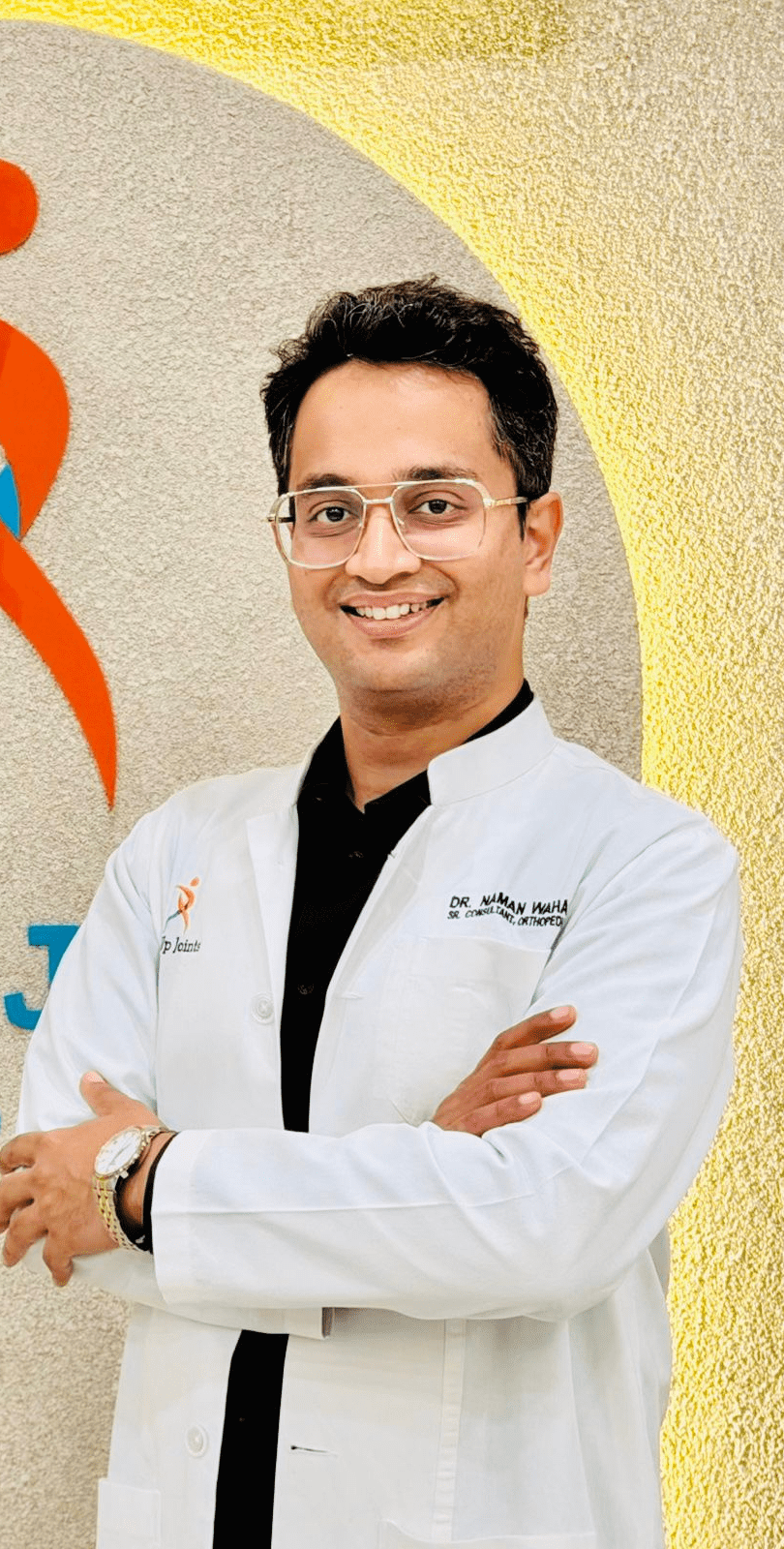
Medically guided by Dr. Naman Wahal, Orthopaedic Surgeon, StepUp Joints
What Are Common Sports Injuries?
The term sports injuries is employed to refer to injuries that involve the muscles, tendons, ligaments, cartilage, bones, and joint elements in human body. Some of the Injuries are acute in nature whereas some of them are overuse injuries.
The major types of sports injuries include:
- Patellofemoral pain or runner’s knee
- Hamstring strain
- Sprain of ankle
- Injury of ligaments (for example, injury of the ACL)
- Meniscus injury
- Strain of muscle
- Tendon injury
- Fracture in bone due to stress
- Instability of shoulder and injury of rotator cuff
- Injuries of hip and groin
A sports medicine or orthopedic evaluation can help differentiate between conditions that may start with similar symptoms. According to the American College of Sports Medicine, team doctors frequently see injuries to the hamstring, ACL, meniscus, ankle, and hip or groin in athletes.
Why Do Running and Sports Injuries Happen?
It is seldom ever only one reason for injuries; injuries are linked to training load, abrupt intensity changes, insufficient recovery, weakness of muscles, movement mechanics, previous injury, and requirements of the sport involved.
For athletes participating in athletics running may involve a sudden increase in running distance or speed or uphill training that places a lot of stress on the tissues involved – tissues that still have not adjusted to the new loads. For field and court sports, repeated sprints, jumps and changes in direction can impose considerable strains on the knees, ankles, hips and hamstring muscles.
According to the American College of Sports Medicine recommendations exercise intensity and type may affect susceptibility to musculoskeletal injuries as well. This means that one should always follow a reasonable progression of exercise volume and intensity and apply certain techniques to prevent injuries before feeling pain.
Runner’s Knee: Symptoms, Causes and Treatment
The term “runner’s knee” refers to patellofemoral pain, which is pain that occurs in the front of your knee and/or behind your knee cap (“AAOS”). As stated by the American Academy of Orthopaedic Surgeons, patellofemoral pain syndrome is also common among other athletes who participate in sporting events.
Signs and symptoms
The symptoms of runner’s knee include:
- Pain in the front part of your knee.
- Pain worsened during running.
- Pain when going up and down stairs.
- Pain after sitting for quite some time.
Pain during squatting activities. The causes of runner’s knee can be unique to each person or the person might have multiple causes at the same time.
Knee pain in runners
Treatment will depend on the underlying cause and severity of the symptoms. A healthcare provider may suggest modification of aggravating activities, improvement of strength and movement issues and physiotherapy treatment.
Rehabilitation may include:
- Strengthening quadriceps and hips
- Controlling movements
- Going back to running gradually
- Changing activity as needed
- Improvement of flexibility and mobility if applicable.
In fact, the goal is not simply to relieve pain, but to restore the ability to perform the activity in question and avoid future occurrences.
Chronic knee pain should not automatically be considered runner’s knee. Other medical conditions such as ligament injuries, meniscal injuries, stresses and other knee problems can have similar symptoms.
Hamstring Strains: Why They Happen and How Recovery Works
The hamstrings have a critical role to play when it comes to physical activities like sprinting and jumping. Problems with the hamstrings can happen because the muscles have reached the limit of what they can endure, which is especially common at high speeds. A person with a hamstring issue usually picks up pain in the back of the leg.
After suspecting a hamstring injury, it’s important to take a few precautions and avoid pushing through pain when running. It’s best to refrain from doing intensive exercise. Instead of avoiding movement completely, try to reduce activities that provoke symptoms and work on rehabilitation.
Gradual progress is key during rehabilitation:
- Achieving full range of motion
- Strengthening the muscle
- Improving running performance
It is important to remember that rehabilitation programs should be developed specifically for the type of the injury.
Ligament Injuries: From Sprains to ACL Tears
Ligaments connect bone and serve to stabilize joints. Certain athletic activities which involve twisting, sudden stopping, cutting and landing put excess strain on knee ligaments.
The ACL plays a vital role in the stability of the knee and is often injured in sports. According to the AAOS ACL injuries can happen through contact or without contact and treatment is based on factors like knee instability, other injuries, health and activity level.
Knee ligament injury symptoms
Symptoms of a significant knee ligament injury can be:
- A popping sound as the injury takes place
- Knee swelling
- Knee giving way or feeling unstable while weight-bearing
- Inability to bear weight
- Limited mobility
- Pain from twisting or landing.
Having an ACL injury does not necessarily imply that surgery will be done. The treatment choice depends on the status of the athlete’s symptoms, instability, associated injury, activity goals and clinical assessments. The patient might receive rehabilitation or some patients, who is active but unstable or has some particular injury combined with instability, needs surgical reconstruction.
Meniscus Injuries in Athletes
The meniscus’s primary functions include shock absorption and knee stabilization. Acute meniscus tears may occur in sports—especially those that involve twisting or pivoting. The AAOS mentions that athletes who suffer from this injury may present signs such as pain, stiffness, swelling, catching, locking or feeling of giving way.
Some of the meniscus injuries may be treated without surgery, while others do require surgery depending on the tear, symptoms, associated injuries and the athlete’s goals.
If the knee remains swollen or continues to catch or lock even after a sports injury, it should be examined thoroughly instead of going back to playing sports.
Ankle Sprains and Other Common Sports Injuries
Sprained ankles rank among the commonest sport injuries. They happen when the foot rolls, twists or lands awkwardly.
Most minor sprains will heal with the proper use of support, training adjustments and rehabilitation. More severe sprains will need to be scrutinized to confirm diagnosis and detection of possible fractures and serious ligament damage.
Other common sport problems:
Muscle injuries: Stretch or excessive stress can result in injuries of muscle tissue.
Tendons problems: Continuous stress can lead to discomfort and malfunction in tendons.
Stress injuries: Repetitive loading can result in stress injuries of bone structures. AAOS says that the initial X-ray appearing normal does not necessarily mean a false negative. MRI can help detect swelling of the bone regarding stress injury suspicions.
Shoulder injuries: Activities like throwing, use of overhead movements, contact sports or falls may contribute to shoulder injuries including instability, rotator cuff injuries and other injuries.
How Are Sports Injuries Diagnosed?
Generally, the process of diagnosis commences with taking a thorough history and performing a physical examination.
The doctor wants the following information:
- How did the injury happen
- Whether there was a popping sound and immediate swelling
- What the location of pain is
- Whether the joint appears unstable
- Whether the patient can carry weight
- Whether the patient has experienced a similar injury in the past
- What type of sport the patient plays and how often they practice it.
- In certain cases, imaging methods can be used.
X-ray
X-ray helps define fractures and certain bone irregularities.
MRI
MRI provides images of soft tissues like ligaments, menisci, tendons and muscles, it is useful when there is a suspicion of serious soft tissue injury.
Other diagnostic techniques
The choice of technique depends on the symptoms and the results of the physical examination. Not all injuries in sports require advanced imaging.
The Fastest Safe Recovery Is Not Always the Fastest Return
Athletes frequently have questions such as: “How quickly can I get back to training?” The answer, however, will depend on the injury. Attempting to get back to action before the tissues are sufficiently healed can heighten the risk of further injury or reinjury. A safer approach is most often a gradual return to activity based upon symptoms, activity, strength and specific functionality of the sport.
For instance, a runner recovering from knee problems may first work up to walking, then jogging before culminating in normal training. An athlete recovering from a ligament injury will have to regain walking and strengthening as well as skills associated with their specific sport before getting back to competitions.
The goal should be safe recovery and functioning, not just some random number of days.
Sports Injury Prevention: What Can Athletes Do?
Injury prevention starts with being adequately prepared.
Warm-Up For Physical Activity
A good warm-up prepares muscles and joints to tolerate physical activities. The intensity and type of warm-up depend on the sport.
Progressive Training
Bodily tolerance for higher loads should develop gradually. Drastic changes in either overall distance, speed, weight, or frequency of training should be avoided.
Strength Training
Strengthening can enhance muscle abilities and will allow to eliminate weaknesses and imbalances. As per the ACSM, resistance training can have a positive impact on muscular abilities and physical readiness and can therefore prevent musculoskeletal injuries.
Balance Training
Balance, coordination, landing mechanics, and control of change of direction are of paramount importance for sportsmen practicing running and sports involving direction change.
Allow for Recovery Time
It takes time for the body to adapt to training changes. Adequate sleep, proper nutrition, and the need for recovery should be considered when planning your training program.
Use Proper Equipment
Right shoes and sport-specific protective gear will help to avoid some injuries, while helmets or any kind of head protection is crucial for sports with a risk of head injury (the CDC recommends the usage of helmets for a number of
When Should You See a Sports Injury Doctor?
“When to seek professional help:
- Pain remains despite changes in activity level
- You are unable to bear weight on an extremity
- Noticeable swelling occurs
- A joint seems to lock frequently
- A popping sound is heard when the injury occurs
- Movement is limited
- Pain occurs repeatedly during training periods
- A ligament, meniscus, or stress injury is suspected
- Performance has suffered because of the ongoing pain.
Athletes need to take any possible head injury seriously. The CDC recommends taking the athlete out of action right away the moment any signs of concussion have been detected.
Choosing a Sports Injury Doctor in South Delhi
When looking for a Sports injury doctor in South Delhi, you should think about whether the physician or rehabilitation team can assess not only the injury itself but also the reasons behind your return to the sports.
A thorough sports injury evaluation may consist of:
Correct diagnosis: Establishing whether the injury lies in the bones, muscle, tendon, ligament, cartilage or some other structure.
Personalized treatment: Choosing different treating techniques ranging from conservative treatment, rehabilitation to surgery depending on the injury as well as on patient’s goals.
Rehabilitation: Regaining strength, mobility, balance and functional capacity.
Sport rehabilitation preparation: Moving gradually from daily activity to athletic training.
StepUp Joints is a Center for the integrated services of orthopedics, physiotherapy, sports rehabilitation and other related services located in Lajpat Nagar 4, South Delhi. StepUp Joints associates Dr. Naman Wahal with the clinic, who is an orthopedic doctor and shoulder expert performing sports injury management.
It should be noted that when looking for clinics for hamstring and ligament stretch treatment it is important for the clinic to provide not only temporary results but also to offer treatment to allow for complete recovery.
What Does Sports Rehabilitation Involve?
The process of rehabilitating sports injuries goes far beyond merely treating patients passively.
Sports injury rehabilitation can entail, depending on what type of injury has been sustained, the following:
- Mobility exercises
- Progressive strengthening
- Core and lower-limb conditioning
- Balance training
- Neuromuscular control
- Sport-specific drills
- Running progression
- Return-to-sport testing
It is crucial that the rehabilitation Programme is adjusted according to the progress made by the patient.
For instance, a person recovering from an ACL injury will probably first concentrate on swelling control and knee movement. After that the patient might undergo muscular strengthening and neuromuscular training, and then take up more demanding sports activities.
Frequently Asked Questions
What is the most common injury among runners?
Runner’s knee, or patellofemoral pain syndrome, is a common running injury, which can vary widely in terms of its cause. Persistent knee pain should be examined if symptoms are unresolved.
Are hamstring injuries treatable without surgery?
While most hamstring injuries are able to recover without surgery, some treatment options depend on the injury location. A full assessment of the injury is needed prior to recommending appropriate rehabilitation.
Does an ACL injury need surgery in all cases?
Not every ACL injury must be immediately repaired with surgery. Treatment comes down to the stability of the knee, any accompanying injuries, the activity level of the person and other variables.
How long does it take to heal from injuries?
There is no single recovery period. Some injuries require shorter recovery periods. Recovery time will depend on individual symptoms, activity and functional requirements connected with the sport played.
Can a person continue exercise in case of injury?
Exercising through a significant pain caused by an injury is not advisable, since the cause must be understood before proceeding.
Conclusion
Injuries in sports can happen to both novice and well-trained athletes. Runner’s knee, hamstring pull, ligament injuries, meniscus tear, ankle sprain stress fractures need to be treated in different ways.
The most efficient and appropriate treatment for an injury should start with diagnosis. After diagnosis, treatment should focus on the relief of pain and the elimination of the injury’s cause, as well as on gradually increasing the patient’s strength, mobility and physical fitness.
In addition to treatment, prevention has to be taken into consideration. Gradual increase of training activities, proper warm-up, strength training, recovery, movement control and use of proper equipment can help the sports participant to reduce the risk of injury during sports.
For the people who are physically active in South Delhi, it is necessary to undergo check-up in order to find out if there is any serious injury that needs treatment.
Medical Disclaimer: This article is delivered for educational purposes only and cannot substitute a visit to a physician for proper diagnosis and treatment plan.
StepUp Joints – Location & Appointment Information
Clinic: StepUp Joints, 1st Floor, 17-A Ring Road, Vikram Vihar, Lajpat Nagar 4, New Delhi 110024
OPD Timings: Monday – Saturday: 9:00 AM – 9:00 PM
Direct Call: +91-7042787560