
Reviewed by Dr. Pulak Vatsya (MBBS, MS Orthopaedics, DNB, MNAMS) is an orthopaedic surgeon specialising in robotic joint replacement, Direct Anterior Approach (DAA) hip surgery, and ACL reconstruction.
Hip pain will slowly begin to affect almost every aspect of daily living. Simple tasks like walking for just a few minutes can become painful, going up the stairs becomes a challenge, and even simple things like getting into a car, wearing shoes, and working out become more difficult to do. In cases where a patient suffers from severe damage to the hip due to advanced hip arthritis or other factors where conventional methods fail to provide sufficient relief, total hip replacement might be required.
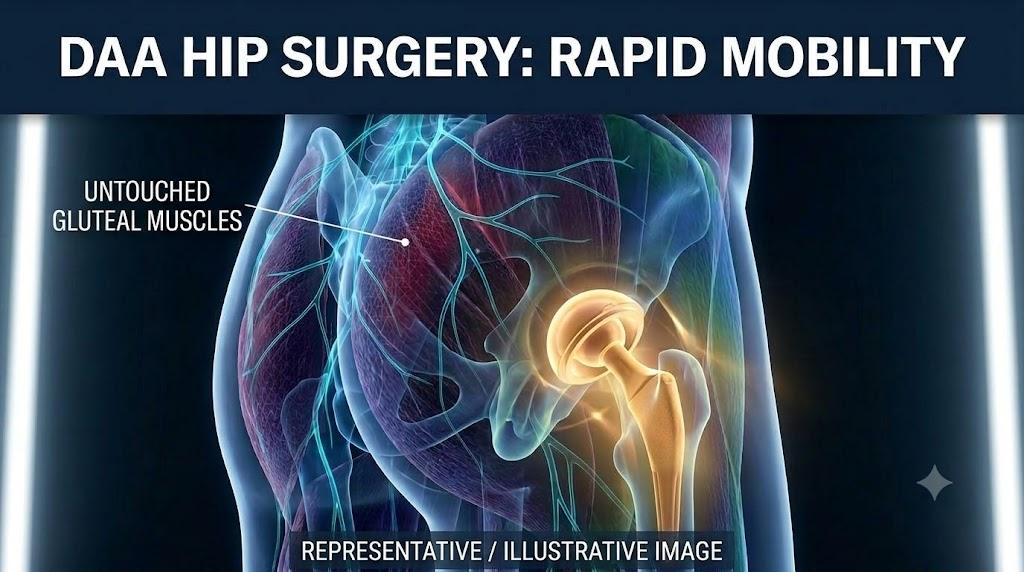
One surgical procedure that is commonly recommended by doctors to most patients is the Direct Anterior Approach Hip Replacement. This surgery is sometimes referred to as muscle-sparing as the doctor gains access to the hip through an anterior approach without having to detach major muscles from their bony attachments.
While considering DAA Hip Replacement Surgery in Delhi, it is essential to have complete knowledge about its pros and cons. A small cut does not necessarily ensure easy recovery for everyone because the optimal surgery will vary from patient to patient depending upon anatomy, diagnosis, activity level, and experience of the orthopedic surgeon.
The latest scientific comparison reveals that DAA may have certain benefits in the early postoperative phase due to shorter stay at the hospital and smaller cut; however, there is little difference between functional results compared to other methods.
What Is Direct Anterior Approach Hip Replacement?
Total hip replacement surgery or total hip arthroplasty is an operation whereby the damaged surfaces of the hip joint are replaced with artificial parts. This surgery is performed in case of disorders such as advanced osteoarthritis among others which cause significant hip joint damage.
The Direct Anterior Approach (DAA) is a surgical technique through which the hip joint is approached from the front of the body.
The rationale behind this approach is that the surgeon can use intermuscular or muscle-sparing intervals in order to access the hip joint thus avoiding muscle detachment from the bone. According to the American Academy of Orthopaedic Surgeons, the classic direct anterior approach is an intermuscular approach which can avoid routine muscle detachment from bone.
That explains why people searching for DAA Hip Replacement Surgery (Delhi) can come across information about a “muscle sparing” or minimally invasive hip replacement surgery.
Nevertheless, minimally invasive does not imply absence of risks and the size of the incision does not make a hip replacement surgery good or bad.
Who May Need Hip Replacement?
Replacement of the hip joint is indicated in the case of persistent pain and functional impairment as a consequence of hip disease where the condition has been properly managed without surgery.
Symptoms that can arise with severe hip joint disease include:
- Pain at the hip or groin
- Pain while walking or standing
- Difficulty in climbing stairs
- Limited hip motion
- Difficulty in putting on shoes/socks
- Getting in and out of chairs and cars
- Difficulties exercising or performing daily tasks
- Pain disrupting sleep
This procedure needs to be carried out after proper evaluation of the patient by the physician rather than solely on the basis of an X-ray image.
What Makes the Anterior Approach Different?
The fundamental distinction lies in the pathway through which the hip joint can be accessed.
Posterior approaches for traditional surgeries involve access to the joint via the posterior route, whereas anterior approaches access the joint via the anterior route. The NICE guidelines for primary elective hip replacement have in the past recommended the consideration of either posterior or anterolateral approaches and have stated that evidence regarding other techniques such as DAA has been more limited.
Further studies have since been performed comparing DAA to other techniques.
A 2025 systematic review and meta-analysis with over 44,000 patients found that the DAA and posterior approaches were comparable for major outcomes such as revision, dislocation, and fractures, but DAA involved a shorter length of hospital stay and incision length.
It should be kept in mind that while DAA may be a superior technique in all respects, DAA surgery does not automatically mean better results than all other procedures in all situations.
Potential Advantages of Direct Anterior Approach Hip Replacement
For those patients who are contemplating undergoing DAA Hip Replacement surgery in Delhi, understanding its advantages is one of the critical factors.
Smaller incision
DAA can be conducted using a relatively small incision in selected patients. Comparing data from various studies have shown a shorter incision length for DAA as compared to posterior approaches.
While most patients are concerned with the cosmetic factor of having a smaller scar, the scar appearance is not the main reason why one surgical approach should be preferred over the other.
Muscle sparing access
One of the unique characteristics of DAA surgery is its access through an intermuscular pathway. Its main advantage is reduced muscle damage when compared with other approaches that require more muscle detaching.
This is the principle behind the muscle sparing hip surgery in Delhi.
Faster potential early functional recovery
Certain comparative studies have shown better early pain or functional results in favor of DAA.
According to the 2025 umbrella review of systematic reviews and meta-analyses, DAA exhibited certain early advantages, such as length of stay and early pain or function, but these differences became less pronounced at later follow-ups.
Also, another large-scale 2025 meta-analysis has found that DAA is characterized by shorter length of stay, with comparable major complications to posterior technique.
Also, 2025 meta-analysis devoted to the topic of enhanced recovery after surgery revealed shorter hospitalization and reduced muscle damage biomarkers, as well as better early functional results in DAA group.
These results suggest that certain individuals can recover faster, but it does not mean that everyone will recover faster
DAA vs Posterior Approach: What Is the Difference?
DAA vs posterior approach is the most frequently asked question by patients planning for hip replacement.
The posterior approach allows the surgeon to reach the hip through its back, while DAA provides access from the front.
Rather than questioning which approach should be considered always better, it is more useful to know in what situations each of them can be more beneficial and what approach a particular surgeon suggests for a particular patient.
Early recovery
There are some reports on the benefit of DAA in terms of early recovery.
Recently published meta-analysis reported better early outcomes, including short hospital stay and, in some cases, improved early pain and functionality compared to the posterior approach.
Long-term recovery
There may be little differences in the long run.
According to the 2025 umbrella review, the early differences in functional recovery between DAA and posterior approach groups were no longer statistically significant after 6 and 12 months.
Complications
There are conflicting results based on outcomes and design of the studies.
In one recent systematic review with many patients, there was no statistical difference observed between DAA and posterior methods for revision, dislocation, or certain fractures.
However, another 2025 meta-analysis of randomized clinical trials demonstrated that DAA was associated with higher risk of postoperative nerve injury.
Therefore, the literature does not prove that DAA can be considered safe.
Is DAA Really “Muscle-Sparing”?
“Muscle sparing” needs to be considered appropriately.
DAA is specifically meant to gain access to the hip by an intermuscular plane and can help bypass routine detachment of some muscles from bony fixation.
This does not imply that there are no muscles and other soft tissues impacted.
Every major surgery involves manipulation of soft tissues, and there are variations in surgical technique by the different surgeons.
Anatomical considerations and complexity of hip replacement itself are some of the factors that might impact the choice of technique.
It is thus quite appropriate for patients seeking muscle-sparing hip surgery Delhi to ask the surgeon about the tissues involved in the surgery.
Is DAA Suitable for Everyone?
Not necessarily.
There are certain parameters that will determine whether a procedure is appropriate for a particular patient. These factors may include:
- Body build and anatomy
- History of hip surgery
- Severity of the disease in the joint
- Bone condition
- Hip deformities
- History of fractures
- Associated conditions
Training and experience of the surgeon with the approach
While some people will need the DAA procedure, others will be better off opting for another technique.
What Happens During DAA Hip Replacement?
Though there are differences between the specific procedures, the common objective of hip replacement surgery is to excise the diseased part of the hip and to replace it with an artificial joint.
The surgical access to the joint is done via the anterior approach, followed by preparation of the acetabular and femoral parts, implantation of artificial joint components and assessment of hip stability and proper position of implants.
Intraoperative imaging and navigation may be performed according to the specific surgical procedure, but in any case, the procedure is very individual.
That is why it is important for a patient to find out from his surgeon about the chosen implant system and surgical technique.
What Is Recovery Like After DAA Hip Replacement?
Recovery will commence almost immediately following surgery.
According to NICE guidelines, it is important that rehabilitation from a physiotherapist or occupational therapist be commenced on the same day as primary elective hip replacement surgery if at all possible or no more than 24 hours following surgery.
Rehabilitation after a DAA hip replacement can include:
- Leaving the bed safely
- Walking using the correct aids
- Increasing distance walked
- Performing exercises
- Building hip strength
- Developing balance and function
- Returning to normal activities gradually
The pace at which this happens can be different for each person.
The patient must not rely solely on the size of the surgical cut as the basis for judging recovery. The deeper tissues still need time to heal, as does the new artificial joint.
Does a Smaller Incision Mean Faster Healing?
Not always.
A smaller incision could be an advantage of the DAA technique, since some studies have shown shorter incision size when compared to posterior techniques.
It is necessary to understand that skin wound closure and deeper tissues healing represent two different biological processes.
It is important to mention that although early mobilization could be achieved faster with this technique, it doesn’t mean that the artificial joint could endure unlimited high impact loads at once.
Thus, the term “faster healing” should be considered as an early functional recovery rather than biologically completed one.
How Important Is the Surgeon’s Experience?
The technique alone constitutes just one element in the outcome.
Hip replacement involves proper bone preparation, correct placement of implants, correction of leg length and hip function, and management of adjacent tissues.
There is also a learning curve associated with DAA because of the different exposure and technique used compared to traditional approaches. The literature on comparative research between DAA and other approaches has brought up issues regarding operational complexity and procedure times in some studies.
In that case, the right question that should be asked while searching for DAA Hip Replacement in Delhi is not: “Do you do DAA?”
It should be:
“Why is DAA appropriate for me, and what are its pros and cons?”
Questions to Ask Before Hip Replacement
Prior to considering surgery, some questions that you may consider asking are:
Why do I need hip replacement at this time?
The reason behind this question lies in your need to understand the diagnosis and options available to you.
Why are you advising DAA for me?
Your reason must include your physical structure, illness, and other needs.
Would posterior or any other approach work just as well?
This allows you to engage in an even-handed conversation as opposed to believing one approach is better.
What are the risks associated with DAA?
The risks include those such as infection, fracture, nerve damage, blood clotting, leg length inequality, dislocation, and revision surgery.
What will be my rehabilitation like?
Understanding the post-operative programme can help you prepare your home and support system.
Who Is a Good Candidate for DAA?
There is no universally accepted list of requirements which would ensure a successful result.
In general, however, DAA can be performed on those patients who need primary total hip replacement surgery and are deemed to be eligible according to their clinical evaluation.
The decision-making process should be based on the anatomy, physical condition, hip joint pathology, expectations and surgical experience of the surgeon of the patient.
Even if a patient is a perfect case for DAA, his/her rehabilitation may differ drastically from another patient who is operated on using this technique.
Why Patients Search for DAA in Delhi
In searching for DAA hip replacement surgery in Delhi, most patients get intrigued with the promise of smaller cuts, minimal muscle damage, faster movement, and a reduced length of stay in the hospital initially.
These possible advantages have been proven to some extent by some comparative studies recently, especially for some early results.
On the other hand, patients must realize that there is more involved in hip replacement results than the method of procedure.
Final Takeaway
Direct Anterior Approach is a well-established procedure for Total Hip Replacement and has gained popularity due to its muscle sparing technique and early post-operative benefits.
For suitable candidates, Direct Anterior Approach Hip Replacement (DAA) Delhi can provide benefits like smaller incision and possibly faster early functional recovery. Evidence from recent studies has demonstrated that there are some early benefits related to pain, function, and hospital stay but many distinctions between DAA and other techniques tend to vanish after long-term follow up.
This evidence proves the need to avoid promoting DAA as automatically better for each patient since complications, surgical difficulties, anatomical features, and surgeon’s experience should all be taken into account.
For patients interested in undergoing muscle-sparing hip surgery Delhi, the most important step is a comprehensive consultation with an experienced hip replacement specialist. The ideal technique for each individual patient is the one that strikes a proper balance of safety, implant placement, functional recovery, and long-term outcome.
Visit StepUp Joints
Clinic Address:
StepUp Joints, 1st Floor, 17-A Ring Road, Vikram Vihar, Lajpat Nagar 4, New Delhi – 110024
OPD Timings:
Monday – Saturday: 9:00 AM – 9:00 PM
Direct Call: +91-7042787560