Reviewed by Dr. Aditya Jain | (MBBS, MS Orthopaedics, DNB, MNAMS)
The shoulder pain may become part of your daily activities over time. The tasks such as reaching your hand overhead, carrying a bag, wearing a shirt, sleeping on the same side and playing your favourite sport become difficult. One of the causes may be a rotator cuff tear which is a shoulder injury caused by the tendons that help to stabilise the shoulder joint and control the movement of the arm.
Having a rotator cuff tear does not always call for surgical intervention. Some people recover through changes in activities, medication and a physiotherapy program. Others, especially who suffer weakness, have ongoing symptoms, traumatic tears or functional problems, might need surgical repair.
The decision on the treatment becomes more personal as compared to either you undergo surgery or not.
For anyone who is seeking rotator cuff tear treatment in South Delhi, understanding how conservative treatment differs from the surgical arthroscopic repair will be helpful. It should be done based on the type and size of tear, symptoms, activities, physical examination, imaging and the general health status.
The American Academy of Orthopaedic Surgeons (AAOS) has developed a new version of the Clinical Practice Guideline in 2025 for rotator cuff injuries.
What Is a Rotator Cuff Tear?
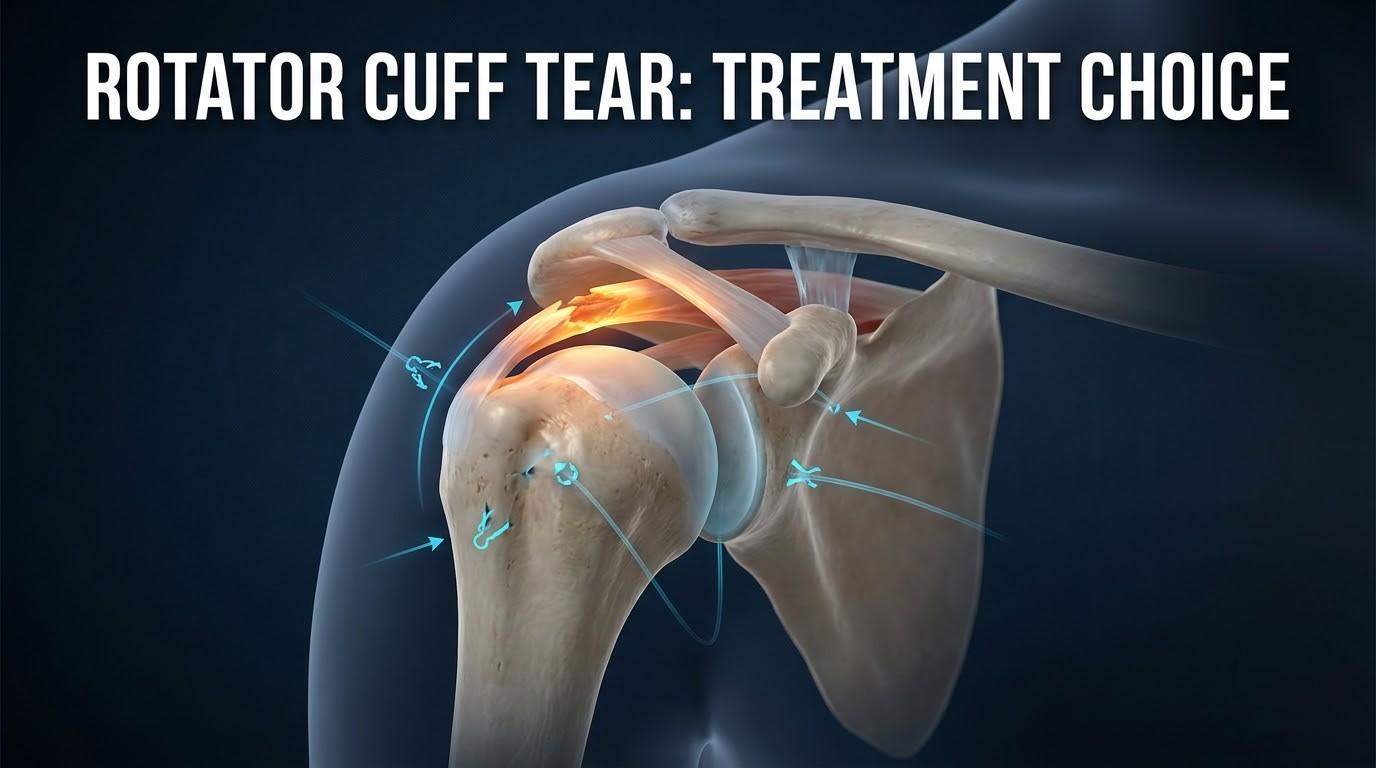
The rotator cuff consists of muscles and tendons which surround the shoulder joint. It helps keep the head of the upper arm bone in the center of the socket while moving the arm.
The tear can be:
Partial-thickness when it affects only the tendon and is not full-thickness (does not pass through the whole tendon).
Full-thickness if the tear affects the whole thickness of the tendon.
It can be small, medium, large, and massive based on its size and configuration.
Rotator cuff tears can arise slowly due to wear and tear and repetitive usage of the shoulder, as well as happen immediately due to an accident or injury.
The presence of symptoms in patients with rotator cuff tears varies greatly and can be different for everyone. Some patients experience severe pain and weakness, while others might have tears found on MRI and no pain.
It is important because treatment is aimed at the patient’s symptoms rather than MRI findings.
Common Symptoms of a Rotator Cuff Tear
A rotator cuff condition may present itself through pain experienced in the shoulder or upper arm, especially when lifting or doing any form of overhead movement.
Typical signs and symptoms may include the following:
- Shoulder pain during shoulder elevation
- Worsening pain in the shoulder at night
- Weakness when lifting or extending the arm
- Difficulty doing overhead movements
- Limited shoulder mobility
- Feeling that the arm is weak
- Shoulder pain following an accident or fall
While some people experience gradual symptoms, others experience sudden pain and weakness following an injury to the shoulder area.
Prolonged pain and weakness should be looked into because there may be various conditions causing shoulder pain, such as rotator cuff disorder, arthritis, labral conditions, bursitis, among others.
How Is a Rotator Cuff Tear Diagnosed?
A correct diagnosis would always begin with a detailed history and physical exam.
The physician might inquire about the start date of symptoms, presence of trauma, provocative movements, weakness of the shoulder, and impact on work, sleep, sport activity, and daily life.
While examining the patient, the mobility and strength of the shoulder joint could be tested. Various clinical tests will assist in determining the probability of a torn rotator cuff.
Then, imaging could be performed to collect more data. Ultrasound and MRI could help in assessing the condition of the rotator cuff tendons and in determining the size and character of the tear. The AAOS Appropriate Use Criteria highlight the need for the combination of the clinical history, examination, and proper imaging in diagnosing symptomatic full-thickness tears.
Therefore, the imaging results must be understood in light of the patient’s complaints and the examination findings.
Conservative Management: When Can Surgery Be Avoided?
Conservative therapy is usually preferred before surgery, especially in cases where the symptoms can be controlled without resorting to an operation.
Non-operative treatments can comprise the following:
Activity modification
Avoidance of repetitive activities that cause irritation and strain of the shoulder can make the symptoms milder, allowing the person to concentrate on recovering.
It doesn’t imply taking a break entirely. Usually, the goal is to remain active while performing activities that don’t create too much stress for the tendon.
Physiotherapy
The role of physiotherapy is important in the conservative management of rotator cuff injury.
A well-designed program can concentrate on regaining proper motion of the shoulder joint and strengthening the muscles that are responsible for shoulder function. Exercises can also be aimed at gaining flexibility and improving control of the scapula and other muscle groups involved.
AAOS advises patients that physical therapy is a type of treatment aimed at regaining movement and strengthening the shoulder.
Exercises chosen should be tailored according to the particular condition of the patient’s shoulders.
Pain control
It would be recommended by doctors to administer suitable pain-relieving or anti-inflammatory drugs to selected individuals, based on the patient’s past medical record and current drug treatment.
In some situations, an injection may also be prescribed to help relieve symptoms temporarily. According to the 2025 AAOS guideline, a single corticosteroid injection with a local anaesthetic could be used to improve temporarily pain and functionality of people with shoulder pain.
The treatment will be personalized, especially for patients that will eventually undergo surgical procedures.
When Can Conservative Treatment Be a Reasonable Choice?
Nonsurgical treatment may be indicated in some cases of rotator cuff injury, in particular where:
- pain is well-managed;
- functioning of the shoulder joint is fairly intact;
- the damage does not imply functional impairment;
- there is a positive response to rehabilitation;
- it is possible to adapt activities or sport to reduce demands on the joint;
surgery does not provide any additional advantage at that time.
The AAOS also found research which demonstrates that physiotherapy is an efficient treatment method in many cases of symptomatic atraumatic full-thickness tears.
But results are individual.
One cannot assume that since a certain person had success with physiotherapy treatment, the same treatment will be indicated in their case as well.
When Might Surgery Be Considered?
The procedure may be indicated in cases where the patient is still suffering from considerable symptoms even with an adequate regimen of conservative management or based on the type of tear where surgery becomes the most suitable form of treatment.
These factors may play an important role during the decision making:
Persistent symptoms: Persistent pain or dysfunction even after the administration of proper treatment may warrant surgery.
Weakness: The inability to use the arm for vital activities may also be significant in clinical terms.
Acute tear: This refers to a case of a tear resulting from an injury and causing considerable weakness, which would warrant a visit to a specialist.
Physical demands: Individuals involved in repetitive overhead activities or sporting activities may have different objectives in the treatment of tears from other patients.
Tear characteristics: Tear size, location, chronicity, tissue quality, and pathology are some of the aspects that determine the repairability and efficacy of repair. According to the educational material issued by AAOS, considerations in the decision for surgery include tear size, persistent symptoms, weakness, physical demands, and trauma.
Thus, treatment of Rotator Cuff tear South Delhi should be looked at as both diagnosis and treatment process.
What Is Arthroscopic Rotator Cuff Repair?
Arthroscopy is a type of minimally invasive surgery in which the doctor uses a camera and specialized surgical tools that are inserted into the shoulder through small cuts.
In arthroscopic rotator cuff repair, the surgeon examines the shoulder joint and fixes the torn tendon when required.
The method of fixing the tear will depend on factors such as the site, size, nature, and quality of the tear.
According to AAOS, arthroscopic rotator cuff repair is an accepted form of treatment for many rotator cuff tears, with the method offering visualization of the joint and reducing the disruption of soft tissues.
However, it is important to note that the word “arthroscopic” does not imply that rehabilitation is not required in the treatment.
Arthroscopic Repair vs Conservative Management
The choice becomes clearer if the two approaches are compared from their objectives.
Conservative approach
The objective is to manage the symptoms and improve the functionality of the tendons without undergoing surgery.
It might comprise physiotherapy, modifying activities, managing symptoms and gradually building up strength.
Its main benefit is the avoidance of surgery. This option may be sufficient for providing adequate functionality to the patients in the long term, especially in case of patients who respond well to rehabilitation.
Its drawback is that the rehabilitation will not surgically connect the ruptured tendon. An operation might be necessary for some patients who have weakness, a tear from trauma, functional impairment or other indications for surgery.
Surgical Repair via Arthroscopy
The objective is to reconnect the torn tendon to its origin and facilitate healing.
According to the AAOS 2025 guideline, there is moderate evidence that, in suitable candidates, healing surgical repair leads to improved patient-reported and functional outcomes as compared to non-operative management and unhealed surgical repair.
Nevertheless, there is also recovery time associated with surgery as well as the risk of certain complications. The tendon that has been surgically repaired must also heal, which means that early resumption of lifting, exercise, or any other overhead activity may affect the recovery process negatively.
This decision must be made after the consultation with the orthopedic physician concerning the expected gains and restrictions.
What Is the Role of Physiotherapy After Surgery?
Regardless of whether treatment involves surgery or not, rehabilitation plays a vital role.
With the arthroscopic procedure, rehabilitation will be done gradually with great care in order to protect the repair while regaining the ability to move and build strength.
According to AAOS, rehabilitation is an important aspect of recovery from rotator cuff injuries.
The early stage of rehabilitation may include protection of the repair and movement. In later stages, rehabilitation will proceed to the strengthening and recovery phase.
The patient needs to understand that it takes time for the shoulder to heal. The reduction in pain does not necessarily indicate completion of healing biologically.
A Note About Bankart Repair
Patients looking for Shoulder arthroscopy doctor near me will find many words like “Bankart repair” while searching for shoulder surgery.
However, a Bankart repair is usually related to shoulder instability and labral tear, especially in cases of repeated shoulder dislocation. This is not the same surgery as rotator cuff repair.
In case you are looking for Bankart repair in Delhi, it becomes necessary to know whether the issue lies in shoulder instability, labral tear, rotator cuff tear, or any other shoulder-related issues.
There are many things that shoulder arthroscopy can help to solve, but the surgery must be done as per the diagnosis.
What Does Recovery Look Like After Rotator Cuff Repair?
The post-operative recovery process takes time.
The actual recovery duration differs based on several factors including:
- The magnitude and nature of the tear
- The surgical procedure
- Quality of tissues
- Any other operation carried out during surgery
- General condition of the patient
- Progress in rehabilitation
- Sporting objectives
Different rehabilitation protocols may be necessary for tears of small and medium sizes from those of large or complicated tears.
According to the latest AAOS guidelines, in the case of small-to-medium full-thickness tears treated through arthroscopic repair, both early and delayed mobilization techniques can yield similar results, but the right rehabilitation protocol still remains a clinical choice.
Hence, patients should adopt their own rehabilitation protocol as recommended by their surgeons and physiotherapists and not make comparisons with others
How Do You Choose the Right Treatment?
There is not one treatment that is the best for everyone with a rotator cuff tear.
A specialist will usually ask the following questions:
How bad are your symptoms?
Anatomic tear which results in few to no problems with function may not need any surgical intervention.
How weak is your shoulder?
Weakness in the shoulder especially after injury may be a factor that should be considered.
How long do you have your symptoms?
Continuation of symptoms after adequate management might be another factor to be taken into account.
What does your tear look like?
Location, size, chronicity and quality of the tissue may be factors that affect the treatment planning.
What are your functional demands?
A person who works using their shoulders extensively may have different needs compared to another one with different functional demands.
Have you done your rehabilitation?
A properly managed rehabilitation program may give a good picture of the reaction of the shoulder to conservative treatment.
When Should You Seek Specialist Evaluation?
An orthopedic assessment should be considered for persistent shoulder pain and/or weakness, particularly when there is:
- the onset of symptoms following an accident or sporting injury;
- a sudden onset of weakness;
- pain that causes disturbance of sleep or everyday tasks;
- inability to lift the arm normally;
- inadequate improvement in symptoms with physiotherapy;
- a diagnosis of a complete tear;
- demanding physical work or activity involving the shoulder.
Early assessment is especially useful following an injury, as the treatment approach for an acute traumatic tear can differ significantly from a chronic degenerative tear.
Choosing Rotator Cuff Tear Treatment in South Delhi
When looking for rotator cuff tear treatment in South Delhi, patients will usually begin their search with the possibility of surgery. Yet, the right way to start will actually be through having an assessment done.
The reason why we should have a proper clinical assessment is not just to see if we can do surgery on the patient. Rather, we need to know if we really should have surgery done on the patient.
At a shoulder and sports arthroscopy consultation, the assessment process may involve the medical history of the patient, physical exam, imaging studies, activity needs, and previous response to treatment.
Final Takeaway
Having a rotator cuff tear does not necessarily indicate that you will require surgery.
There are many patients who are able to get well with the help of a properly devised conservative approach especially in cases where there are positive responses from physiotherapy and adjustment of activity. There are also those who would benefit from the use of an arthroscopic approach because of persisting symptoms, weakness, trauma, and tear characteristics. The latest recommendations by AAOS promote individualized decision-making depending on the case and available information.
For patients who are seeking treatment for a rotator cuff tear South Delhi, the critical thing to do is to determine the cause of their symptoms and the type of tear first.
These two approaches are not mutually exclusive at all times and, in some instances, can complement each other.