Medically reviewed by: Dr. Aditya Jain
Qualifications: [(MBBS, MS Orthopaedics, DNB, MNAMS) ] Trained at AIIMS New Delhi with advanced international fellowships in the UK, USA, and Switzerland,
Specialty: [ specializing in sports injuries, ACL reconstruction, and arthroscopic procedures.]
Clinic : – [StepUp Joints, Lajpat Nagar, South Delhi ]
Last reviewed: [6 – November -2026]
Doctor’s Clinical Perspective
Dr. Aditya Jain emphasizes that the management of an ACL injury should be based on the patient’s knee stability, clinical findings, activity requirements and associated injuries. An individual assessment helps determine whether rehabilitation alone or ACL reconstruction should be considered. Patients should also understand the importance of structured rehabilitation following treatment.
Summary
Tearing your anterior cruciate ligament (ACL) can leave your knee feeling unstable and disrupt your active lifestyle. While some patients manage with physiotherapy alone, many require surgical reconstruction using a tissue graft to restore stability. From preparing for the procedure and understanding the key surgical steps to committing to months of targeted rehabilitation, navigating an ACL injury takes preparation and patience. This guide covers everything you need to know about ACL surgery, recovery milestones, and what to expect on your path back to everyday movement and sport.
What Is ACL Surgery?
The anterior cruciate ligament (ACL) provides stability to the knee. If damaged it can cause instability when twisting. ACL surgery is often done by reconstructing the ligament. This means replacing the damaged ligament with a graft from a tendon. In some cases the injury can be repaired however most of the time it will be reconstructed.
The graft can be taken from your own tissue (autograft) or donor tissue (allograft). Common grafts include hamstring, patella and quadriceps tendon. It depends on individual circumstances which graft will be used and should be discussed before surgery.
This gives you a general overview of ACL surgery.
Does Every ACL Tear Need Surgery?
This is a bit of a subjective question. Some patients can have good functional outcomes with a structured physiotherapy programme. However, if there is on going instability symptoms, desire to play high level pivoting sports, or associated injuries then surgery may be considered. This should be based on your clinical findings and goals rather than what the MRI report says.
Before going into the steps of ACL surgery, it is important that patients have an understanding of their options, benefits, and limitations to their treatment. Important questions to ask can include:
- Will I be able to achieve my activity goals with rehab only?
- Are there any associated meniscal/cartilage injuries?
- What are the pros and cons of each graft?
- How much rehab will I need to commit to?
This will help you to make shared decisions and ensure you are fully informed.
How to Prepare for ACL Surgery
Preparation includes medical assessment, exercises where appropriate and practical arrangements for recovery.
Pre-op assessment
Your healthcare team will assess you to ensure that you are fit to have the surgery. They may ask you some questions about your health, take your blood pressure and organize some blood tests. You will be asked to bring a list of medications you are on so they can be accurate. This is also a good opportunity to ask any questions you may have regarding the operation and recovery.
Knowing the steps involved in ACL surgery means that you can ask questions to clarify what will happen during your operation, as well as understand how the intra-articular treatment may affect your rehab.
Exercise programme
You may be given some pre-op physio exercises to help reduce swelling, regain movement and strengthen the muscles around your knee. Your programme should be tailored to your injury and fitness level. Don’t increase your exercise intensity unless advised. If you are getting more pain or swelling with activity then avoid this.
Medication and fasting
Ask the surgical team if you need to continue taking any medications and if any need adjusting. Follow the specific instructions given by the hospital regarding eating and drinking.
Home and transport
Ensure you have someone to take you home and assist you with everyday tasks. Ensure that you have any regularly used items to hand. Remove any loose rugs and trailing electrical wires. If required, prepare some food. Talk to your employer about how much time you will be off work for, considering the physical demands of your job.
Understanding the steps in ACL Surgery
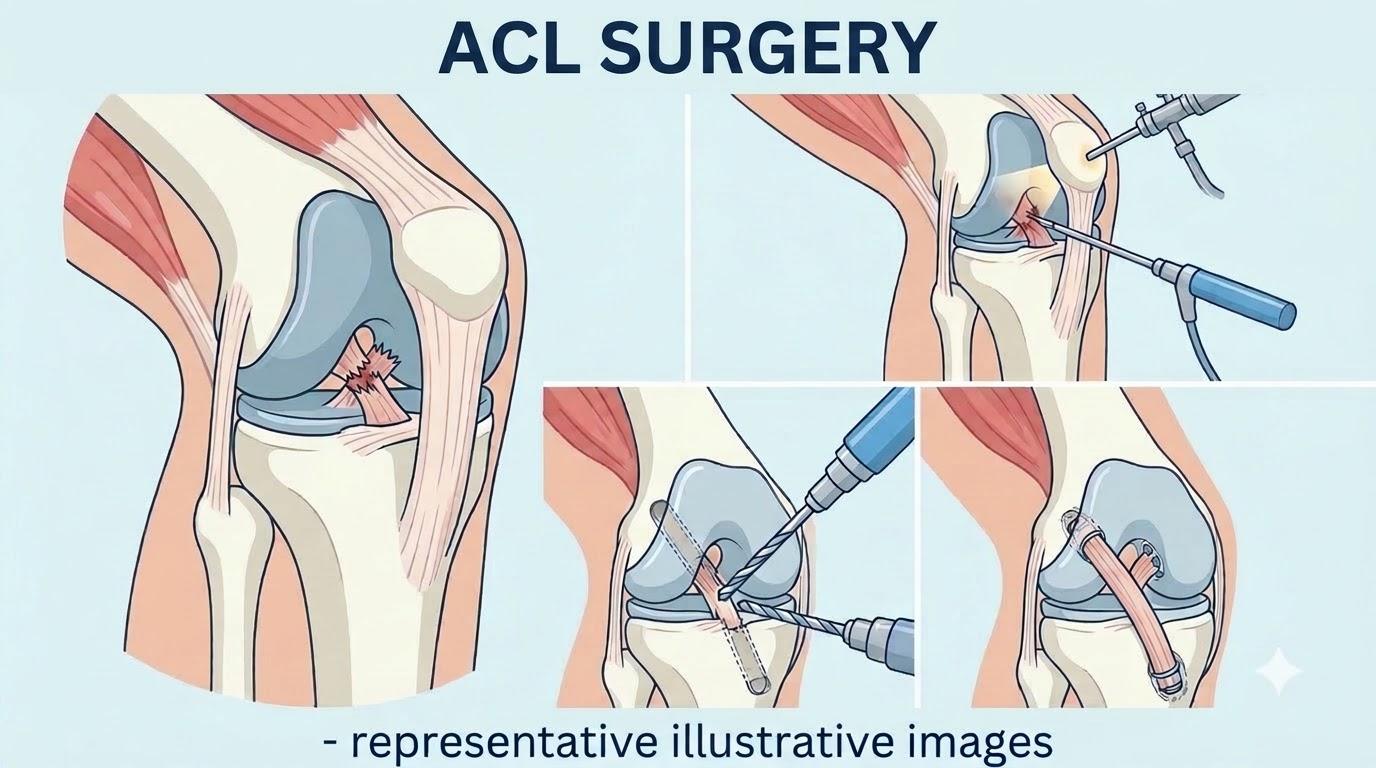
ACL surgery will usually involve anaesthesia, joint inspection, graft preparation, creating bone tunnels, securing graft and closing up the wound. The exact order and type of surgery can vary depending on the graft, injury and any extra procedures.
1. Anaesthesia and preparation
Before you have your operation the team will confirm what operation you’re having. You’ll be given anaesthesia so you do not feel any pain during the operation. The anaesthetist will also talk through the type of anaesthesia they would like to use and if there are any considerations to make. ACL reconstruction is often done using arthroscopic techniques. This involves small cuts to give access to the joint.
2. Arthroscopy
An arthroscope (small camera) is inserted into your knee. This allows the surgeon to look at ACL and other structures within your joint such as the meniscus and cartilage. Any damage found may need treating during the operation.
This is a key step in acl surgery as it allows the surgeon to look inside your knee.
3. Harvesting the graft
If you’re having an autograft then the surgeon will harvest tendon tissue from the area they’ve chosen. They may need to make another incision to do this. The tissue is then prepared ready to be placed into your knee as a replacement ligament. Alternatively you can have donor tissue.
There are many pros and cons to each type of graft. For example, the type of graft you have may cause symptoms at the donation site. Evidence shows autografts have lower failure rates in younger patients than donor grafts. However there isn’t just one option that will be right for everybody.
4. Tunnel creation
The surgeon makes tunnels/sockets in your thigh bone and shin bone. This helps to place the graft in the right place. This is an important part of ACL surgery to help provide stability and movement in your knee.
5. Graft placement
The graft is placed into the correct position and fixed using devices such as screws. The surgeon will check that the graft is tight and how your knee is moving. This keeps the graft in place whilst it heals.
6. Final checks and wound closure
Once the surgeon has checked your reconstruction and any treatment they have done they will remove their instruments. The incisions are then closed and dressings applied. You will then be moved to the recovery area. Your acl surgery is now complete however rehabilitation is a key part of your treatment.
After surgery
You will be monitored and given pain relief as required whilst in recovery. You will also begin to move safely under the guidance of nurses and physiotherapists. Once you are recovering well, moving safely and with approval of the medical team you will be able to leave the hospital. Many people can go home the same day as their surgery.
Prior to leaving you will be given instructions regarding:
- The pain medication you have been prescribed,
- How to look after your wound and dressings,
- How to safely use your crutches,
- If you need a brace,
How much weight you can put through your leg and what exercises you can do.
Depending on associated procedures you may have more instructions. For example if you have had a meniscus repair you may have further limitations. Please follow instructions specific to your surgery.
Rehabilitation following ACL reconstruction
It can be helpful to know what will happen during your ACL surgery. As well as this, knowing the rehabilitation process can help. In many cases it can take months to make full recovery. The speed you make progress will depend on how your knee is responding, how strong and mobile it is and what activity you are trying to get back into.
Early recovery
In the early stages you will need to manage your pain and swelling. You may also need crutches. A brace may also be needed. Using ice (wrapped in a towel) and raising your knee can also be helpful. Always follow the advice from your treatment team.
Do not be tempted to go running, jumping or twisting if you can walk comfortably.
Regaining mobility and strength
Physiotherapy will aim to improve your knee mobility, strength in your quads and hamstrings and improve your balance and co-ordination. The exercises will be progressed depending on how well you are managing your pain, range of movement and strength.
It is important to keep attending physio regularly. However, do not overdo your exercises. If you increase your activity too quickly it can make your symptoms worse.
Returning to work, driving and sport
Returning to work will depend on your job and how you are recovering. If your job is mainly sedentary then you may be able to return sooner. If your job requires heavy lifting, kneeling or climbing then it may take longer. You should only return to driving when your medical team feel it is safe to do so.
Returning to sport can take around 12 months however this can vary. You should only return when you have regained strength, control in your knee and made progress with function. Just completing the steps of your ACL surgery does not mean you are ready to return to competitive sport.
Potential Risks/Complications
There are potential complications that can occur during an ACL reconstruction. These include:
- Infection
- Blood clots
- Stiffness or limited movement of the knee
- Persistent pain and swelling
- Numbness around incisions
- Pain/discomfort at the site of the graft being taken
- Stretching of the graft, graft failure or re-tearing
- Ongoing instability requiring further surgery
It is important to understand the procedure, risks and alternative treatments available. You will also need to know what rehab you will require.
If you experience any worrying symptoms such as increased calf pain, redness or swelling seek medical advice ASAP. This could be a sign of a blood clot. If you have sudden chest pain or trouble breathing you should seek emergency medical attention as this could be due to the blood clot travelling to your lungs.
Questions to Discuss With Dr. Aditya Jain
Having a one-to-one consultation will help you understand your diagnosis and treatment options. You may want to bring a list of questions to ask:
- Why am I having surgery?
- What can be achieved with non-surgical rehabilitation?
- What graft is being recommended and why?
- Will there be any further injuries requiring treatment?
- How may this affect my weight bearing and recovery?
- What will I need at home?
- What milestones do I need to achieve to get back to sport?
Knowing the steps involved with acl surgery will help you have a focused discussion however the final plan will depend on your examination, goals and situation. Talking through alternative treatments, risks and rehabilitation is all part of making an informed decision.
Frequently Asked Questions
1.What involves the surgery?
The surgery would generally involve anaesthetic, arthroscopy with inspection of the knee joint, graft preparation, drilling of tunnels into the bones, graft insertion and fixation. Other injuries could also be treated at the same time.
2.Is it keyhole surgery?
The ACL reconstruction is generally performed via keyhole surgery using small incisions. An extra incision may be required to harvest the tendon tissues if an autograft is being used.
3.When will I be able to walk?
Many patients will be able to start walking with some support shortly after surgery. The amount of weight you are allowed to put through your leg will depend on how your reconstruction was performed, any additional procedures and your surgeons and physios instructions.
4.Will I need Physio?
Physiotherapy is an important part of your recovery. Physio will help improve your mobility, strengthen your muscles, improve your balance and functional ability. Exercises will be done at your own rate of recovery. Surgery will not replace physiotherapy.
5.Can I guarantee going back to sport?
Nothing can be guaranteed. How well you recover from your physiotherapy, how well your knee functions and how much your sport requires will influence how you recover. Complications can also occur which can affect your outcome. Always follow medical advice.