Medically reviewed by: Dr. Devender Bairwa,
[Qualification : – Trained at premier institutes including AIIMS, JIPMER and MAMC ]
[Specialty : – Dr. Bairwa has over 13 years of experience in Clinical Immunology and Rheumatology ]
Clinic: StepUp Joints, Lajpat Nagar, South Delhi
Last reviewed: [6 – November -2026]
Doctor’s Statement
Proposed wording for Dr. Devender Bairwa’s review and approval—not a verified quotation:
“Persistent back pain should be assessed according to its pattern, not simply its severity. Pain that improves with movement, worsens after rest or interrupts sleep may suggest an inflammatory cause. Associated eye, skin, bowel or joint symptoms are also important. A rheumatology assessment brings together the history, examination and investigations to guide an individual treatment plan.”
Summary
Imagine waking up every morning feeling as though your back has been locked in concrete—only for that crushing stiffness to miraculously ease up the moment you start moving around. Most people brush it off as a bad mattress or a long workday, but when back pain behaves this way, it’s often telling a completely different story. Unlike typical mechanical strain, inflammatory back pain is a quiet hallmark of ankylosing spondylitis, a condition where the body’s immune system mistakenly targets the spine. Catching these early whispers of discomfort can make all the difference, helping you protect your mobility and stay one step ahead of chronic joint damage.
What Is Ankylosing Spondylitis?
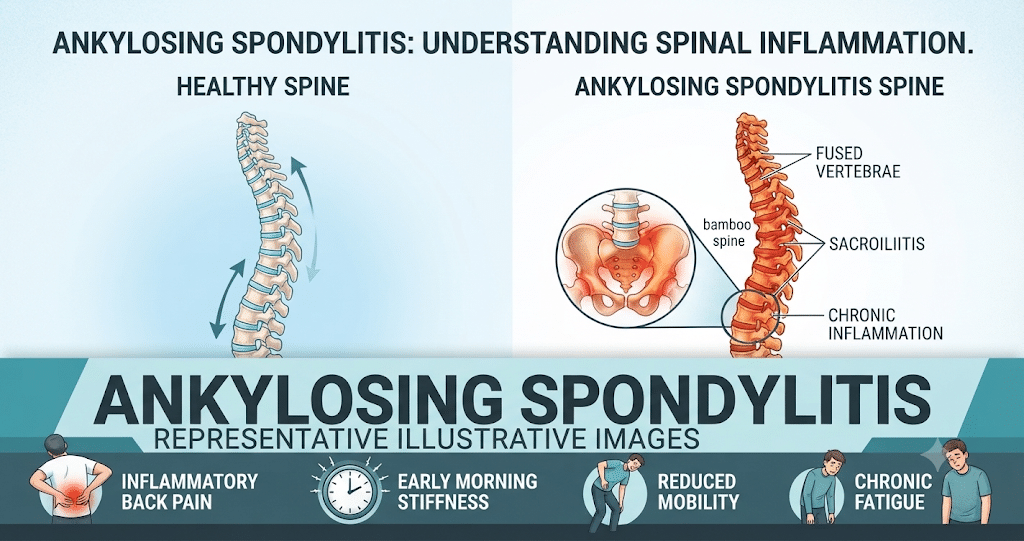
Ankylosing spondylitis (AS) is an inflammatory arthritis that affects the spine and sacroiliac joints which are joints that join the pelvis to the bottom part of the spine. It can lead to pain, stiffness and decreased mobility. Some people will experience problems in other joints or parts of their body.
Ankylosing spondylitis is part of a wider group of conditions called axial spondylarthritis. Ankylosing spondylitis generally refers to axial spondylarthritis where there are typical changes to the sacroiliac joints seen on x ray. There are some people who have axial spondylarthritis but do not have any changes on x ray, this is called non-radiographic axial spondylarthritis.
It is important to know that just because an x-ray is normal it does not mean that your back pain is not caused by an inflammatory condition.
Early Symptoms of Ankylosing Spondylitis
Symptoms can develop slowly over months or years. Key features include:
1. Chronic low back pain and stiffness.
Low back pain is a common symptom. Inflammation should be considered if there is chronic low back pain starting before 45 years of age and lasting >3 months. Especially if other symptoms are also present.
Not everyone with chronic low back pain in younger people will have Ankylosing Spondylitis.
2. Stiffness in the morning.
Stiffness can be a key feature. Symptoms may be worse in the morning or after long periods of inactivity. Symptoms often improve with activity.
3. Improvement with exercise.
Improvement with exercise is a key feature. Rest may not help much or can aggravate symptoms in Ankylosing Spondylitis.
4. Pain disturbing sleep.
There can be pain disrupting sleep especially in the latter part of the night. This is more relevant if combined with morning stiffness, buttock pain or improvement with activity.
5. Buttock pain.
Buttock pain can occur due to the sacroiliac joints often being affected. This can be mentioned as a symptom.
6. Extra-articular symptoms.
Possible symptoms can include:
- Joint pains and swelling (hips/knees).
- Tendon/ligament pains (enthesis’s).
- Fatigue.
- Reduced spine mobility.
- Inflammation in the eyes.
- Psoriasis or inflammatory bowel disease.
These can occur at different times so symptoms involving the eyes, skin or bowel may seem unrelated but can be relevant.
What Is Inflammatory Back Pain?
Inflammatory back pain is a symptom pattern that raises suspicion of inflammation affecting the spine or sacroiliac joints. It is not a diagnosis by itself. Clinicians consider the overall pattern, associated conditions, examination findings and investigations.
Features that increase suspicion include:
| Feature | Why it matters |
| Gradual, persistent symptoms | Inflammatory conditions may develop slowly rather than follow a single injury. |
| Onset before age 45 | This is an important consideration in referral guidance. |
| Improvement with movement | A recognized feature of inflammatory back pain. |
| Little improvement with rest | Commonly reported in ankylosing spondylitis. |
| Waking during the second half of the night | A feature considered when assessing possible axial spondylarthritis. |
| Buttock pain or associated joint symptoms | May indicate involvement beyond a simple back strain. |
No individual feature confirms or excludes the condition. The combination is more informative than any one symptom.
When Should You Consider a Rheumatology Consultation?
If you have had longstanding back pain with features of inflammation (especially if the symptoms started before the age of 45 and persisted for more than 3 months) then it may be useful to discuss a rheumatology referral with your clinician. Other factors which could suggest a reason to refer include symptoms of psoriasis, eye inflammation in the past, inflammatory bowel disease, joint swelling and family history of spondylarthritis.
The referral criteria include a combination of these factors. Do not try to self-diagnose using an online symptom checker. You do not need to wait 3 months for symptoms to persist if they are severe or worrying.
A rheumatology appointment can help to differentiate between axial spondylarthritis and other causes of back pain. This will help to determine whether further investigations or treatment are required.
What Happens During the Consultation?
Medical history
You will be asked about when your symptoms started and how they affect you with activity or rest and if they are affecting your sleep. You may be asked about any previous joint problems, psoriasis, bowel issues, inflammation of the eyes and family history.
Before your appointment you may want to write down:
- When your pain and stiffness started
- If your symptoms are affected by activity or rest
- If you are waking due to pain
- Any symptoms in your buttocks, heels or other joints
- Previous history of a painful red eye
- Any relevant skin, bowel or family history
- What medications you have tried and what effect they had
- This helps build up a picture of your symptoms.
Physical examination
Depending on your symptoms you may have an examination of your spine, pelvis, joints, heels or chest. They may also look at your mobility and range of movement. They will also look at how your symptoms are affecting you.
Blood tests
You may have blood tests to look for signs of inflammation, this can include checking your C reactive protein (CRP) and Erythrocyte Sedimentation Rate (ESR). They may also decide to check your HLA-B27.
It is important to remember:
- A normal CRP and ESR does not rule out spondylarthritis.
- A negative HLA-B27 does not rule out spondylarthritis.
A positive HLA-B27 does not confirm the diagnosis as some people have this genetic marker but do not develop the disease.
Imaging
An X-ray can show changes in your sacroiliac joints but this may take many years to develop. An MRI can help show any inflammation sooner where appropriate. It is important to take into account your history, examination and other findings when interpreting the imaging.
Treatment Options for Ankylosing Spondylitis
There is no cure, however treatment can help manage symptoms, keep you mobile and functional. Usually treatment will include medication alongside exercise and physiotherapy.
Exercise and Physiotherapy
Having a personalized exercise plan can help you stay as mobile as possible, keep your strength and correct your posture. NICE recommend specialist physiotherapy which can include: stretching, strengthening, moving your spine, improving your posture, breathing exercises and aerobic exercises.
Your programme should be tailored to your symptoms and physical ability.
Anti-Inflammatory Medication
You may be offered non-steroidal anti-inflammatory drugs (NSAIDs) to help with pain and stiffness. You should have a personalized treatment plan taking into account your risk factors. Do not start or increase medication without appropriate advice.
Targeted Medication
If your disease is still active after initial treatment, your rheumatologist may decide to give you targeted treatment such as biologicals or targeted medication. This will depend on whether you are eligible for this based on your clinical presentation and safety. This will need to be assessed by a specialist.
Monitoring of Related Conditions
You may also be monitored or treated for any related conditions such as eye inflammation, psoriasis, inflammatory bowel disease or joint symptoms. By mentioning these issues it can help your treatment team to look at your condition holistically.
A Painful Red Eye Needs Urgent Attention
Ankylosing spondylitis may be associated with acute anterior uveitis (iritis). Symptoms include:
- eye discomfort
- redness
- sensitivity to light
- blurred or poor vision
If you experience any of these symptoms seek an ophthalmology review the same day. If you are suspected by the clinician to have acute anterior uveitis refer to the rheumatology department urgently (NICE recommendations). Early management is important to prevent damage to your vision.
Conclusion
Back pain that is persistent should not be immediately assumed to be due to strain or posture if they are displaying signs of an inflammatory pattern. Becoming aware of symptoms and having discussions with your clinician can help to ensure you are appropriately assessed and managed to keep you moving, functional and improve your quality of life.
FAQs
1. What are the symptoms I may notice in early stages?
Lower back pain is often slowly progressive. Symptoms such as pain at night, stiffness on waking and pain improving with activity may be noticed. Pain in your buttocks and other joints can be present.
2. If I have inflammatory back pain does that mean I definitely have ankylosing spondylitis?
Inflammatory back pain is a pattern of symptoms which means we need to consider inflammatory conditions. We must take into consideration the whole clinical picture.
3. Can women get axial spondylarthritis/ankylosing spondylitis?
Yes. NICE recommend clinicians should be aware it affects equal numbers of women and men.
4. Can blood tests come back normal?
Yes. Inflammatory markers do not rule out spondylarthritis. A negative HLA-B27 does not rule it out.
5. If my HLA-B27 is positive does that mean I definitely have the condition?
No. Some individuals have HLA-B27 but never develop ankylosing spondylitis. This is just one of several factors that will be considered.