Dr. Naman Wahal – Orthopaedic Surgeon
Medically reviewed by: Dr. Naman Wahal
[Qualification– Trained at AIIMS New Delhi and MAMC, with an advanced international fellowship at ATOS Klinik, Germany.],
[Registration No : – 9143]
[Specialty – specialist Shoulder & Sports Orthopaedic Surgeon . ]
[Clinic: StepUp Joints, Lajpat Nagar, South Delhi ]
Last reviewed: [21 – November -2026]
Doctor’s Statement – Dr. Naman Wahal
“Frozen shoulder is a condition in which the shoulder gradually becomes painful and stiff, affecting everyday activities such as dressing, reaching overhead and sleeping comfortably. Treatment depends on the stage of the condition, the degree of stiffness and the individual’s functional needs. Gentle, appropriately selected exercises can help maintain shoulder mobility, but movements should be adjusted according to pain and clinical assessment.”
Introduction: When Simple Shoulder Movements Become Difficult
Everyday tasks such as reaching items from a shelf, putting clothes on and brushing your hair can become difficult if you have a stiff and painful shoulder.
Frozen shoulder (adhesive capsulitis) occurs due to the thickening and tightening of the joint capsule surrounding the shoulder joint. This can cause pain during movements and can be severe at night.
There are ways to improve your shoulder movement over time with the correct treatment and rehabilitation. Knowing what you are suffering from, what stage of frozen shoulder you are in and completing the correct exercises can make it easier to cope with the stiffness.
Exercises to help with frozen shoulder can vary depending on your symptoms and which stage of frozen shoulder you are in. Being too aggressive with your stretches or placing your arm into painful positions can make your symptoms worse.
This article will give you an overview of the 3 stages of frozen shoulder, some exercises you can complete at home to help with your mobility, precautions you can take and when to seek an orthopaedic assessment.
1. What Is a Frozen Shoulder?
Frozen shoulder
The shoulder joint is a very mobile joint. The joint has a surrounding capsule which allows you to move your arm in many directions. In a frozen shoulder the capsule becomes inflamed causing thickening and tightening. This can restrict active and passive movement.
This can cause:
- difficulty lifting your arm above your head
- pain when moving your arm around your back
- difficulty putting on shirts and jackets
- discomfort when lying on the affected shoulder
- stiffness when doing everyday tasks
- loss of mobility when overhead
Frozen shoulders tend to develop slowly. This can affect one or both shoulders at different times.
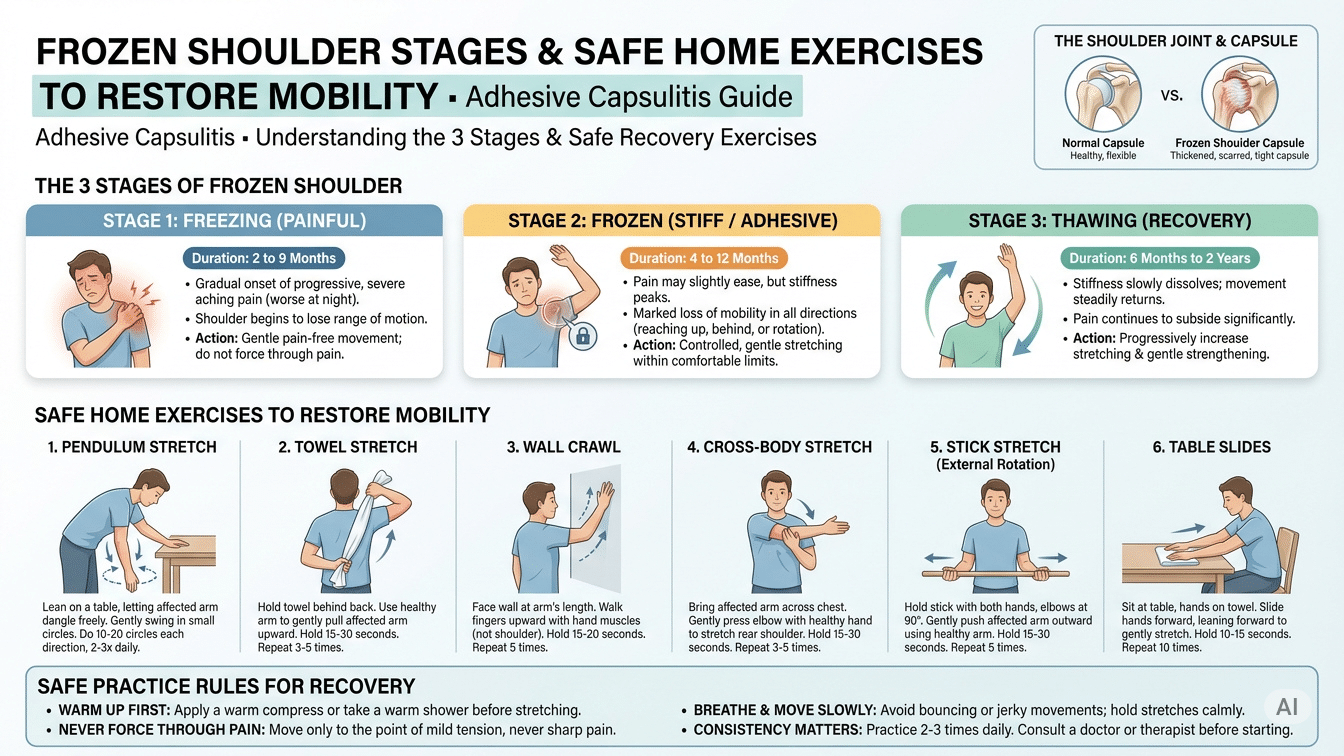
2. What Are the Three Stages of a Frozen Shoulder?
Most cases of frozen shoulder will progress through 3 stages however can vary depending on the individual.
Stage 1 – Freezing phase
During this stage there will be an increase in pain and stiffness.
- Symptoms
- Shoulder pain
- Increased discomfort at night
- Difficulty raising arms above head
- Increasing stiffness
- Pain during daily activities
It is important to try to remain comfortable and manage your pain. Gentle exercises may be beneficial throughout this phase.
Stage 2 – Frozen phase
During this phase you will start to notice increased stiffness in the shoulder. There should be less pain than the previous stage, however you may feel some discomfort especially at end ranges.
- Symptoms
- Restricted range of movement
- Difficult to reach around the back
- Difficult to raise the arm
- Reduced flexibility
- Difficult to dress and groom
You may wish to perform some exercises under the right supervision to maintain your range of movement and slowly work on stiffness.
Stage 3 – Thawing stage
Improvement is seen.
Symptoms may include:
- Less stiffness
- Increased arm elevation
- Improved daily activities
- Increased range of movement in the shoulder
- Gradual improvement in functional movements
This can be a long stage of recovery and can last several months. Some people will still have some restrictions.
3. Frozen Shoulder Stages: Comparison Table
| Feature | Freezing Stage | Frozen Stage | Thawing Stage |
| Main concern | Increasing pain | Marked stiffness | Gradual recovery |
| Pain | Often noticeable | May reduce | Usually improves |
| Movement | Progressively restricted | Significantly restricted | Gradually improves |
| Night discomfort | Common | May continue | Often reduces |
| Exercise focus | Comfortable movement | Gentle mobility | Progressive mobility and function |
| Main goal | Manage discomfort | Maintain and improve movement | Restore daily function |
Understanding the stages helps explain why the same exercise may not be suitable for everyone.
4. 7 Safe Home Exercises for Frozen Shoulder
Exercises can be performed at home to keep you comfortable and gradually increase your shoulder mobility. The type of exercise will depend on the degree of pain, range of movement and what has been identified by your practitioner.
Note: This is a general guideline. If you are experiencing any severe pain whilst doing the exercises stop.
Pendulum Exercise
This will help you to gently move your arm, using your body weight.
- Stand by a solid table/chair.
- Bend forward and place your good arm down.
- Place your affected arm down comfortably.
- Gently move your body forwards and backwards.
- If comfortable you can also start to move your arm in small circles.
- This will help to get your shoulder moving gently.
Table Slides
This will help you to get your shoulder moving forwards.
- Sit facing the table.
- Place both hands on a towel on the table.
- Gently slide the towel forwards.
- Leaning forwards slightly as your hands move away.
- Stop when you feel a comfortable stretch.
- Slowly return to the starting position.
This will help to encourage your shoulder to move forwards.
Exercise 3 – Assisted Shoulder Flexion
Sit comfortably on your back.
- Using your unaffected arm, hold onto the wrist of the affected arm.
- Slowly raise your arms.
- Move to a comfortable range.
- Slowly return to the starting point.
This helps to get you used to moving your shoulder joint with assistance.
Exercise 4 – External Rotation Stretch
Stiffness in external rotation can occur due to frozen shoulders. A gentle assisted stretch may help.
- Sit/stand in a comfortable position.
- Bend the elbow of the affected arm so it is around 90 degrees.
- Keep the elbows tucked into your body.
- Use a stick or your unaffected arm to gently push the forearm of your affected arm out.
- Only move as far as you can before you start to feel a nice gentle stretch.
This helps to keep external rotation mobile.
Exercise 5: Cross body shoulder stretch
- Stand or sit upright.
- Gently bring the affected arm across your body.
- Hold with your unaffected hand.
- Only move as far as you can before you feel a gentle stretch.
- Slowly return to the starting position.
This will help to improve your ability to move your shoulders comfortably.
Exercise 6: Wall walking
This can help to get you used to raising your arm with assistance.
- Stand facing the wall.
- Place the fingers of your affected hand on the wall.
- Slowly raise your fingers.
- Stop once you are starting to get quite a bit of pain.
- Slowly bring your fingers back down.
This will help improve your control of your shoulder when raising it.
Exercise 7 – Scapula Squeeze
This exercise can help improve your control of the muscles in your upper back and your posture.
- Sit or stand up in a comfortable upright position.
- Relax your arms.
- Gently squeeze your scapula.
- No shrugging of the shoulders.
- Repeat after releasing.
This will help improve control of your scapula and upper body posture.
5. Which Exercises Are Suitable for Each Frozen Shoulder Stage?
Choosing the right movement is important because pain and stiffness can change as the condition progresses.
| Stage | Exercise approach | Main objective |
| Freezing | Gentle pendulum and supported table slides, if tolerated | Maintain comfortable movement |
| Frozen | Assisted flexion, gentle external rotation and cross-body stretching | Address restricted mobility |
| Thawing | Progressive mobility and strengthening under guidance | Improve functional movement |
Remember: These are general examples rather than fixed stage-specific prescriptions. Some people need a more conservative approach, especially when pain remains significant.
6. How Often Should You Perform Frozen Shoulder Exercises?
There is no specific routine that everyone can follow. You will need to change the frequency and number of repetitions depending on your symptoms, stiffness and response to rehab.
Your physio may advise:
- Short gentle exercises
- Gentle stretching
- Gradual progress
- Frequent monitoring of your range of motion
- Functional exercises
Avoid trying to go deeper into your stretch. Being consistent with your exercises and doing the correct exercises is more important.
7. Common Mistakes to Avoid During Shoulder Exercises
Some exercises can actually increase pain and slow down your recovery.
- Overhead movement of arm:- Could aggravate your pain
- No pain at night:- Increasing pain at night could mean you need to review the intensity of your exercises.
- Heavy shoulder exercises:- If you have a lot of stiffness and pain heavy resistance exercises may not be suitable.
- Not moving:- Keeping your shoulder still for long periods of time can cause more stiffness.
Not considering why you are doing the exercises. There may be other reasons why you are getting pain in your shoulder such as rotator cuff problems, arthritis etc. It is important to get a correct diagnosis.
Choose stretches and range of movement exercises that are appropriate for you (American Academy of Orthopaedic Surgeons).
8. What Causes Frozen Shoulder and Who Is at Risk?
Primary frozen shoulder may develop for unknown reasons but there are some risk factors that are associated with increased chance of developing frozen shoulder.
Common risk factors include:
Diabetes : – Frozen shoulder is more common in those with diabetes.
Thyroid issues : – Issues with the thyroid gland are associated with increased risk.
Prolonged immobility : – Shoulder issues causing immobility such as post operatively or following injuries can cause stiffness.
History of shoulder issues : – Some injuries or procedures involving the shoulder can cause secondary frozen shoulders.
Age : – Frozen shoulder is commonly diagnosed between the ages of 40-65 years.
Those with diabetes or thyroid issues may benefit from appropriate clinical assessment if suffering from chronic stiffness.
9. How Is Frozen Shoulder Diagnosed?
The diagnosis of a frozen shoulder can often be made by taking a history of symptoms and medical history as well as examination of joint movements.
An Orthopaedic specialist will often ask:
- When your symptoms started
- If there are any worsening symptoms at night
- What your active range of movement is
- If there is any passive restriction
- If there is any specific loss of external rotation
Your medical history including any previous injuries, diabetes, thyroid issues and any previous surgery to the shoulder.
In some cases an imaging investigation will not be required however, an X-ray can be useful to exclude any arthritis or bony issues. If there is suspected another issue with the shoulder then an ultrasound or MRI may be considered.
However, recent clinical guidelines suggest that a clinical diagnosis should be made based on history and examination. Imaging should only be used as an adjunct.
10. What Are the Treatment Options for Frozen Shoulder?
Depending on the stage of your condition, how much pain you are experiencing, any restriction of movement and your individual needs.
Non-Surgical
Physiotherapy- A structured programme of Physiotherapy including exercises to increase your range of movement, stretching and functional exercises.
Medications – Your doctor may advise on appropriate medications based on your medical history and potential side effects.
Steroid Injections – Injection into the joint can be beneficial in reducing pain and improving function in some patients.
Hydro dilatation – Injection of fluid into the shoulder joint (under appropriate guidance) to stretch the joint capsule. This may be an option.
Surgical Treatment
Surgery is typically performed if there are significant symptoms and functional issues that are not improving with appropriate conservative management.
This can include:
- Manipulation under anaesthesia.
- Arthroscopy and capsular release.
Depending on your findings, history and prior treatments there are various surgical options. However not all patients with a frozen shoulder will require surgery.
11. When Should You Consult an Orthopaedic Specialist?
See your doctor if:
- your shoulder is stiff and getting worse
- you have persistent pain in your shoulder
- you are finding it harder and harder to lift your arm
- you have a limited range of movement when reaching around your back
- you are having trouble sleeping due to pain
- you are having trouble doing everyday tasks
- you have a stiff shoulder following an injury or operation.
See a medical professional immediately if:
You have sudden severe pain in your shoulder following an injury, any visible deformity, you are unable to move your arm following an injury, or you have pain in your shoulder along with chest pain or difficulty breathing.
This can help to identify whether your symptoms are caused by adhesive capsulitis or another shoulder issue.
Conclusion
Frozen Shoulders can make everyday tasks difficult. Knowing what you are suffering from will help you have realistic expectations. Frozen Shoulder can normally be broken down into 3 stages: freezing, frozen and thawing. This can cause a range of pain and stiffness.
Choosing the correct exercises for Frozen Shoulder can help maintain your mobility. Ensuring you aren’t over exerting yourself with exercises.
If you’re still experiencing stiffness in your shoulder which is causing problems getting to sleep, dressing and reaching then you can have an orthopaedic assessment to help identify what the issue is and provide the correct treatment.
Dr. Naman Wahal can provide orthopaedic assessments and treatment for shoulder and sports related issues at StepUp Joints in New Delhi.
Frequently Asked Questions (FAQs)
1. What are the best exercises for frozen shoulder?
Pendulums, sliding exercises on a table, passive flexion, gentle external rotations and walking on the wall can all be useful. Depending on how painful your shoulder is and how mobile you are will determine which exercise is best for you.
2. How long does it take to recover from a frozen shoulder?
It can vary quite a lot. Some people will improve in a few months whilst others may suffer with their symptoms for between 1-3 years. You may not fully regain your mobility.
3. Can frozen shoulders get better without surgery?
In many cases yes. If you can control your pain, do the right exercises and Physiotherapy then you can make a big improvement. However surgery will only be considered in certain cases.
4. Should I move my shoulder during the freezing stage?
A small amount of movement can be beneficial however you should not be causing too much pain. Usually it would not be advisable to do any intense stretching if you are experiencing quite a bit of pain.
5. Is frozen shoulder linked to diabetes?
Yes. Diabetes is a known risk factor. People with diabetes often have prolonged symptoms and stiffness.
Disclaimer: This post is for educational and awareness purposes only. Please consult a doctor for personalized medical advice.