Medically reviewed by: Dr. Pallavi Sharma
[Qualification:- MBBS — Batch Topper, MD Psychiatry ]
[Specialty: Consultant Psychiatrist at Fortis Escorts Hospital, New Delhi and StepUp Joints, Lajpat Nagar 4. With over 6 years of clinical experience ]
[DMC Registration No : – 109428]
[Clinic: StepUp Joints, Lajpat Nagar, South Delhi]
Last reviewed: [21– November -2026]
Doctor’s Statement – Dr. Pallavi Sharma
MBBS, MD Psychiatry | Consultant Psychiatrist
“Recovering from a sports injury involves more than physical healing. Some athletes continue to experience fear, hesitation and a lack of confidence even after their physical symptoms improve. These psychological responses can influence movement, rehabilitation participation and readiness to return to sports. Recognizing these concerns and addressing them through appropriate psychological support, gradual exposure and individualized rehabilitation can be an important part of the recovery process.”
Introduction: When Your Body Is Ready, But Your Mind Is Still Afraid
Despite completing rehabilitation for an ACL injury and being able to comfortably walk and begin sport specific movements, the person may feel reluctant to perform certain movements.
They may feel fearful of jumping, quickly changing direction or returning to sport. As they may be reminded of their injury.
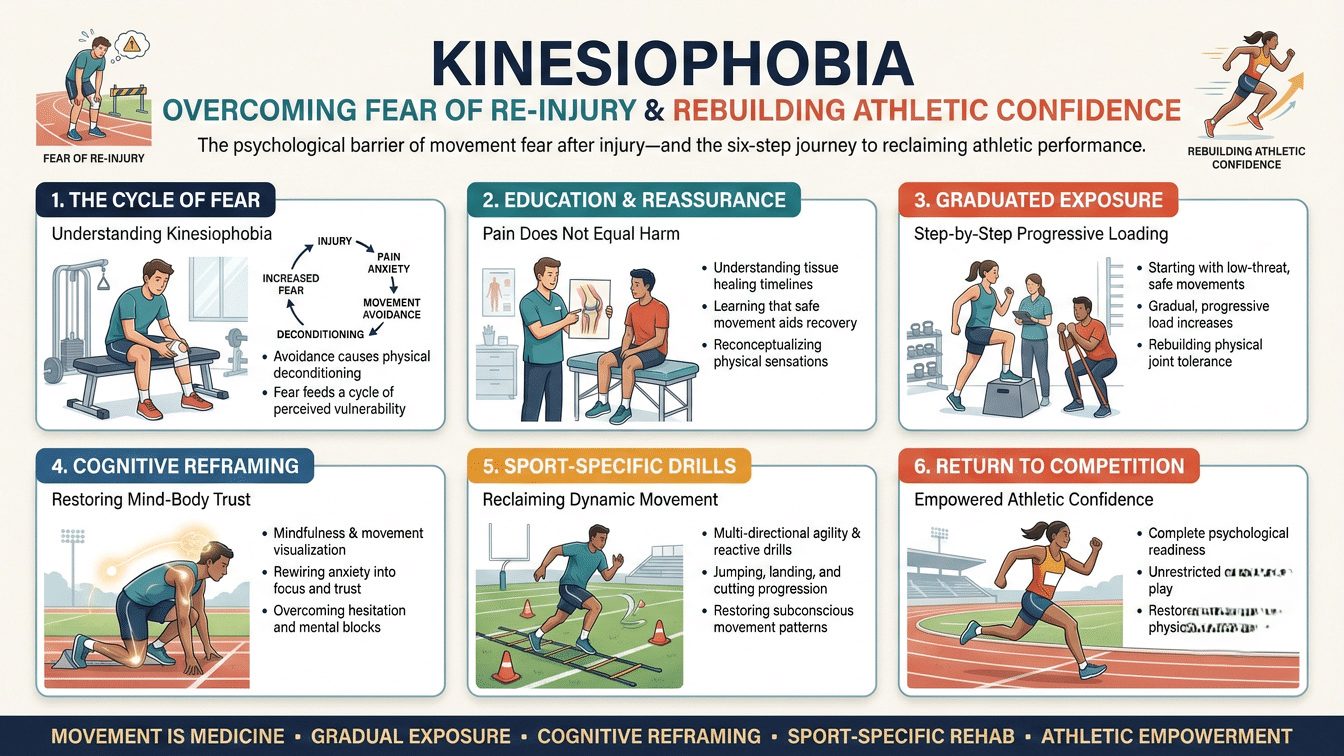
This is not necessarily due to physical limitations. It may be due to kinesiophobia. A fear of performing movements in case of pain or re-injury.
Psychological effects following a sports injury can occur. Anxiety, frustration, lack of confidence and fear of getting the same injury again may occur. These psychological effects may persist despite physical improvement.
It is important to understand the relationship between psychological readiness and physical recovery to allow a safe, individual return to sport.
This article will outline what fear of re-injury is, the Tampa Scale of Kinesiophobia, psychological recovery following sports injuries and how CBT may be used to support athletes to challenge unhelpful thinking and regain confidence.
What Is Kinesiophobia?
Kinesiophobia is an excessive fear of movement, due to a belief that it will cause you pain, re-injury or damage.
This word can be broken down into:
Kinesio – movement
Phobia – fear
Kinesiophobia may occur in sports rehabilitation following injury, surgery or painful experiences.
An example of kinesiophobia is patients avoiding running due to a previous ligament injury and fear of re-injuring their knee. Alternatively, patients may be reluctant to perform plyometric movements in rehab, despite being given permission to perform these movements.
Not all fear following injury should be considered abnormal. Being cautious during recovery is often appropriate, particularly if tissue healing is taking place.
However, fear may become a problem if it is excessive in relation to the individual’s current status, and prevents them from undertaking appropriate rehabilitation or daily activities.
Why Do Athletes Develop Fear of Re-Injury?
Kinesiophobia may develop due to:
1.Past painful injury
If an athlete suffers a ligament tear, muscle injury or dislocation, they may develop a fear of performing certain movements.
A football player may develop a fear of turning quickly if they have suffered a knee injury.
2.Possibility of re-operation
Some injuries may require surgery, and a lengthy period of rehabilitation.
Therefore, the possibility of having further surgery, missing training & repeating a period of rehabilitation may cause some anxiety.
3.Lower confidence in injured joint
Despite improvements in their physical condition, an athlete may feel that their injured joint is weaker and less reliable than previously.
This may affect what movements they are willing to make, especially at high speeds.
4.Pressure from others
An athlete may feel pressured by coaches, teammates, family members or competition times to return to sport.
Returning to sport prior to being ‘mentally ready’ may increase stress and hesitancy.
5.Existing psychological issues
Existing issues such as anxiety, stress, perfectionism and negative experiences within rehabilitation may cause different responses to injury.
6.Uncertainty
Not knowing when you will be able to run, jump and return to sport may cause fear. To reduce uncertainty good communication should occur between the athlete, orthopaedic surgeon, physio and mental health professionals.
Common Signs of Kinesiophobia After a Sports Injury
This may occur in many forms. Some athletes express these concerns and others may be reluctant to express them, believing that they should be confident.
Possible indicators may include:
- Avoiding movements associated with the injury
- Reluctance to jump, run and change direction
- Anxiety during sport specific rehabilitation
- Constantly concerned about getting re injured
- Avoidance of competition even if a good physical recovery has taken place
- Loss of confidence in the injured part of the body (knee, shoulder, ankle)
- Tense muscles prior to activity
- Comparison of current sport performance to pre injury
- Frustration at delayed return to sport
These symptoms in themselves do not necessarily mean that an athlete has a psychological disorder. They need to be placed into context with regard to their injury, physical recovery and individual experience.
What Is the Tampa Scale of Kinesiophobia (TSK)?
Tampa Scale of Kinesiophobia
This questionnaire measures the fear of re-injury associated with movement.
It allows health care professionals to gain an understanding of how much pain, injury or risk a patient associates with movement.
This scale is useful within research on musculoskeletal conditions and sporting injuries in rehabilitation.
What Does the Tampa Scale Measure?
Belief in:
- Harm from physical activity.
- Increased pain from physical movement.
- Avoiding physical activity due to risk.
- Physical weakness.
- Pain in relation to physical activity.
There are 17 questions in the original TSK. The questionnaire can be given using 4 point agreement scales. In some instances an alternative 11 question version of the TSK is used.
Depending on the version and scoring system used, scores can be interpreted in different ways.
Why Is TSK Assessment Useful?
It can help practitioners:
- Determine phobias related to movement
- Understand psychological barriers to rehabilitation
- Identify changes in phobia levels
- Identify patients who may require additional psychological support
- Support physical assessment of rehabilitation
- Please note that the TSK is not a diagnostic tool. It is a questionnaire. There is no cut-off score which independently indicates the presence of a psychological disorder, or whether an athlete can return to sport.
Physical Recovery vs Psychological Recovery After Sports Injury
An athlete’s physical and psychological recovery do not always progress at the same rate.
For example, an athlete may regain knee strength and range of motion but continue to experience anxiety during jumping or sudden direction changes.
| Physical Recovery | Psychological Recovery |
| Improved joint movement | Increased confidence in movement |
| Muscle strength restoration | Reduced fear of re-injury |
| Better balance and coordination | Improved trust in the injured body part |
| Completion of rehabilitation exercises | Confidence in performing sports-specific tasks |
| Improved physical performance | Psychological readiness for competition |
Both aspects are relevant to return-to-sport decision-making.
Physical improvement alone does not necessarily mean an athlete feels prepared for competitive sports. Similarly, feeling confident does not automatically mean the injured tissues are ready for unrestricted activity.
A comprehensive assessment considers both.
How Does Fear of Re-Injury Affect Athletic Performance?
1. Avoidance of Movement
To avoid pain, athletes may avoid certain movements, such as jumping, landing, sprinting and changing direction.
This could restrict the athletes ability to practice sport specific skills.
2. Poor Engagement with Rehabilitation
Some athletes may be reluctant to complete movements as part of an appropriately designed rehabilitation program.
This could restrict their progress in the rehab process.
3. Altered Movement Strategy
Due to fear, a protective strategy may develop in the athlete, causing stiffness or reduced load on the injured limb.
This can cause inefficient movement patterns and a reduction in confidence.
4. Anxiety
Athletes may become very anxious about making mistakes, re-injuring themselves or letting the team down. This can affect their focus and decision making while playing.
5. Reduced Confidence
If this individual was previously confident with this activity they may begin to doubt their physical capabilities. It may take time, correct rehabilitation and psychological support to help regain their confidence.
How Cognitive Behavioral Therapy (CBT) Can Help
Cognitive behavioral therapy (CBT) is a psychological intervention.
Within athletes with persistent movement related fears, CBT techniques can be used to help challenge negative thinking and encourage more balanced thinking.
The aim of this is not to ignore any real risk of injury, but to differentiate between appropriate precautions, and avoiding movement due to fear.
1.Identify negative thoughts:
During activity, an athlete may be thinking:
- An athlete may repeatedly think:
- “My knee will tear again if I run.”
- “I will never perform at my previous level.”
- “One wrong movement will cause another injury.”
- “I cannot trust my injured leg.”
CBT allows individuals to become aware of these thoughts and determine if they are realistic.
2. Challenging negative thoughts
Example:
Negative thought: ‘If I do this movement, it will re-injure me.’
Balanced thought: ‘It is important to consider my past injuries. ‘However, assessing my current capabilities, and recovery status can give us a better idea of what movements are appropriate.’
3. Gradual exposure
Gradually expose an individual to the feared activity.
An individual recovering from a knee injury may be gradually exposed to:
- Weight bearing
- Controlled strength training
- Balance and co-ordination tasks
- Supported landings
- Progressively difficult sport specific movements.
Progression through these activities should be guided by the rehab team depending on tissue healing, physical capability and medical clearance.
4. Reduce anxiety
Practicing breathing techniques, relaxation techniques and controlling attention could all help reduce anxiety.
This can be helpful when undertaking more difficult tasks or sport specific tasks.
5. Increasing self-efficacy
Realistic objectives can be set in rehabilitation, so that people can see progress.
People may want to gain functional improvements in smaller steps, rather than just returning to sport.
Practical Ways to Rebuild Athletic Confidence After Injury
Psychological preparedness can be improved by appropriate physical rehabilitation, good communication and personal coping strategies.
Small achievable goals
Break your rehabilitation down into small goals
Examples include:
- Strengthening exercises
- Improved balance
- Controlled landings
- Increased running capacity
- Returning to sport specific skills (if cleared)
- Understanding how you are progressing
Understanding why exercises are being performed can help reduce anxiety.
Ask your Physiotherapist to explain why you are doing the exercises at each stage of rehabilitation.
Avoid Comparing Your Recovery With Other Athletes
Do not compare your progress with that of others
As you may have different injuries, surgery and rehabilitation requirements, your rehabilitation will be unique.
Comparison with other people may cause pressure.
Communication of concerns
If there are movements you are concerned about, communicate this to your physiotherapist/doctor.
This will help the rehab team understand if further investigation/gradual introduction is required with certain activities.
Recognize Progress Beyond Competition
Improvements in balance, strength, coordination and everyday movement are meaningful milestones.
Confidence can develop as athletes become more comfortable with appropriately selected activities.
Return to Sport: Is Physical Fitness Enough?
Consideration must be given to physical, functional and psychological factors.
Despite returning to full strength, patients may be unsure about returning to sport.
Factors to consider include:
- Pain
- Range of movement
- Strength
- Balance
- Landing/jump technique
- Ability to perform sport specific movements
- Psychological readiness
- Type of sport
Psychological testing, such as the ACL-Return to Sport after Injury (ACL-RSI) scale may be appropriate during the rehabilitation phase following some ACL injuries.
Both the TSK and ACL-RSI test different factors. It is important that neither test is used on its own to determine whether an athlete can return to play.
Decisions regarding return to sport should be made by consideration of the individual’s case in conjunction with the managing orthopaedic team and rehabilitation professional(s).
When Should an Athlete Consult a Mental Health Professional?
It can be helpful to get some support if you are having any psychological difficulties affecting your recovery.
Consider seeing a professional with psychological expertise if you are experiencing:
- Constant feelings of fear preventing you taking part in recovery
- Very high levels of anxiety before participating in sport/physical activity
- Intrusive thoughts about the injury
- Difficulties sleeping due to worries about the injury
- Persistent low mood or lack of interest in sport and other activities
- Difficulties coping with changes in sporting identity/role
- Continued fear even after physical recovery
A psychiatrist or clinical psychologist will be able to identify issues of concern and discuss appropriate psychological treatment.
Conclusion
Psychological factors are important to consider within the rehabilitation process.
Athletes may be fearful of re-injury. This may result in them avoiding certain movements, or doubting their physical capabilities.
Knowledge of kinesiophobia, using screening tools such as the Tampa Scale of Kinesiophobia, and implementing CBT based interventions can help to understand psychological barriers.
Working together with orthopaedics, physiotherapy and psychological support can support the athlete with physical and psychological concerns.
Although it is important to return to sport in a timely manner, the aim should be to do so appropriately with support to optimally support physical function, and psychological preparedness.
Frequently Asked Questions (FAQs)
1. What is kinesiophobia?
Kinesiophobia refers to a high level of fear around movement due to fear of pain, injury or re-injury. This can impact a patient’s engagement in rehabilitation and confidence returning to sport.
2. Why am I scared of getting injured again?
A history of pain, negative associations with the injury, uncertainty around being physically capable and pressure to return to sport can cause re-injury fears. Psychological recovery can lag behind physical recovery.
3. What is the Tampa Scale for Kinesiophobia?
The Tampa Scale for Kinesiophobia is a questionnaire which allows health care professionals to better understand psychological barriers to movement.
4. Can CBT help me with re-injury fears?
Yes, CBT may allow individuals to challenge their unhelpful thoughts, create balanced cognitions, reduce feelings of anxiety and gradually get back into the feared activity, when it is safe to do so.
5. Is kinesiophobia common following ACL surgery?
It is reasonable to be cautious following ACL surgery. If you are experiencing persistent kinesiophobia in a way that is affecting your rehabilitation or sport, further psychological and rehabilitative assessment may be beneficial.