Medically reviewed by: Dr. Neha Narula ,
[Qualification : – Dr. Neha believes lasting recovery begins where medical science meets consistent, compassionate follow-up ],
[Specialty : – Head of Physiotherapy & Rehabilitation • 10+ years of experience ]
[Registration No : – IAP-31212 ]
[Clinic: StepUp Joints, Lajpat Nagar, South Delhi ]
Last reviewed: [31-10-2026]
Doctor’s Statement
Reviewed by DR. NEHA NARULA (PT) — Head of Physiotherapy & Rehabilitation • 10+ years of experience
Knee pain when using stairs may not be an indication of major damage to the knee. It can be due to increased forces acting on the patella, decreased strength, stiffness, irritation to the tendons or a recent change in activity.
It is important to not ignore any long term symptoms, but also not to attempt to self diagnose. A thorough assessment of your knee movement, strength, gait, balance and medical history will help determine if some physiotherapy rehab or a medical review could be indicated.
Exercise should be done slowly and should be comfortable. Some mild muscle ache can be expected when beginning a new exercise programme, but if you are experiencing any sharp pain, increased pain, swelling, catching or instability then this should not be ignored.
— Dr. Neha Narula (PT), Head of Physiotherapy and Rehabilitation, StepUp Joints
Summary
Pain in the knees when walking up or down the stairs, standing up from a chair, squatting or walking uphill is a common problem. In some cases people may also experience discomfort when walking down the stairs.
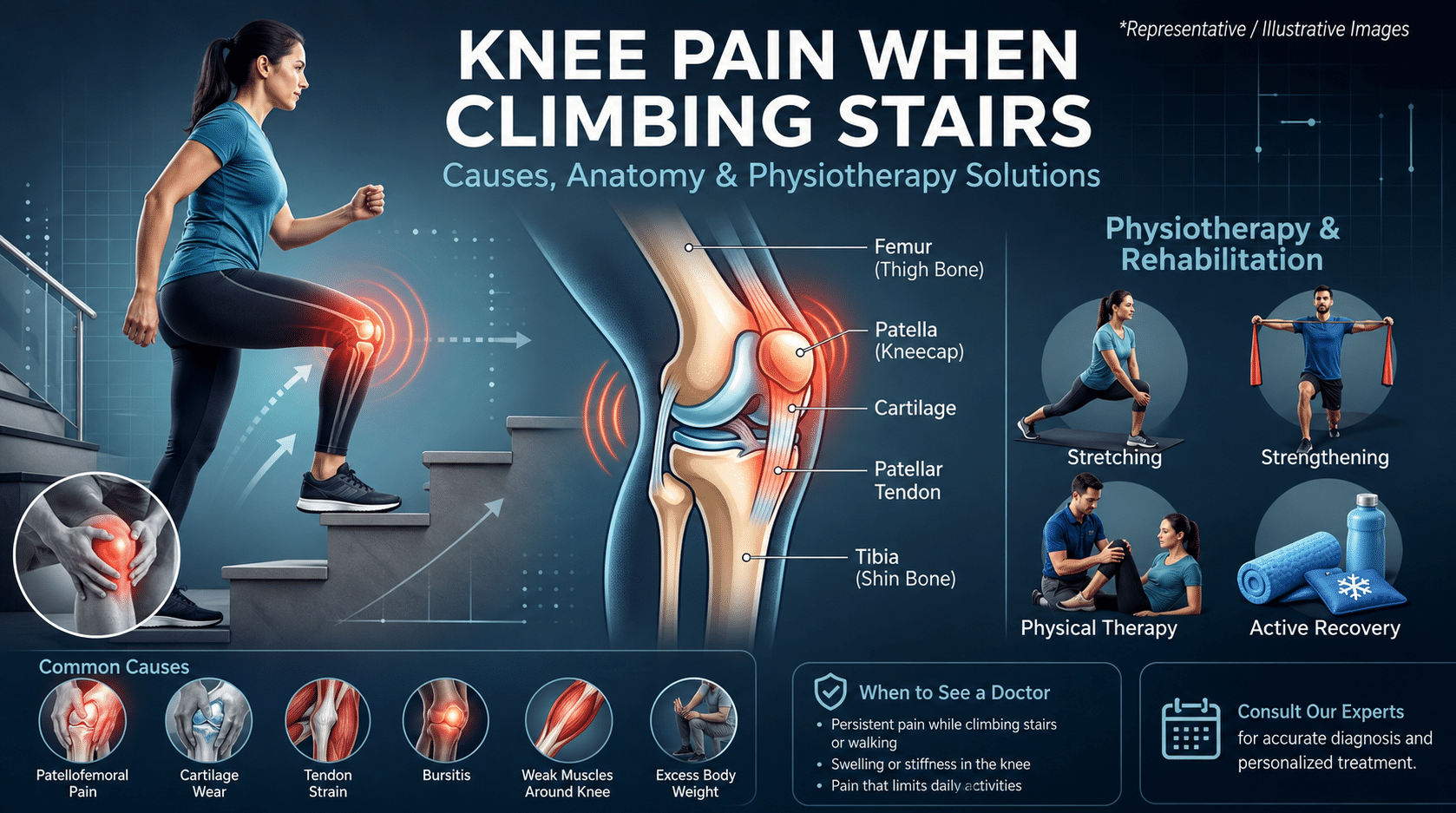
There are a number of reasons why you may be experiencing pain in your knees when using the stairs. This could be due to pain around your patella (kneecap), osteoarthritis, weak muscles, tendinitis or an injury. It is important to consider the symptoms and any other medical history and physical examination to identify what is most likely causing your symptoms.
The information provided in this article is for general knowledge only. It will give you some safe ways to manage your symptoms, and when to seek medical/physio advice. We recommend that you always seek individualized advice from a qualified healthcare professional.
Why Does Your Knee Hurt When Climbing Stairs?
Taking the stairs will cause the knee joint to work harder. This is due to the quadriceps, hip and calf muscles helping to help control your weight while the knee bends and straightens.
If there is any irritation in the kneecap, joint surfaces, tendons or muscles around the knee, taking the stairs can become painful. Going down stairs can be particularly uncomfortable as you rely on your quadriceps to help you move your body weight while your knee is bent.
Common causes include:
1. Patellofemoral pain
Pain caused by the kneecap. Pain can be exacerbated by activities such as using stairs, squatting, running, jumping, kneeling and prolonged periods of sitting with knees bent.
This type of pain can be related to a sudden increase in activity, decreased strength of your hip and knee muscles, increased training demands and movement patterns. A clinical assessment is needed to determine if this is the issue.
2. Knee osteoarthritis
A degenerative joint disease which affects the cartilage, bone and surrounding tissues. It can cause pain, stiffness and swelling in the knee. Making it difficult to walk, use stairs and get up from a chair.
Sometimes symptoms can be more prominent after rest or increased activity. Just because you are experiencing knee pain doesn’t mean you have osteoarthritis, however if symptoms are persisting then an assessment from a health professional would be needed.
Exercise is a key factor in managing osteoarthritis including strengthening exercises and being physically active.
3. Lack of strength in hips and knee
The quadriceps (front of thigh) helps control movement in the knee. The hip muscles help with balance, control of pelvis and leg alignment when walking and using stairs.
If there is a lack of strength and/or endurance it can cause difficulty when using stairs. This doesn’t necessarily mean everyone with knee pain will have a lack of strength however it can make a difference.
4. Tendon irritation
Tendons attach muscles to bone. The patellar tendon (below the kneecap) and quadriceps tendon (above the kneecap) can become painful due to repetitive jumping, running and squatting. Or due to a sudden increase in training.
This is sometimes referred to as a tendinopathy. Activities causing aggravation should be modified and a progressive strengthening programme implemented.
5. Meniscus/Ligament Injury
The meniscus are pieces of cartilage that help disperse load through the knee. Ligaments help provide stability.
Injuries can occur due to a fall, twisting, sport injury or accident. Symptoms can include sudden swelling, a popping/snap at the time of injury, difficulty extending your knee fully, locking and instability. These symptoms should be assessed by a medical professional quickly.
Why Is Going Downstairs More Painful?
When descending stairs the quadriceps muscles will contract and lengthen (eccentric muscle control).
This may cause pain around the knee cap or joint as the knee is flexed under load. Pain when descending stairs is common with patellofemoral pain however can also occur with osteoarthritis, tendon irritation or other knee problems.
Pain location and pattern can help give information but cannot substitute a clinical examination.
Knee Pain Location: What It May Suggest
Pain location alone cannot diagnose the cause of knee pain, but it can help you describe your symptoms during an assessment.
| Pain location | Possible association | When to seek advice |
| Front of knee or around the kneecap | Patellofemoral pain, quadriceps or patellar tendon irritation | If pain persists, worsens, or affects stairs, squatting, or daily activity |
| Inner side of knee | Osteoarthritis, meniscus irritation, ligament strain | If there is swelling, locking, instability, or persistent pain |
| Outer side of knee | IT band-related pain, lateral joint irritation, tendon problem | If pain continues despite activity modification |
| Back of knee | Hamstring irritation, joint swelling, or a Baker’s cyst | If swelling, restricted movement, or persistent discomfort develops |
| Deep inside the knee | Meniscus, ligament, or joint-related problem | Seek assessment if there is locking, giving way, or major swelling |
This information is general and does not replace a physical examination.
Why Knee Pain May Become More Common With Age
Pain in the knee when using stairs can happen at any age, but may become more common with age.
Muscle strength, balance and joint movement can slowly begin to decrease. Osteoarthritis is also more common with age. Previous injuries to the knee may also contribute.
Low activity levels can cause stiffness and decreased strength. Sudden increases in exercise can cause overload of unprepared tissues. Exercise that is specific to individual needs, such as strengthening muscles and aerobic exercise is still very important for many people with osteoarthritis.
How to Climb Stairs With Less Knee Pain
If you have mild knee pain, the following may help:
- Walk slowly and use the handrail.
- If your knee is painful take one at a time.
- When going upstairs lead with the less painful leg.
- When coming downstairs lead with the more painful leg.
- Try not to carry heavy weights when your symptoms are active.
- Ensure your knee is in line with your foot and do not let it cave in.
- If there is any acute pain, instability or increased swelling stop.
This is a general guide to modifying activity. If you are struggling to bear weight or feel that your knee is unstable then seek advice from a professional.
Heat or Ice for Knee Pain?
Depending on your situation both heat and cold can be used to help relieve symptoms.
Cold pack: A cold pack may be useful if the knee has become sore due to a recent minor injury or flare-up caused by activity. It can be applied for up to 20 minutes every 2-3 hours, making sure to place a towel between the ice and skin.
Heat: This may provide some comfort if there is a stiffness or chronic ache. If there is not much swelling then it may be helpful to apply heat. The NHS recommends using heat or ice, whichever you prefer. This should generally be used for up to 15 minutes with a protective barrier.
Do not apply heat to a hot, red and swollen knee.
Be cautious of applying heat or ice if you have poor sensation in your skin or circulation issues.
If you have a hot, red and swollen knee along with feeling unwell or having a temperature this should be seen urgently.
Activities to Modify During a Painful Flare-Up
During a flare up it can sometimes help to scale back activities which are causing repetitive pain. However generally it is better to remain active within your limits.
Activities which may need adjusting include:
- Deep/Heavy squats
- Jumping, downhill running or high impact workouts
- Deep lunges causing a sharp pain
- Kneeling directly onto hard surfaces
- Stair climbing with heavy bags
- Exerting yourself through sharp, increasing or unstable pain
Low impact activities could be a good alternative. Walking within your limits, using a stationary bike if it is comfortable, swimming or guided strengthening exercises. You shouldn’t perform any high intensity exercises during an acute flare up but once symptoms begin to ease you should gradually build up.
Seven-Day Knee Symptom Diary
Keeping a short diary can help you and your healthcare professional see any patterns to help plan the next steps.
Each day write down:
- The date and main task you did
- Pain score out of 10
- Front, inside, outside or behind
Swelling?
- Did it lock/catch/feel unstable?
- What made it better/worse?
- Did it wake you up?
Example:
Day 1: Climbed two flights of stairs. Pain 6/10 in front. No swelling. Pain got worse going downstairs. Rest helped.
Take this with you to your physiotherapy or medical appointment.
Can Pain Come From Somewhere Other Than the Knee?
Sometimes pain in or around your knee may also be referred from a different area.
Pain in your hip or back can cause referred pain into your knee. Problems in your foot or ankle can cause changes in your gait affecting your knee. This doesn’t mean there is damage to your knee but could be the reason you are not improving with knee specific exercises.
During your assessment a Physiotherapist may examine your hip, back, foot and ankle.
Can Physiotherapy help?
Physiotherapy can be considered if your knee is causing you pain, weakness, stiffness, poor balance or loading.
They can undertake an assessment of your knee for any problems with movement, swelling, muscle weakness, walking, balancing and functional movements. They will then create a plan of rehab to best suit your needs.
Depending on the cause of your issue, physiotherapy can include:
- Strengthening exercises for quadriceps and hips.
- Stretching and mobilization.
- Balance and control exercises.
- Load management and modifying activities.
- Returning gradually to walking, stairs, work or sport.
- Education on how to exercise safely, manage your efforts and monitor your symptoms.
The type of exercise will vary depending on your knee problem. A physiotherapist will create a plan based on your diagnosis, degree of pain, medical history and stage of recovery.
Five Practical Ways to Manage Knee Discomfort on Stairs
The following general advice may help whilst you organize your assessment. However it will not replace individualized medical advice:
1. Reduce activity rather than stop completely
If you are experiencing increased symptoms when climbing stairs try to reduce unnecessary stair climbing. Do not stop being active completely unless advised by a health care professional.
Some people find it useful to pace their activity and work up to increasing your tolerance.
2. Use the handrail
Using the handrail can help. Some people find it easier to lead with the less painful leg when going up stairs and the more painful leg when coming down stairs.
If you are feeling instability or difficulty putting weight through your knee please seek advice from a professional.
3. Wear suitable footwear
Wearing comfortable well fitting shoes with the correct support can help with everyday activities. It will not help with all causes of knee pain but can help with making walking and everyday activities more comfortable.
4. Don’t increase activity too quickly
Increasing your activity such as running, jumping, gym training, hiking or stair climbing too quickly can cause overload to your tissues.
If your symptoms came on after a change in activity try to reduce the aggravating activity and work back up slowly. A physiotherapist can help you to plan a safe return to activity.
5. Keep a symptom diary
Keeping a note of when your pain occurs, where you feel it, if there is any swelling and what makes your symptoms better or worse can help your doctor/physiotherapist to plan an appropriate assessment.
Weight Management and Knee Osteoarthritis
Managing your weight could help relieve knee pain and improve physical function if you have osteoarthritis of the knee and are overweight or obese. Losing any amount of weight can be helpful. A healthcare professional can help you to make realistic and sustainable changes to your lifestyle to suit your health and mobility.
Knee Exercises: What May Be Recommended?
Exercise should be done at a comfortable level where you feel in control. Some mild discomfort may happen during or shortly after exercising but if you experience any sudden pain, worsening pain, new swelling or instability then stop exercising and seek advice.
Exercises that may be considered include:
1.Quadriceps activation
Lie on your back with your legs straight. Squeeze the front of your thigh by gently pushing the back of your knee towards the floor. Hold for a few seconds and then release.
2.Straight leg raise
Lie on your back with one knee bent and one leg straight. Squeeze the thigh of the straight leg, lift the leg a small amount keeping your knee straight. Lower slowly.
3.Sit to stand
Sit on a firm chair with your feet flat on the floor. Slowly stand using both legs, then sit down with control. You may need to use a higher chair or armrests.
4.Mini squat/ wall slide
Stand with your back against a wall and feet slightly forward. Gently bend your knees within a comfortable range. Return to standing. Ensure your knees do not cave in and avoid any pain.
5.Hip strengthening
Exercises such as bridges, side lying hip lifts and clamshells may be used to strengthen your hip. This may be indicated if your knee symptoms are caused by weakness or poor control of your hip.
If you have recently had surgery or a major injury then follow the rehabilitation guidelines given to you by your healthcare team.
What Is a Normal Recovery Timeline?
Recovery will depend on the cause, severity, activity levels, and individual factors.
If the irritation is mild due to activity it can be improved by reducing your activity and building up gradually.
- Symptoms from osteoarthritis can come and go. Often self-management is required.
- Tendon issues may require regular loading over several weeks/months.
- Recovery will vary a lot after an injury or surgery so it is important to follow the advice of a professional.
- If you are not making any improvements after a reasonable period of altered activity then review.
Joint pain may worsen initially when starting therapeutic exercise. However, regular exercise can be beneficial for joints. It is advised by NICE to build up to a long term exercise plan to help reduce pain and improve function and quality of life.
What Happens During a Physiotherapy Assessment?
An assessment can include:
- A discussion about your symptoms including when you started the pain, any injury history, what movements make it worse and any relevant medical/surgical history.
- Testing of your movement including your knee range of movement, swelling, muscle strength, walking, balance, squatting and stairs.
- Testing of adjacent areas including hip, back, foot and ankle.
- Identifying what is causing your symptoms including weakness, stiffness, poor balance, activity demand or movement patterns.
- A rehabilitation plan will be made including individualized exercises, adapting your activity, providing education and setting up a review plan.
- If there are any symptoms indicating a structural injury, risk of fracture, infection or other medical issue, a physiotherapist may advise you to consult a medical/orthopaedic professional first.
When to See a Physiotherapist or Orthopaedic Doctor
Physiotherapy assessment may be appropriate if you have ongoing pain, stiffness, weakness and/or difficulty moving.
Orthopaedic assessment may be required if you have pain following a significant injury to your knee, large amounts of swelling, locking or instability, difficulty bearing weight or your symptoms aren’t improving with appropriate rehabilitation.
Some people will benefit from both medical assessment and physiotherapy rehabilitation.
How to Choose a Physiotherapist in Delhi
When choosing your Physiotherapist consider;
- Qualifications and Registration.
- Experience working with similar conditions to yours such as knee rehabilitation, osteoarthritis, sporting injuries or post-op.
- Individual assessment.
- Explanation of what exercises to do, what to be careful with and reviewing your progress.
- Working alongside your Doctor if required.
- Convenience of location, availability of appointments, cost and how often you will have treatment.
Do not choose a provider that promises guaranteed or fast results. Everyone will recover at their own pace.
Physiotherapy Services at StepUp Joints
StepUp Joints offers Orthopaedic and Rehabilitation Services in Lajpat Nagar, South Delhi. The clinic is led by Dr. Neha Narula (PT) – Head of Physiotherapy and Rehabilitation.
If you are experiencing Knee Pain, which is affecting your ability to climb stairs, walk, exercise or complete daily tasks, you can contact the clinic to see if you could benefit from an assessment. When contacting the clinic we would recommend mentioning if you have had any injury related pain, swelling, length of time symptoms have lasted and if your knee feels like it is giving way.
Conclusion
Knee pain when climbing or descending stairs may be due to patellofemoral pain, osteoarthritis, muscle weakness, tendon irritation or injury. Treatment will depend on the cause.
Activity modification, using a handrail, wearing supportive footwear and applying heat or ice if indicated can help relieve symptoms in some patients. If you continue to have pain, swelling, catching, instability or trouble putting weight through your knee then it is important to get this assessed.
A physiotherapist with appropriate qualifications can assess any restriction to movement and advise on an individual rehabilitation plan.
Frequently Asked Questions
1.Why is my knee causing me pain when going up and down stairs?
The knees are involved in more bending movement and muscle control when going up and down stairs. This means that any issues in the patella, joint, tendons or muscles may cause pain when going up and down stairs.
2.Should I visit a Physio for my knee pain?
If your knee pain is due to lack of strength, movement, balance or loading during activities then visiting a Physio may be beneficial to you. The Physio will treat the cause of the issue with strengthening, mobilization, activity modification and patient education.
3.Should I apply heat or cold therapy?
Cold may be beneficial if the knee pain is due to a recent minor injury or flare up with swelling. Heat may be more comfortable if experiencing stiffness with minimal swelling. Apply heat or cold with a towel between the skin. If there are any issues with circulation or sensation then seek advice.
4.Should I keep doing stairs?
Avoid doing any sharp or increasing pain. Try to avoid doing excess stairs. If required use the handrail. If pain persists or feeling unstable then seek assessment.
5.What exercises should I do?
There is no one specific exercise. Strengthening the quadriceps, straight leg raises, sit to stand exercises, supported squats and hip strengthening exercises may be considered following assessment.
For general information about knee pain, rehabilitation options, and when to seek assessment, explore the clinic’s educational resources.