Medically guided by Dr. Pulak Vatsya (MBBS, MS Orthopaedics, DNB, MNAMS)
Doctor’s Clinical Statement
“The choice between partial and total knee replacement should be based on the extent and location of arthritis, the condition of the knee’s supporting structures, alignment, and the patient’s functional needs. In appropriately selected patients, partial knee replacement can preserve healthy bone, cartilage, and ligaments, helping retain more of the knee’s natural anatomy and biomechanics, while total knee replacement may be more appropriate when arthritis is widespread. The goal is to choose the procedure that provides reliable pain relief and restores function while preserving healthy knee structures whenever clinically possible.”
Summary : –
Partial and total knee replacement are two surgical options for treating advanced knee arthritis, but they differ in how much of the natural knee they preserve. Partial knee replacement replaces only the damaged compartment and preserves healthy bone, cartilage, and ligaments in carefully selected patients. Total knee replacement replaces damaged surfaces across the main compartments and may suit patients with more widespread arthritis.
The choice depends on factors such as the location and severity of arthritis, ligament stability, knee alignment, activity level, and overall joint condition. With appropriate patient selection, partial knee replacement may help preserve more natural knee anatomy and biomechanics. Both procedures aim to reduce pain, improve mobility, restore function, and enhance quality of life. An orthopaedic specialist can assess the knee and recommend the most suitable approach for each patient.
Partial vs. Total Knee Replacement: What Is the Difference?
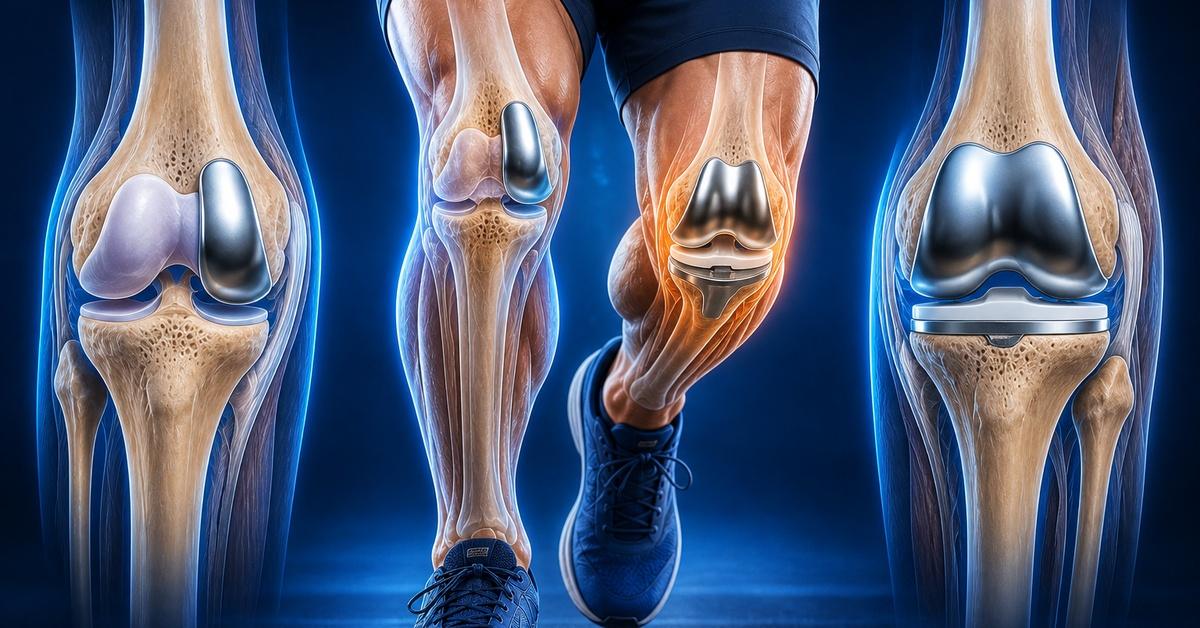
The knee has three main compartments: the medial compartment on the inner side, the lateral compartment on the outer side, and the patellofemoral compartment, where the kneecap meets the femur.
Osteoarthritis can sometimes affect just one compartment of the knee. In these cases, partial knee replacement, also called unicompartmental or unicondylar knee replacement, can replace the damaged area while preserving the healthy parts of the knee.
In this procedure, the surgeon extracts damaged parts of the compartment and replaces the damaged parts with corresponding implants, which also enables saving healthy cartilage and bones away from the site of surgery.
Though complete knee replacement implies replacement of all the damaged knee joint surfaces in major compartments, it is done in cases of more extensive arthritis.
Thus, partial and total knee replacements is decided based on the nature and degree of knee damage rather than just age or preference.
When Is Partial Knee Replacement Considered?
Partial knee replacement is generally considered for select patients who suffer from arthritis primarily affecting one compartment of the knee.
The surgeon considers several factors, such as the following:
- The presence of arthritis primarily limited to a single compartment
- The cartilage in other compartments being intact
- The integrity of the ligaments, especially that of the anterior cruciate ligament
- Proper alignment of the knee
- Normal range of motion
- Absence of any active inflammatory joint disease
Patients whose symptoms do not respond adequately to other forms of treatment may be considered for the procedure.
With the help of modern diagnostic techniques and examinations, surgeons determine the suitability of the disease pattern for partial knee replacement.
It must be noted that the presence of arthritis evident on an X-ray does not necessarily mean that partial knee replacement would be the right choice. The history and condition of the knee need to be taken into consideration too.
What Are the Potential Benefits of Partial Knee Replacement?
Partial knee replacement‘s biggest benefit is the fact that more of the original knee remains intact.
Due to the treatment being only performed on the defective knee area, the healthy bones and cartilage in the areas of the joint that are healthy will stay in place. Furthermore, the operation is likely to allow for more of the natural ligaments involved in the work of the knee remaining intact, creating more of a natural feeling when moving around on a daily basis.
One more important thing about partial knee surgery is that it is not as intensive as full knee surgery in most cases. Many patients with an appropriate diagnosis might have a smaller surgery and, as a result, go through a shorter rehabilitation process.
However, individual results quoted by different patients are very diverse.
When Is Total Knee Replacement More Appropriate?
Total knee replacement surgery may be suggested when the condition of arthritis has deteriorated across more than one region or when the knee joint’s structural or functional integrity has suffered substantial damage.
Upon consideration from the medical staff, patients may present with any of the following conditions:
- Several areas impacted by arthritis
- Gone-and-completely-depleted cartilage
- Knees that are visibly misshapen
- Knees that suffer from stiffness and lack of movement
- Looseness of ligament structures
Extensive injury that cannot be treated appropriately through partial implantation
Pain that significantly impairs quality of life
In those circumstances, an operation aimed at replacing the damaged parts of the joint will be able to contribute to the patient’s overall medical care.
This means that if the osteoarthritis or other injury is severe enough, it is likely that a total knee replacement will provide a better chance for success than making an attempt to preserve the area of the joint that has already sustained serious damage.
Partial vs. Total Knee Replacement Recovery
Patients frequently ask about the differences between partial and total knee replacement recovery time.
However, recovery can depend on numerous factors, like a patient’s age, physical state, methods for therapy, as well as other surgical techniques.
Patients with appropriate medical conditions can undergo partial knee replacement surgery with a quicker recovery due to the fact that fewer alterations have been done in the knee in comparison with total knee replacement surgery.
And even though total knee replacement is likely to lead to a great outcome, the recovery can be more complicated because of an extensive amount of joint that is replaced in the procedure.
Regardless of the method of treatment implemented in the process of recovery, it is vital to apply early mobilization, physiotherapy, controlling edema, progressive strengthening, and proper walking training.
The patients must be aware of the fact that recovery is not a race because it should take place in line with the healing, developing muscle control, knee functionality, and the recommendations of the medical specialists.
Preserving Natural Knee Biomechanics
One of the most important factors that influences the decision of surgeons to opt for partial knee replacement is the promise of having better natural knee biomechanics. The structure of a natural knee is made of ligaments, cartilage, and bones which work together to provide stability and facilitate control of movement. If knee bones are intact, certain movements may be retained. It is essential for some activities, such as walking, climbing stairs, sitting, and standing, getting in and out of a car, doing household chores, etc.
Partial knee replacement does not result in the recreation of the natural knee, but the use of the elements that were not damaged may result in a more natural knee for the right patient.
Thus, Partial Kneeling Replacement cannot be just about the size of an implant, as it also deals with retaining as much as possible of the natural structure of the knee of the patient.
What Is Unicondylar Knee Replacement?
Unicondylar knee replacement is the term often used to refer to partial knee replacement surgery.
In this surgical technique, only one compartment of the knee joint is replaced. For example, only patients suffering from isolated medial compartment arthritis can benefit from medial unicondylar knee replacement surgery.
Its biggest advantage is that only the affected compartment is replaced instead of also taking care of the healthy parts of the knee joint.
Patients scheduled to undergo Unicondylar knee replacement in Delhi should first consider choosing the right orthopaedic surgeon and clinic where they will undergo a procedure instead of opting for a particular procedure based on the information available online.
In a consultation, the patient will go through an examination, imaging, the assessment of ligament stability, the alignment evaluation, and the setting of surgical goals.
What Is Robotic Partial Knee Surgery?
Modern joint replacement surgery has come to be reliant on technology. Robotic partial knee surgery uses computer technology to assist the surgical team in performing bone preparation and placing the implant with maximum accuracy.
Depending on the particular robotic system and surgical method used, robotic surgery can help the surgeon:
- Determine the implant position
- Check knee alignment
- Balance the knee
- Get rid of exactly the right amount of bone tissue
- Use maximum efficiency in placing the implant
Robotic technology can assist but not replace the medical expertise of a surgeon. The most vital thing is to choose patients correctly. An advanced procedure cannot help if partial replacement is done in the case of unsuitable conditions.
Partial vs. Total Knee Replacement: Which One Is Better?
There is no single answer to this question.
In cases of isolated compartmental arthritis, where all ligaments are intact, alignment of the limb is good, and the other compartments of the knee are healthy, partial knee replacement may be preferred and will help to preserve more original tissue.
However, in the case of generalized arthritis or deformity, with ligamentous insufficiency or involvement of more than one compartment, total knee replacement should be performed.
Hence, Partial vs. Total Knee Replacement should always be assessed according to each case.
The best procedure is the one that correctly treats the individual’s pathology while saving healthy tissues when possible.
How Does Implant Longevity Compare?
Numerous individuals are worried about the longevity of knee replacement.
Both forms of knee replacement can provide effective pain relief and allow the knee to work better. Nevertheless, implant survival depends on a variety of factors, such as the patient’s age, activity level, design of the implant, method of surgery, varying degrees of alignment, weight of the body, development of arthritis or problems in the other knee.
In the case of partial knee replacement, there is an additional issue since some healthy compartments would be still functioning. In some cases, it means that arthritis might occur in these previously mentioned areas. In some cases, the partial implant can operate without any issues for a prolonged period of time.
Therefore, patients need to receive information regarding longevity and further treatments from their surgeon rather than focus on one number concerning the expected lifetime of the implant.
What Happens During the Decision-Making Process?
Evaluating the eligibility for knee replacement surgery generally consists of more than the X-ray process. The surgeon will assess various factors such as:
- Arthritis location: Is the arthritic condition localized to specific compartments or broader?
- Ligaments status: Are the ligaments performing their stabilizing functioning well?
- Movement range: Is the joint functioning within the normal range?
- Leg alignment: Is the deformity rectifiable?
- Pain impact: How does the pain affect one’s life (work and sleeping in particular)?
- Expectations: Which future activities would the patient like to return to?
- General health: Do any underlying medical conditions affect function during the procedure or post-surgery?
Rehabilitation After Knee Replacement
No matter if the patient is undergoing a partial knee replacement or a full knee replacement procedure, rehab plays a significant part in the success of the procedure.
A standard rehab program can help with:
- Minimization of the swelling
- Rehabilitation of the knee
- Building of the quadriceps strength
- Learning how to walk
- Balance improvement
- Improvement of daily activities
- Doctors tailor the rehabilitation program to each patient’s individual needs.
When you are looking into Partial vs total knee replacement recovery, there is no need for the patients to compare themselves to anyone else.
One patient might recover quickly while another may take a lot of time to complete the recovery process due to weaknesses, being overweight or being old.
What is more important is to follow the recommendations of the doctor and physiotherapist rather than focusing on the arbitrary timeline of recovery process.
Questions to Ask Your Orthopaedic Surgeon
Before agreeing to a knee replacement, it is important for the patient to ask questions such as:
Does arthritis affect only one compartment of my knee?
Do I qualify for a partial knee replacement?
Is total knee replacement a better solution for my knee?
Are my ligaments functioning normally?
What are the pros and cons of every procedure?
What will be the rehabilitation process after the operation?
Do I require robotic technology in my case?
What exercises can I do after my surgery?
Open discussion will explain any unanswered questions.
Conclusion
The selection process of either partial or total knee replacement is dependent on factors like anatomy of the patient, the pattern of arthritis, function of ligaments, alignment of the leg, symptoms, and life goals.
Partial vs. total knee replacement involves more than simply choosing between a less invasive and a more invasive procedure. The goal of partial replacement is to treat localized disease while leaving intact healthy tissues.
Partial knee replacement can preserve the normal anatomy of the knee and promote natural movement. Total knee replacement can help patients with advanced arthritis.
People thinking about Unicondylar knee replacement or robotic partial knee surgery need a complete orthopedic evaluation before proceeding.
Dr. Pulak Vatsya (MBBS, MS Orthopaedics, DNB, MNAMS) maintains that the best treatment is eventually one that meets the specific need of the patient. Thus, personalized assessment is the key to successful knee replacement.
StepUp Joints delivers specialized orthopedic evaluations to patients seeking advice on treatment of knee arthritis and replacement in Delhi.
Frequently Asked Questions (FAQs)
1. What’s the distinction between partial and total knee replacement?
Partial knee replacement involves treating arthritis that mainly affects just one compartment of the knee while keeping the compartments that are healthy intact. On the other hand, total knee replacement replaces the damaged surfaces in all the main compartments of the knee. Which procedure is the right one depends on the degree and position of arthritis, condition of ligaments, alignment as well as the function of the knee.
2. Who is a good candidate for partial knee replacement?
A patient is eligible for partial knee replacement only when the condition mostly affects just one compartment, the other compartments remain mostly healthy, the ligaments function well, and the knee has needed alignment and motion. A thorough clinical examination and imaging evaluation must precede the decision making process.
3. Is partial knee replacement better than total knee replacement?
No single procedure is better than the other in every situation. When arthritis affects only one area of the knee, partial knee replacement may benefit the patient because it preserves more of the knee’s natural structures. However, when arthritis affects multiple areas of the knee, total knee replacement may be a better option, especially when deformity, stiffness, or ligament damage is present.
4. Is recovery after partial knee replacement faster?
The recovery process may differ between partial and total knee replacement because partial knee replacement usually constitutes a less invasive procedure. Certain individuals may return to their day-to-day life sooner than others. Still, recovery may vary depending on underlying factors including age, overall health, rehabilitation, and the severity of the knee condition.
5. What is unicondylar knee surgery?
Unicondylar knee surgery is a synonym for partial knee replacement, which suggests replacing the damaged portions of the joint as opposed to changing the whole knee.
StepUp Joints – Location & Appointment Information
Clinic: StepUp Joints, 1st Floor, 17-A Ring Road, Vikram Vihar, Lajpat Nagar 4, New Delhi 110024
OPD Timings: Monday – Saturday: 9:00 AM – 9:00 PM
Direct Call: +91-7042787560
Patients seeking assessment for acute fractures, sports injuries or other orthopaedic concerns can contact the clinic to enquire about appointment availability.