Doctor’s Clinical Perspective
Medically guided Dr. Naman Wahal, MBBS, MS Orthopaedics Rotator cuff tears can cause persistent shoulder pain, weakness, and difficulty with daily activities. As an orthopaedic specialist, my focus is on accurate diagnosis, appropriate treatment, and personalized rehabilitation to help patients regain shoulder strength, mobility, and function.
Summary
A torn rotator cuff can make everyday tasks painful and difficult. When conservative treatments fail, Rotator Cuff Repair Surgery in Delhi—expertly performed using advanced arthroscopic techniques by specialists like Dr. Naman Wahal—restores shoulder strength, mobility, and a pain-free lifestyle.
What Exactly Is Rotator Cuff Repair Surgery?
Before proceeding to the treatment options, let’s briefly discuss the anatomy of the human shoulder. Our rotator cuff is a group of 4 muscles and their associated tendons that form a structure around the shoulder joint. Their primary function is to provide a stable connection between the humerus (upper arm bone) and deltoid muscles while allowing a wide range of motion.
However, due to various incidents such as injuries, overloads during sports activities or even prolonged period of time – the individual’s rotator cuff tendons might experience. As a result, the muscles in the damaged area become unable to provide sufficient mobility and stability.
The Rotator Cuff Repair Surgery in Delhi is a procedure, during which a qualified medical professional will reattach the torn tendon to the upper arm bone.
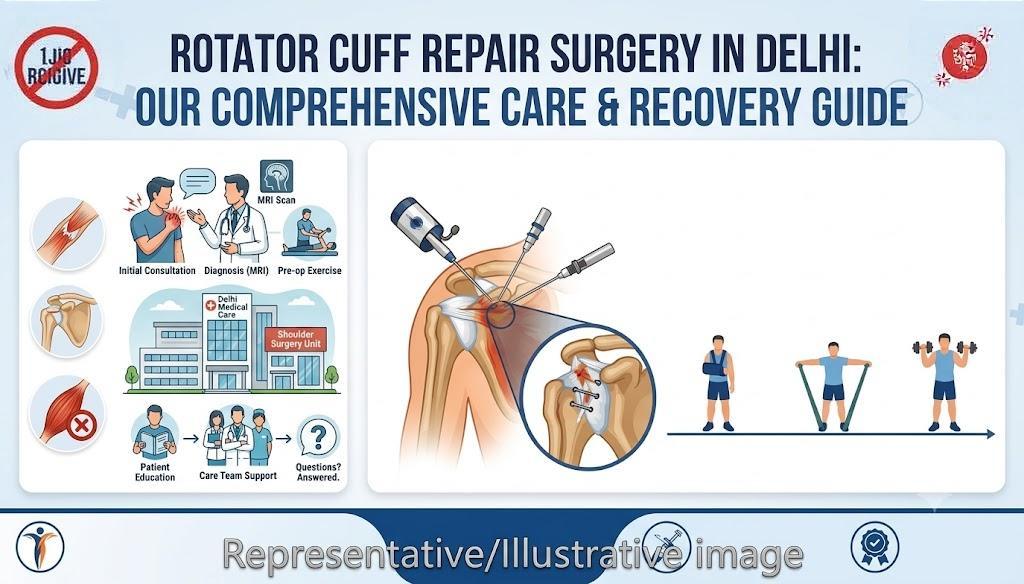
Thanks to the modern techniques and equipment, it is now possible to perform the repair using minimally invasive methods. During the operation, the surgeon will make several small incisions in the patient’s shoulder in order to access the damaged tissue. A special instrument called an arthroscope is used to visualize the interior of the joint and perform the actual repair with micro-surgical instruments. As a result, the patient will experience less post-operative discomfort and faster healing compared to the traditional open surgery.
When Is Rotator Cuff Surgery Actually Needed?
Here is a piece of good news for you – not all shoulder tears require you to go under anesthesia on an operating table. For minor strains and partial tears, physical therapy combined with anti-inflammatory medication and certain lifestyle modifications can do the trick.
However, there are some instances when physical therapy alone is not enough. We often get asked by patients about when the need for surgery arises. These are the instances when a
Rotator Cuff Repair Surgery in Delhi is recommended:
- Rotator Cuff Repair Surgery in Delhi is recommended for a complete thickness tear – in other words, if the tendon has ripped off completely from the bone, it will not reattach itself since it will naturally want to contract and shrink away.
- The second case where you may need to consider Rotator Cuff Repair Surgery in Delhi is if you have been going through rigorous physical therapy for the past 3-6 months. If your pain levels persist, and you are waking up at night because of pain, it is time to consider a surgical procedure.
- If you are not able to lift your arm away from your side, you need to get yourself evaluated for a prompt Rotator Cuff Repair Surgery in Delhi. Delay may lead to permanent loss of function of your shoulder muscles.
- If you are an active person or a sportsman, and you have suffered a massive tear due to some trauma, you need to get your torn tendon reattached by undergoing a Rotator Cuff Repair Surgery in Delhi as soon as possible.
- Sometimes a course of physical therapy combined with cortisone injections offers only temporary relief. In such a scenario, a definitive solution would be to get a Rotator Cuff Repair Surgery in Delhi.
- However, make sure that you consult a specialist with a sound experience in diagnosing and managing rotator cuff disorders, such as Dr. Naman Wahal. He will get you an MRI or ultrasound to evaluate whether you are a candidate for surgery.
What to Expect on the Day of Surgery
It should be evident that the prospect of any surgery can turn your stomach inside out. The knowledge of what to expect helps put the fear of any operation to rest. Here is what to expect during Rotator Cuff Repair Surgery in Delhi:
- Pre-Op Screening: Prior to the surgery, patients are subjected to a standard health check-up (blood tests, cardiac screening, and anesthesiology consult) to ensure their fitness for surgery.
- Anesthesia: Patients will be kept unaware by a standard combination of a regional nerve block anesthesia and the lightest possible form of general anesthesia.
- The Procedure: Using an arthroscopic approach, Doctor Naman Wahal will clean up the frayed edges of the rotator cuff and reattach the injured tendon to the underlying bone with special bio-compatible suture anchors.
- Post-Op Recovery: After waking up from the anesthesia, the patient will spend some time in the post-anesthesia care unit before being discharged for home or to the hospital for a short observation if complications arise.
The Ultimate Recovery Guide: Your Roadmap Back to Action
The rehabilitation period plays a significant role in the healing process. Since the tendons need to heal and fuse firmly with the bones, the post-surgery recovery in case of Rotator Cuff Repair in Delhi takes 4 – 6 months to regain full range of motion or ability to do moderate exercises and even 1 year for strenuous activities.
The first six weeks following the operation are vital for the healing process and thus, the doctor recommends a series of specific shoulder rehabilitation procedures.
Protection and Immobilization (Weeks 1-6)
The patient has to wear a shoulder sling most of the time, even when sleeping. It is necessary to reduce stress on the repaired tissues.
Passive motion is introduced on the first post-surgery days to avoid frozen shoulder syndrome development and help the repaired muscles relax.
Progressive Motion and Mild Exercise (Weeks 6-12)
The sling is removed upon the doctor’s approval, and the patient is allowed to move their arm using the uninjured one for assistance.
This stage is vital to restore active motion and strengthen the repaired muscles.
Resistance Exercise and Gradual Return to Daily Activities (Months 3-6)
The patient is introduced to simple resistance training and advised to use light weights under the supervision of a physical therapist.
In addition, they can gradually return to performing day-to-day tasks, including driving a car (while being off pain medications) and working at a computer.
Gradual Resumption of Sports Activities (Months 6-12)
The patient can resume sports activities, heavy lifting, or any other strenuous exercises when their shoulder movement and strength are fully recovered to the pre-injury level.
By following the comprehensive post-surgery shoulder rehabilitation guidelines provided by the medical professional, the patient can ensure optimal healing and benefit from the money spent on Rotator Cuff Repair in Delhi.
Conclusion
If you are experiencing discomfort in your shoulders, it can make a person feel as if they are living in a prison of their own body. The way to escape this situation is to choose the best rotator cuff repair surgery in Delhi, India. Under the expert guidance of Delhi’s top orthopedic surgeon, Dr. Naman Wahal, his team of highly skilled professionals provides contemporary arthroscopic techniques and a personalized approach to the condition. This helps in repairing the damaged tissue well before it causes significant distress to the patient. It also ensures that they can quickly return to their regular activities and resume an active lifestyle without any discomfort.
Frequently Asked Questions (FAQs)
1. What is rotator cuff repair surgery?
Rotator cuff repair surgery is a procedure used to repair torn tendons in the shoulder. These tendons help keep the shoulder joint stable and allow you to lift and rotate your arm. Depending on the type and severity of the tear, surgery may be performed arthroscopically through small incisions or using an open surgical approach.
2. When is rotator cuff surgery needed?
Rotator cuff surgery may be recommended when a tendon tear causes persistent shoulder pain, weakness, or difficulty lifting the arm, especially when symptoms do not improve with physiotherapy, rest, and other nonsurgical treatments. Surgery may also be considered for large or acute tears, particularly after an injury. An orthopaedic specialist can assess the tear and recommend the most appropriate treatment based on the patient’s condition.
Q3. When should I consult a knee and hip specialist?
A person should consult a knee and hip specialist in the following conditions: Pain, swelling, stiffness, walking difficulties, or limited movement of the joints. One should seek immediate medical attention if one cannot bear the weight on the knee or hip, or if the knee or hip appears deformed. In addition, one should also consult a doctor if one has a hot, swollen knee or hip accompanied by fever.
Q4. What are the non-surgical options for treating knee pain?
The non-surgical options for treating knee pain include physiotherapy, altering activity, losing weight, and medications. Injections can also help in treating some types of knee pain. Meanwhile, knee surgery is usually required when the pain persists for a long time or when non-surgical options do not work.
Q5. Under what circumstances is knee replacement surgery required?
Knee replacement surgery is required when knee pain interferes with daily activities. Moreover, it is also required if there is severe pain in the knee or hip that does not improve with non-surgical treatment. In this case, an orthopaedic surgeon determines the appropriate course of treatment based on physical examination, movement tests, X-rays, and symptoms.
Disclaimer: This post is for educational and awareness purposes only. Please consult a doctor for personalized medical advice.