Medically reviewed by: Dr. Aditya Jain
Qualifications: [(MBBS, MS Orthopaedics, DNB, MNAMS) ] Trained at AIIMS New Delhi with advanced international fellowships in the UK, USA, and Switzerland,
Specialty: [ specializing in sports injuries, ACL reconstruction, and arthroscopic procedures.]
[Registration No : – 76740]
Clinic : – [StepUp Joints, Lajpat Nagar, South Delhi ]
Last reviewed: [21 – November -2026]
Doctor’s Statement – Dr. Aditya Jain
“A meniscus injury can affect knee stability, movement and the ability to participate in sports or everyday activities. Treatment decisions depend on the tear pattern, location, tissue quality, associated injuries and the patient’s functional requirements. Wherever clinically appropriate, preserving functional meniscal tissue is an important consideration because the meniscus plays a significant role in distributing loads and protecting the knee joint.”
Introduction: Why a Small Knee Injury Deserves Attention
Your knees can suffer injuries when you twist suddenly in football, land awkwardly after jumping or turn quickly in your exercise. You may feel some mild pain at first. Over the next few hours/ days you may develop swelling, stiffness and pain when bending the knee.
This may be due to a torn meniscus.
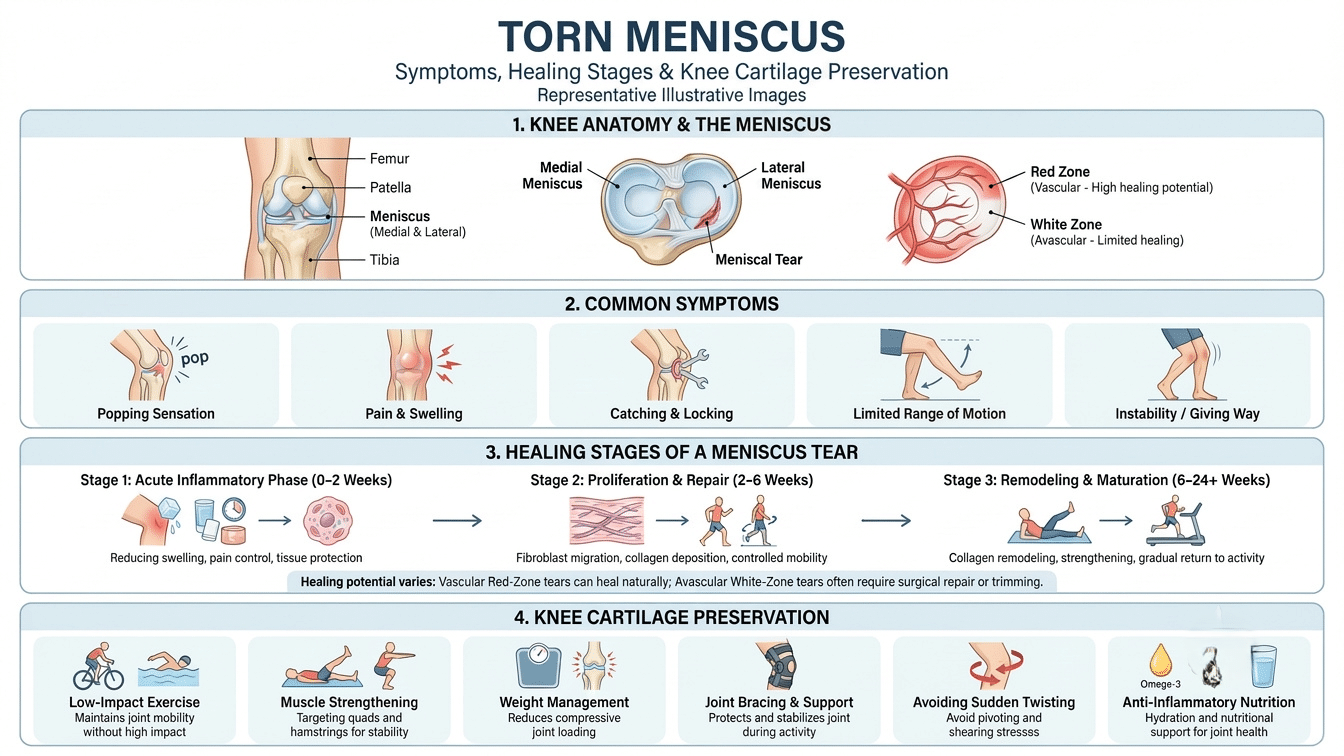
Menisci are special cartilage tissues that act as cushions between the thighbone and shinbone. There are 2 per knee that help to spread weight, absorb impact and provide stability.
Being aware of symptoms of a torn meniscus can help you understand if you need an assessment from a specialist orthopaedic clinician. A meniscus tear doesn’t always require surgery. Some can be managed with changes to activity and rehabilitation. Some tears can be repaired surgically.
The outside of the meniscus has a good blood supply compared to the inside.
1. What Is a Meniscus Tear?
A meniscal tear is a tear to either of the two C-shaped fibrocartilage structures within the knee.
There are two menisci, medial (inner) and lateral (outer).
They have several functions including:
- evenly distribute load through the joint.
- Absorb force when walking, running and jumping.
- Improve the congruency between the femur and tibia.
- Provide stability for the knee.
- Protect the surfaces of the joint from overload.
A meniscal tear can occur either acutely due to twisting injury or gradually due to degenerative changes of the meniscal tissue.
2. What Are the Common Meniscus Tear Symptoms?
Depending on the location, size, type of tear and other associated knee injuries you may experience different symptoms.
Symptoms of a common meniscus tear can include:
Pain : – Pain within the knee (either on the medial or lateral joint line) when twisting, squatting or bending.
Swelling : – Fluid builds up within the knee a few hours or days after the injury.
Stiffness : – Pain when bending or extending your knee.
Locking/Grinding : – A sensation that something is locking within your knee.
Locking : – If there has been a displaced tear sometimes you may feel physically locked within your knee and struggle to fully extend your leg.
Instability :- Your knee may feel unstable whilst walking, turning or changing direction.
Limited mobility : – You may struggle to do everyday tasks such as stairs, sitting cross-legged or squatting.
These are not always experienced by everyone. You may also feel similar symptoms with ligament injuries, cartilage damage and other knee problems. Therefore it cannot be confirmed that you have torn your meniscus just from experiencing symptoms.
3. What Causes a Torn Meniscus?
There are generally two ways that meniscus injuries can occur:
A. Traumatic Tear
Meniscus tears can often occur due to twisting or rotating movements when the knee is bent.
This can happen during:
- Sports (football/basketball)
- Suddenly changing direction
- Awkward landings
- Deep squatting/rotating
- Contact injuries
Traumatic tears can occur on their own or with an ACL (anterior cruciate ligament) injury.
B. Degenerative Tear
As we get older our menisci can become weaker over time. This means that a small movement such as getting up from a low chair or twisting whilst holding something can cause a tear. These tears are more common in middle aged and older people and can happen with osteoarthritis of the knee.
4. What Are the Different Types of Meniscus Tears?
Meniscus tears are classified according to their shape and location.
| Tear type | Description |
| Longitudinal tear | Runs along the length of the meniscus |
| Radial tear | Extends from the inner edge towards the outer region |
| Horizontal tear | Separates the meniscus into upper and lower layers |
| Bucket-handle tear | A displaced longitudinal tear that can cause locking |
| Flap tear | A partially detached fragment of meniscal tissue |
| Complex tear | Combines multiple tear patterns |
The tear pattern matters because it influences the possibility of repair, the stability of the remaining tissue and the treatment approach.
5. Red-Red, Red-White and White-White Zones: Why Tear Location Matters
One of the most important aspects of meniscal healing is the vascularity of the area damaged.
There are three zones often described within the meniscus. These have different healing potentials due to unequal vascularity.
Red-Red Zone
- This is the outer 1/3 of the meniscus.
- It has a relatively good blood supply.
- There is a greater potential for healing.
- Some tears may be amenable to repairing.
The tear pattern and tissue quality will determine if this is possible.
Red-White Zone
- This is the middle 1/3.
- Blood supply is less.
- There is an intermediate amount of healing potential. This can be varied.
- Some tears may be amenable to repair.
However the tear pattern and other factors will determine if this is done.
White-White Zone
- This is the inner 1/3.
- There is very little vascularity.
- There is generally a reduced spontaneous healing potential.
- Some symptomatic tears will not be amenable to conventional repair.
Selected unstable or symptomatic tissue may need to be trimmed following clinical assessment.
Comparison of Meniscus Vascular Zones
| Feature | Red-Red | Red-White | White-White |
| Location | Outer region | Middle region | Inner region |
| Blood supply | Good | Limited | Very limited |
| Healing potential | Relatively higher | Variable | Lower |
| Repair possibility | Often considered | Selected cases | Generally limited |
| Main consideration | Preserve and repair where suitable | Individual assessment | Tear stability and symptoms |
Important: A tear’s location alone does not determine treatment. Age, activity level, tear pattern, tissue quality, associated injuries and existing arthritis must also be considered.
6. What Are the Healing Stages of a Meniscus Tear?
There is no set time frame for recovering from meniscus damage. It will depend on whether the injury is managed conservatively or by meniscus repair or partial meniscectomy.
Stage 1: Injury
Pain and swelling can occur immediately following injury.
You will be advised to:
- Avoid any activity that makes your knee painful
- Apply a frozen pack (wrapped in a towel) to the area for short periods of time
- Keep your leg elevated when at rest
- Compression
- Seek medical advice if symptoms are severe.
Stage 2: Diagnosis
The next stage is to identify where and what sort of tear there is. You may be referred to a specialist who will advise you to have:
- A clinical examination
- MRI scan (if required)
- Assess any ligament damage
- Assess cartilage and arthritis in the knee.
- Depending on the findings, you may need any or all of the following treatments:
- Rehabilitation.
- Activity modification.
- Surgery.
Stage 3: Rehabilitation
Once a treatment plan has been decided, you may begin rehabilitation exercises to help improve:
- Range of motion in the knee
- Reduce swelling
- Restore strength into the quadriceps
- Improve balance and muscle control
- Gradually increase your activities.
Stage 4: Functionality
At this stage you will work on getting back to doing activities such as walking, stairs, running and sport. High impact activity should only be undertaken once you have returned to full functionality and received the all clear from medical staff.
7. Meniscus Repair vs Partial Meniscectomy: What Is the Difference?
Meniscus repair and partial meniscectomy are common procedures.
Both can be performed using knee arthroscopy. However, the aims of these procedures differ:
A. Meniscus Repair
This procedure involves re-attaching the torn meniscus tissue with special suture/fixation devices.
Aims:
- Retain meniscus tissue.
- Allow a biological repair of the tear.
- Maintain shock absorbing properties.
- Help protect the knee joint.
- Some tears with good healing potential may be repaired including certain longitudinal tears at the periphery of the meniscus.
Rehabilitation time is usually longer than for partial meniscectomy. Depending on the type of repair and tear, weight bearing and flexion may be restricted.
B. Partial Meniscectomy
This is a surgical procedure where only damaged/unstable parts of the meniscus are removed.
Objectives:
- To remove the unstable parts
- To treat certain tears which are unlikely to heal
- To leave as much of healthy meniscal tissue as possible
Recovery:
The recovery period is usually quicker, but rehabilitation is still an important part to get your knee moving, strengthening and functioning properly.
Meniscus Repair vs Partial Meniscectomy
| Comparison | Meniscus Repair | Partial Meniscectomy |
| Procedure | Torn tissue is stitched | Damaged tissue is trimmed |
| Main aim | Preserve and heal tissue | Remove unstable tissue |
| Suitable tears | Selected repairable tears | Selected irreparable symptomatic tears |
| Blood supply | More favorable in repairable regions | Often considered for poorly healing unstable tears |
| Recovery | Generally longer | Generally shorter |
| Rehabilitation | Essential | Essential |
| Tissue preservation | Retains repaired meniscus | Some tissue is removed |
Neither procedure is appropriate for every patient. The choice requires an assessment of the individual tear and the condition of the knee joint.
8. Why Is Knee Cartilage Preservation Important?
The meniscus plays an important role in protecting the knee joint.
It spreads out the load through the joint, decreasing the pressure on the articular cartilage that covers the ends of the bones.
If a large amount of meniscal tissue is lost there may be less surface area to distribute pressure, increasing the stresses on the joint.
Therefore it is important to try and preserve as much functional meniscus tissue as possible.
In 2024, the American Academy of Orthopaedic Surgeons released a clinical practice guideline which states that “if surgery is indicated for an acute meniscal tear, preserve as much functional meniscal tissue as possible to reduce the risk of osteoarthritis.
This does not mean that all tears should be repaired, if the tear is unstable and cannot be repaired it will need to be managed differently.
9. How Is a Meniscus Tear Diagnosed?
This involves understanding the mechanism of injury, symptoms and physical examination findings.
Physical Examination
An orthopaedic specialist may perform the following examinations:
- Joint line pain
- Knee swelling
- Range of motion
- Knee stability
- McMurray test
- Thessaly test (as required).
These tests are then combined with the patient’s history to help make a diagnosis.
MRI Scan
MRI scans are commonly used to assess meniscal injuries. They provide detailed images of soft tissues.
They can help determine:
- Where the meniscus is torn
- How the meniscus has been torn
- Any displaced pieces of meniscus
- If there is an associated injury to the ACL or ligaments
- Other cartilage issues.
An X-ray will not show a torn meniscus but they can help find any bone problems or osteoarthritis.
10. What Are the Treatment Options for a Meniscus Tear?
Treatment will depend on the cause of injury, symptoms, type of tear, location and any joint problems.
Non Surgical Treatment
Certain types of meniscal tears can be treated without surgery.
Treatment may include;
Relative rest from causing pain by twisting movements, deep squatting and impact activities.
Physiotherapy – A structured physiotherapy programme can help increase your knee range of movement, strengthen your quadriceps and hip muscles and improve balance.
Medication – The appropriate medication may be advised having considered your medical history.
Increasing activity – Gradually increasing walking and other activities depending on your symptoms and functional recovery.
Surgical Management
Surgical options should be considered if there is appropriate anatomical pathology, chronic functional limitation or a displaced tear limiting knee movement.
Options include:
- Arthroscopic meniscal repair.
- Partial meniscectomy.
- Selective meniscal root repair.
Treatment should be determined by clinical assessment rather than MRI findings.
11. When Should You Consult an Orthopaedic Specialist?
You may need an assessment if you are experiencing:
- Persistent pain behind your knee
- Swelling following a twisting injury
- Recurring catching or locking
- Pain when bending or straightening the knee
- Instability with walking
- Difficulties returning to sport/exercise
If you are unable to put weight on your leg, pain when bending or straightening your knee, severe pain following an injury, or you have a red, swollen knee with a fever you should seek urgent medical attention.
Conclusion
This can cause issues with knee mobility, pain and sporting activities. Knowing symptoms of Meniscus Tear and knowing where the damage has occurred can help aid the correct assessment and treatment.
It can provide insight into the condition of the tear. The red-red, red-white and white-white regions of the meniscus have different vascular supplies and so can therefore heal differently.
It is important to consider meniscus preservation as it plays a part in the shock absorption and weight bearing capabilities of the knee.
An orthopaedic assessment can help identify any issues that may be causing pain, swelling, locking or limited range of motion in the knee.
Clinical Care: Dr. Aditya Jain, provides orthopaedic assessment and care for knee injuries, sporting injuries and joint related issues in New Delhi.
12. Frequently Asked Questions (FAQs)
1. What are the early symptoms?
Pain, swelling, stiffness and pain with twisting movements and bending. Some have a clicking or popping sensation.
2. Can the meniscus heal naturally?
Yes, some tears can heal. Certain tears in the vascular zone can have healing potential. Other tears can get better with rehab but will not fully heal.
3. What is the difference between the red-red zone and white-white zone?
The red-red zone is the outer part of the meniscus and has a reasonably good blood supply. The white-white zone is the inner part of the meniscus and has very poor blood supply, so less healing potential.
4. Is healing better than partial meniscectomy?
If the tear is suitable and has healing potential then repairing the meniscus can be beneficial to maintain the meniscus tissue. If the tissue is unstable and cannot be repaired then a partial meniscectomy could be considered. This would depend on your individual findings.
5. How long will I be off after meniscus surgery?
This would depend on the surgery carried out. According to the AAOS patient information you can expect to have around 3-6 months of rehab following a repair and 3-6 weeks following a partial meniscectomy. This is just a general guide.