Medically reviewed by : Dr. Neha Narula
[Qualification : Head of Physiotherapy & Rehabilitation • 10+ years of experience]
[Specialty: Consultant Psychiatrist at Fortis Escorts Hospital, New Delhi and StepUp Joints, Lajpat Nagar 4. With over 6 years of clinical experience ]
[Registration No : IAP-31212]
[Clinic: StepUp Joints, Lajpat Nagar, South Delhi ]
Last reviewed: [14 – November -2026]
Doctor’s Statement
Exercise selection for people with knee arthritis should consider their pain levels, joint mobility, muscle strength, balance and everyday activities. A gradual physiotherapy programme may include muscle-strengthening exercises, gentle movements and suitable low-impact activities. The exercises should be adjusted to the individual’s ability, with attention to technique and the knee’s response.
Dr. Neha Narula (PT)
Head of Physiotherapy & Rehabilitation, StepUp Joints
Introduction
Is your knee causing you pain when climbing stairs, sitting down or even walking for a short time? Simple everyday tasks may become difficult if your knee feels stiff, painful and unstable.
If you have arthritis in your knee movement can sometimes be uncomfortable which can cause you to decrease your levels of physical activity. This can cause your muscles to become weak and will make everyday activities even harder to complete. Often however complete rest is not the solution.
A suitable exercise plan can help strengthen the muscles around your knee and keep you mobile. Exercises to help reduce knee pain caused by arthritis will depend on the type of arthritis you have, your symptoms, overall health and current fitness levels.
This guide outlines simple exercises you can do at home, isometric exercises, exercises that may need adapting and how to stay safe. It also explains when it would be useful to have a physiotherapist assess you.
What Is Knee Arthritis?
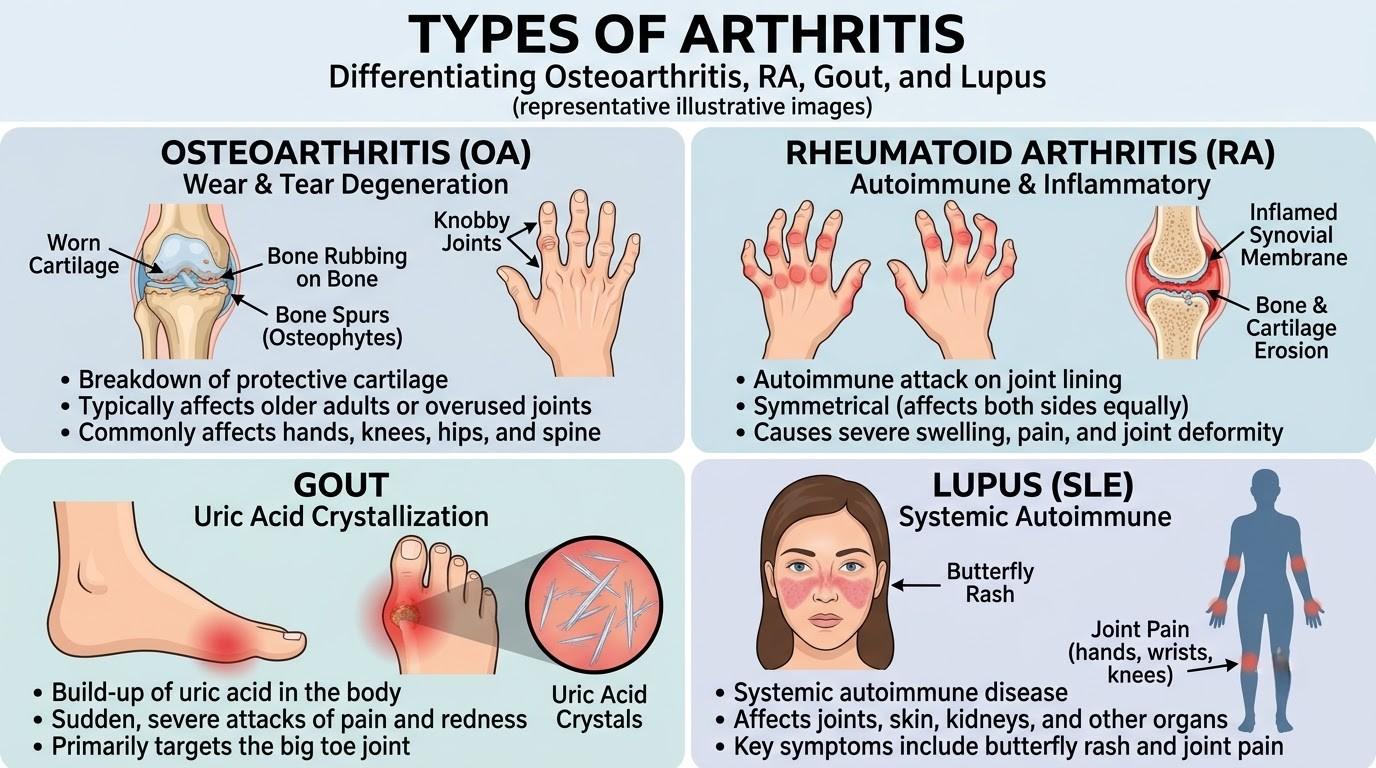
Knee arthritis encompasses a group of conditions affecting the knee joint. One of the most common types is osteoarthritis. This causes changes to the cartilage and bone of the joint causing pain, stiffness and limiting movement.
Other conditions such as rheumatoid arthritis can cause issues with the knee. This is an inflammatory autoimmune condition and may have a different treatment pathway.
Common symptoms include:
- Pain when walking, standing or climbing stairs.
- Pain and stiffness after sitting or resting.
- Swelling.
- Difficulty flexing or extending the leg.
- Walking shorter distances.
- Weakness.
Symptoms will vary between individuals. A clinical assessment can help discover what the underlying issue is and what activities would be appropriate.
Why Are Exercises Important for Knee Arthritis?
Exercise plays an important role in helping manage your knee osteoarthritis. Doing the right amount of physical activity will help keep the muscles strong, joints mobile and you fit.
The quadriceps (front of thigh), hip and hamstring muscles help with controlling movement of the lower limb. Strengthening these muscles will help with functional movements such as walking, standing and climbing stairs.
Your physio may provide you with:
- Strengthening exercises for the muscles around your knee.
- Stretching exercises to keep your knee moving within a comfortable range of motion.
- Low impact aerobic exercise to improve your cardio fitness.
- Balance exercises to improve your control.
- Functional exercises to practice sitting and standing.
Exercise will not reverse damage to your joint but will help you improve/keep your physical function.
7 Knee Pain Exercises for Arthritis at Home
Below are some examples of exercises that can be performed as part of your knee rehabilitation. Please choose exercises that you feel comfortable with based on your symptoms and fitness levels. Ideally talk to your physio about which exercises would be best for you.
1.Static Quadriceps Exercise (Quad Sets)
- This is an isometric exercise that will work the thigh muscles.
- Sit or lay with your leg straight and comfortable.
- Place a small rolled towel under your knee if required.
- Engage the muscles in the front of your thigh.
- Press the back of your knee gently into the towel/ support.
- Hold for around 5 seconds and release.
This will help to engage your quadriceps muscles and begin to strengthen them.
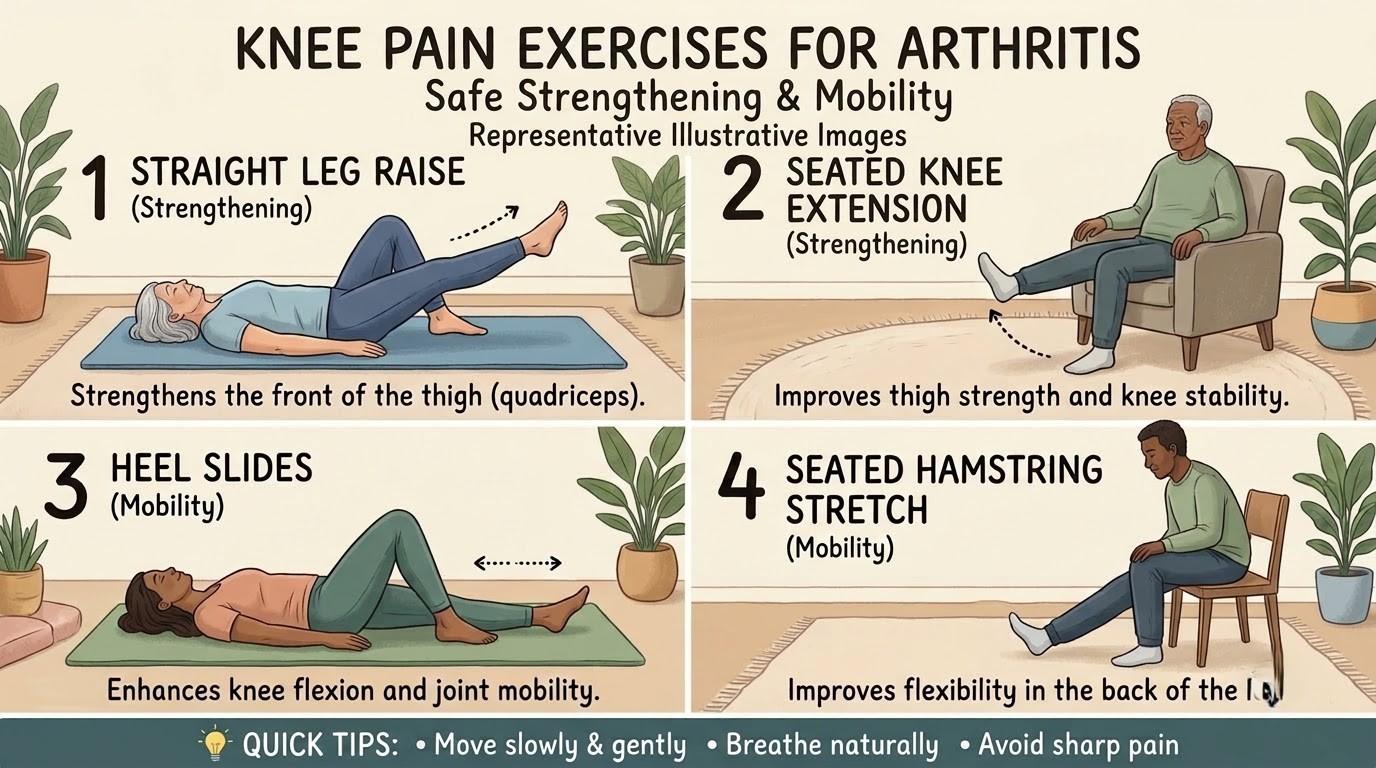
2.Straight Leg Raise
- This exercise will strengthen your quadriceps keeping your knee straight.
- Lay on your back with one knee bent and one leg straight.
- Engage your thigh muscles.
- Slowly lift your leg around 20-30cm or as far as feels comfortable.
- Hold and slowly lower.
- Repeat on the other side if required.
- This will help strengthen your thigh muscles.
3.Heel Slide
- This will help to bend and straighten your knee gently.
- Lay on your back with both legs straight.
- Slowly slide your heel towards your body.
- Only bend your knee as far as feels comfortable.
- Hold and slowly return your heel to the start point.
- Repeat without forcing.
- This will help keep your knee moving and comfortable.
4. Seated knee extension
Straighten your knee.
- Sit sitting up with one foot on the floor. Place one foot on the floor then slowly extend the second knee.
- Stop once you feel comfortable and hold. Then slowly lower your foot.
- Move your knee to strengthen your quads.
5. Chair assisted stand
Stand up practice.
- Sit on a firm stable chair and place your feet under you comfortably.
- Your feet should be around the width of your hips.
- Tilt forward with your upper body.
- Apply pressure to your feet and slowly stand up, using your hands or arms if needed.
- Controlled sit back down.
- Build your strength and coordination for everyday tasks.
6. Standing heel lifts
- Strengthen your calf muscles.
- Stand behind a sturdy chair or firm object.
- Stand with your feet comfortably apart.
- Slowly lift your heels, leave your toes on the ground.
- Hold briefly.
- Gently lower your heels.
- Build your strength in your lower legs to help with balance when standing and walking.
7. Low impact exercise (walking or cycling)
- Many people may be able to do low impact aerobic exercises.
- Start with a short time and a comfortable speed.
- Walk on level ground or cycle on a stationary bike with a comfortable seat height.
- Do not push your knee into any painful movements.
- Work up slowly to a level that you can tolerate. Take regular breaks.
- This will help improve your general fitness, mobility and activity levels.
Safe vs Exercises That May Need Modification
Not every exercise suits every person with knee arthritis. The movement, intensity, range and resistance may need to change depending on symptoms and physical ability.
| Exercise or activity | General consideration |
| Static quadriceps | Often suitable as an introductory strengthening exercise |
| Heel slides | Can help maintain comfortable knee movement |
| Straight leg raises | May be suitable when performed with good control |
| Supported sit-to-stand | Can be adjusted using a higher chair or hand support |
| Walking on a level surface | May be suitable at a comfortable pace |
| Deep squats | May need reduced depth or an alternative |
| Repeated high-impact jumping | May be unsuitable during painful symptoms or for some individuals |
| Running during a symptom flare | May need temporary modification |
| Heavy resistance exercises | Require appropriate load selection and technique |
Important: No exercise is automatically harmful for every person with arthritis. Some activities may be appropriate when symptoms are controlled and strength improves. A physiotherapist can help modify movements rather than unnecessarily restricting all physical activity.
How Often Should You Do Knee Pain Exercises for Arthritis?
It can be difficult to personalize training programmes. How often you do exercises, how many times you repeat them and how much resistance you use will depend on your pain levels, strength, mobility and any other health issues.
Your physiotherapist may advise you to:
- Start with low repetition.
- Use light movements first.
- Take breaks between strengthening exercises.
- Progressively increase repetitions.
- Be mindful of your symptoms.
Generally it is more beneficial to do regular sessions rather than a high intensity session. If you experience severe pain, large amounts of swelling or a decrease in mobility whilst doing the exercises you should stop doing that exercise and refer to a professional.
You may also feel some mild short-term discomfort when starting therapeutic exercises. However if you feel your pain significantly worsen you should not ignore this.
Exercises to Avoid or Modify During a Knee Pain Flare
Increased pain, swelling, heat and stiffness may occur. You may need to modify your exercise regime.
Try:
- Reducing the intensity of activities that cause your symptoms to flare-up.
- Don’t force yourself into deep knee bending if it causes an increase in pain.
- Modify high impact activities.
- Perform gentle movements within your range of movement.
- Ask your physio if gentle mobilization exercises are suitable for you.
- If you experience sudden increases in your knee swelling, heat or redness or have a fever then you should see a medical professional as soon as possible. Sudden painful swelling shouldn’t be assumed to be a regular flare up of arthritis.
The Role of Physiotherapy in Knee Arthritis
A physio will be able to assess your movement patterns, muscle strength and difficulties you may have with everyday activities.
You may receive a programme that includes:
- Exercises tailored to your symptoms, range of movement, muscle strength and activity needs.
- Exercises with resistance and repetition as appropriate for your physical ability.
- Learning how to do your exercises in the correct position and with control.
- Exercises to help improve your balance and functional activities such as walking, standing, turning and stairs.
- Your physio can also provide feedback on your symptoms, range of movement and how well you are tolerating your exercises and adjust your programme accordingly.
- Physiotherapy is not just about showing you exercises but also helps teach you how to stay active and adapt your activities
When Should You Consult a Doctor or Physiotherapist?
You should seek professional assessment if you have:
- Persistent or recurrent knee pain.
- Difficulties walking or climbing stairs.
- Swelling and stiffness that affects your everyday activities.
- Loss of movement in your knee joint.
- A sensation that your knee could give way.
- Pain prevents you from sleeping or doing normal activities.
If your knee suddenly becomes very warm, red and swollen, seek urgent medical advice. This should also be done if you have a temperature or cannot put any weight through your knee following an injury.
A health care professional may perform an assessment to determine your symptoms, medical history and physical function. Investigations such as imaging or blood tests may also be performed depending on your clinical presentation. This would be based on whether there was uncertainty around the diagnosis or suspicion of an inflammatory condition.
Conclusion
Regular exercise can help manage arthritis-related knee pain by improving muscle strength, flexibility and joint mobility. Choose gentle exercises according to your comfort and physical ability. If pain or swelling increases, consult an orthopaedic specialist or physiotherapist for appropriate guidance.
Frequently Asked Questions
1. What are some exercises that can be done?
Static quad sets, straight leg raises, heel slides, seated knee extensions, assisted sit to stand and low impact aerobic exercises may be performed depending on the individual’s condition. It depends on your symptoms and your physical capability.
2. Will walking help?
Many people with knee osteoarthritis will benefit from walking to stay active and keep fit. Start with walking a comfortable distance and at a comfortable pace. If symptoms get worse then adjust your exercise.
3. Are isometric exercises helpful?
Isometric exercises involve contracting the muscle without moving the joint much. Static quad sets are an example. These can be used as part of a rehabilitation programme if you find repetitive movements painful.
4. Should I exercise if my knee is sore?
You may feel some mild discomfort when starting an exercise programme. However if you experience any sharp pain or your symptoms worsen significantly then you should adjust/stop the exercise. Seek advice if symptoms continue.
5. Can you do squats if you have knee arthritis?
Some people may be able to do modified squats comfortably. Others may find their pain gets worse. You can ask a physio to assess how deep you can squat, what support and resistance you need or they may recommend an alternative exercise.