Medically reviewed by : Dr. Pulak Vatsya
[Qualification: MBBS, MS Orthopaedics, DNB, MNAMS]
[Specialty: robotic joint replacement, Direct Anterior Approach (DAA) hip surgery, and ACL reconstruction.]
[DMC Registration No : – 13678 ]
[Clinic: StepUp Joints, Lajpat Nagar, South Delhi]
Last reviewed: [14– November -2026]
Doctor’s Clinical Perspective
Dr. Pulak Vatsya – Orthopaedic Surgeon | Joint Replacement and Direct Anterior Approach (DAA) Hip Replacement
Dr. Pulak Vatsya’s clinical perspective for this educational article is that recovery after total hip replacement should be guided by the patient’s comfort, mobility, muscle function and individual surgical findings. The anterior approach may preserve certain muscle and tendon structures, but rehabilitation and postoperative precautions should still be personalized.
Introduction
Improve your ability to walk, sit, go up and down stairs and do everyday activities. Those with severe arthritis may find everyday activities very difficult. They can experience chronic pain and stiffness, this can affect their sleep and independence.
A total hip replacement is where damaged parts of the hip joint are replaced with artificial components. Rehabilitation is also an important part of recovery.
How long will I be recovering for?
This is a common question that many patients ask. The recovery time can depend on various factors such as the type of approach used during surgery, your general health, muscle strength prior to surgery, any comorbidities you may have and how well you recover during rehabilitation. A type of surgery that can be used to perform a total hip replacement is the Direct Anterior Approach (DAA). This is where the hip joint is accessed from the front of the body through an interval between muscles. This means that certain muscles/tendons do not need to be detached.
Some patients may be able to mobilize quicker however this does not mean they will completely recover within a few weeks. Knowing what to expect during the first 12 weeks can help you and your family to prepare for your rehabilitation and give you an idea of realistic milestones you can achieve.
What Is Total Hip Replacement?
Total Hip Replacement (Arthroplasty)
In a normal hip joint you have a ball and socket. This consists of the rounded head of the thigh bone (femur) fitting into the pelvis (acetabulum). If both surfaces are smooth with good cartilage they will move easily.
If a hip joint has been damaged secondary to severe Osteoarthritis, Rheumatoid Arthritis, Avascular Necrosis or certain types of hip injury then an orthopaedic surgeon may talk about joint replacement. This may be indicated if patients do not have any improvement of their pain and limitation following appropriate non-operative treatment.
The artificial joint usually has 4 components:
Acetabular component: This is an artificial socket which goes into the pelvis
Femoral stem: This is placed inside the thigh bone.
Femoral head: This is the ball component which attaches into the Femoral stem.
Liner: This is the bearing surface.
The design and type of fixation will depend on the patient anatomy, bone quality, activity levels and surgical plan.
What Is the Direct Anterior Approach (DAA)?
The Direct Anterior Approach.
This approach is considered muscle sparing as it uses the natural space between muscles.
Potential benefits:
Muscle sparing : – Certain muscles around the hip joint will not be detached. The natural space between muscles is used.
Early mobilization : – Some patients will be able to mobilize early using assistance to stand and walk.
Component positioning : – Good exposure for the surgeon to ensure components are positioned correctly. Correct imaging and techniques can be used.
Tailored rehab : – Patients will need gradual exercise, mobilization and regular follow ups.
There are several disadvantages to this approach. There may be a learning curve for surgeons. Specific complications can occur such as nerve damage to surrounding structures and wound complications.
The anatomy, body type, bone quality and previous hip surgery can affect whether this approach is suitable. It is important not to give the impression that DAA is a guaranteed way to accelerate recovery with no precautions.
Anterior vs Posterior Hip Replacement: What Is the Difference?
Both anterior and posterior approaches are established surgical methods for total hip replacement. They differ mainly in the route used to reach the hip joint.
| Feature | Direct Anterior Approach | Posterior Approach |
| Surgical access | Through the front of the hip | Through the back or side-back of the hip |
| Muscle interval | Uses an interval between muscles | Involves working through the posterior soft tissues |
| Muscle handling | Certain muscles are generally preserved | Posterior soft tissues are repaired according to technique |
| Early rehabilitation | May allow early mobilization in selected patients | Also allows early mobilization under an appropriate protocol |
| Precautions | Depend on the surgeon’s technique and patient factors | May include precautions related to hip flexion, adduction and rotation |
| Suitability | Depends on anatomy, health and surgical assessment | Depends on anatomy, health and surgical assessment |
Neither approach is automatically suitable for everyone. The surgeon considers the patient’s condition, anatomy, implant requirements and clinical circumstances before selecting a technique.
Hip Replacement Recovery: Week-by-Week Timeline
Both anterior and posterior approaches are established surgical methods for total hip replacement. They differ mainly in the route used to reach the hip joint.
| Feature | Direct Anterior Approach | Posterior Approach |
| Surgical access | Through the front of the hip | Through the back or side-back of the hip |
| Muscle interval | Uses an interval between muscles | Involves working through the posterior soft tissues |
| Muscle handling | Certain muscles are generally preserved | Posterior soft tissues are repaired according to technique |
| Early rehabilitation | May allow early mobilization in selected patients | Also allows early mobilization under an appropriate protocol |
| Precautions | Depend on the surgeon’s technique and patient factors | May include precautions related to hip flexion, adduction and rotation |
| Suitability | Depends on anatomy, health and surgical assessment | Depends on anatomy, health and surgical assessment |
Neither approach is automatically suitable for everyone. The surgeon considers the patient’s condition, anatomy, implant requirements and clinical circumstances before selecting a technique.
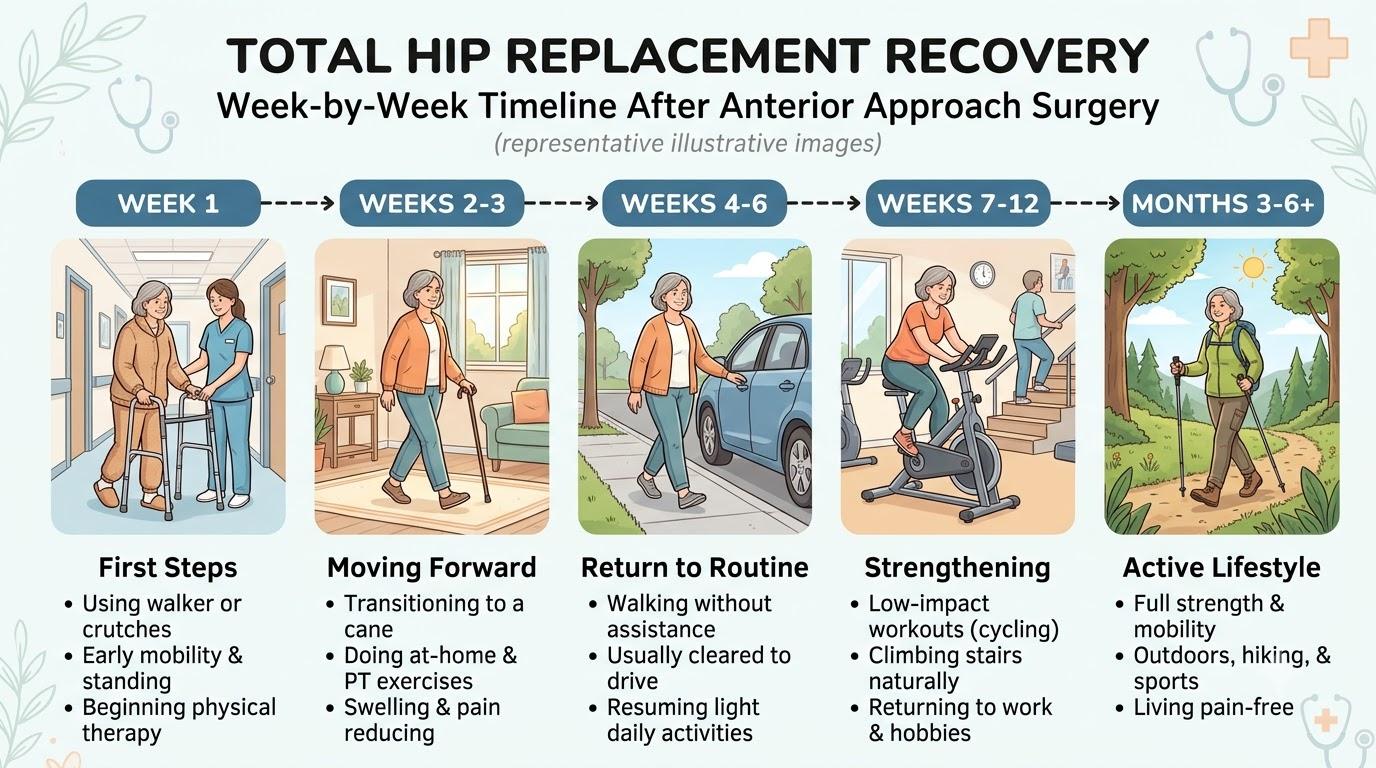
Hip Replacement Recovery: Week-by-Week Timeline
This is a general guideline and patients will progress at different rates. Patients may have additional procedures or underlying medical issues.
Week 1:
Focus is to mobilize safely. Pain management and wound management will also be an important part of this week.
Depending on your condition and advice given after surgery, you will begin to mobilize (stand and walk) using your walker or any aids recommended.
You may start to complete some exercises including:
- Ankle pumps
- Quadricep/Gluteus activation
- Stand with assistance and walk short distances.
- Transfer from bed to chair.
- Hip movements within your range.
Follow advice regarding weight bearing, wound management and taking medication to prevent clots.
Week 2:
Patients may begin to gain confidence with basic tasks.
- Walk short consistent distances.
- Improve walking pattern.
- Continue exercises.
- Sit and stand safely.
- Wound review.
Some patients may have their stitches/staples reviewed/removed depending on how they were closed and what advice your surgeon has given.
Weeks 3-4:
As pain and swelling has reduced, you may begin to become more independent.
Exercises you may complete include:
- Increase walking distance.
- Improve hip and thigh muscle activation.
- Controlled transfers.
- Improving balance with assistance.
- Continue light strengthening exercises.
Don’t stop using your walking aid, even if you are feeling better. Think about your balance, walking and safety.
Weeks 5-6:
Some patients may be able to complete more functional tasks and become more independent.
Exercises may include:
- Improving hip muscle strength.
- Increased standing control.
- Practice stairs safely.
- Improved walking endurance.
- Gradually increase functional exercises.
Not all patients will reach these aims by week 6. If patients have had additional procedures or their muscles are not recovering as quickly they may need a longer early rehab phase.
Weeks 7-8:
You may become more challenged with your exercises.
These may include:
- Resistance exercises
- Single leg balance with support.
- Longer walks
- Sit to stand in a controlled manner.
- Function exercises for daily living activities.
The goal is to improve your quality of movement and increase your confidence, without overloading your healing tissues.
Weeks 9-10: Advanced Functional Rehabilitation.
Certain patients will continue to strengthen and increase their endurance. The physio may assess your gait, hip strength, balance and functional abilities.
Progress at your own pace. If you are experiencing persistent pain, increased swelling or difficulty with walking please consult your treatment team.
Weeks 11-12: Functional Recovery Review.
Many patients will have progressed well by 12 weeks but may not be fully recovered. Your clinical team may assess;
- Hip range and mobility
- Muscle strength
- Gait
- Balance and independence
- Wound healing
- Returning to work and activities.
Some patients may need to continue to strengthen and rehabilitate beyond 3 months.
12-Week Hip Replacement Recovery Milestone Table
| Recovery period | Main rehabilitation focus | Possible functional milestone |
| Week 1 | Wound care and assisted mobility | Standing and short walks with support |
| Week 2 | Walking and daily activity practice | More comfortable transfers and short walks |
| Weeks 3–4 | Movement and basic strengthening | Increasing independence in selected activities |
| Weeks 5–6 | Strength and balance | Improved walking and stair practice |
| Weeks 7–8 | Endurance and functional control | Longer walks and progressive exercises |
| Weeks 9–10 | Advanced strengthening | Improved tolerance for daily activities |
| Weeks 11–12 | Functional assessment | Review of progress and future activity goals |
These milestones are examples, not guaranteed outcomes. The treating surgeon and physiotherapist should determine progression according to clinical findings.
Does the Anterior Approach Mean No Hip Precautions?
This is an important factor to consider with regard to the DAA hip.
Although some anterior approaches allow for increased movement of the hip joint compared to traditional precautions in some posterior approaches, you should not assume that there will be no precautions to follow.
Factors to take into account include:
- Technique used.
- Location and stability of implant.
- Bone quality and patient anatomy.
- Additional procedures carried out.
- Post-op protocol of surgeon.
Some patients may be advised not to fully extend their hip joint and externally rotate it at early stages of recovery. Others may have different restrictions.
It is always best to ask your surgeon about what movements you are allowed to do, any restrictions with lying or sitting and when to increase your activity.
Why Is Physiotherapy Important After Hip Replacement?
This will replace the damaged surfaces of the joint however will not immediately improve muscle strength, balance and endurance.
Physiotherapy can help improve function and may include:
Range of movement exercises:- This can help the patient start moving the hip and lower limb with comfort.
Strengthening exercises:- This can help strengthen muscles such as the quadriceps, glutes, hamstrings and hip stabilizers.
Gait exercises:- This can help improve balance, coordination and gait.
Balance exercises:- This can help improve control of the patient.
Functional exercises:- This can help the patient practice sitting, standing, stairs, getting into and out of bed.
The patient’s rehab will need to be individualized. Some exercises may not be suitable for certain patients.
Tips to Support Recovery at Home
You can do more of your daily activities by creating a safe environment.
Make sure you have everything you need to hand.
- Remove any loose rugs or hazards.
- Use walking aids as advised.
- Wear supportive non-slip footwear.
- Take your medications as prescribed.
- Eat healthily and eat a variety of foods including high protein foods.
- Drink plenty of fluids (unless told otherwise).
- Attend all of your review appointments.
- Don’t do more exercise than you usually would.
In the beginning your family/caregivers may be able to help you with shopping, cooking and housework.
Warning Signs That Need Medical Attention
There may be some pain, bruising and swelling following your operation. The following symptoms need to be reported.
Contact your medical team if you experience any of these symptoms:
- Increased redness, warmth or discharge from the incision site
- Fever and/or shivering
- Increased pain around the hip
- Swelling in the leg
- Pain/tenderness in the calf
- Ability to walk suddenly becomes difficult
If you suddenly have difficulty breathing, chest pain, dizziness or are coughing up blood this could be a sign of something serious such as a pulmonary embolism. Contact medical staff immediately.
Conclusion
Complete recovery after total hip replacement can be a lengthy process. It involves strengthening muscles, walking, balance and gaining confidence to perform daily activities.
A Direct Anterior Approach is a muscle sparing incision that allows some patients to mobilize sooner. However, rehabilitation will still be needed.
Understanding how long it may take for you to recover can help you know what you need to do during your recovery. This can help you take appropriate precautions and understand what level of function you can expect. Regular follow up and individualized rehabilitation is still an important part of your recovery.
Frequently Asked Questions
1. How long does recovery take?
Many patients will notice substantial improvement within their first 6-12 weeks. You will however need a few months to fully recover which will depend on your general health, muscle strength, operation and rehab.
2. Does anterior hip replacements have faster recovery times?
Some studies and guidelines have shown that it can provide benefits with faster functional recovery. This can vary and long term outcomes may be similar. This will depend on surgeons experience and individual patient requirements.
3. Can I walk straight after an anterior hip replacement?
Many patients will be able to stand and walk with assistance the same day/next day. This will depend on your surgeons advice and how you are feeling.
4. Are there any restrictions after having a DAA hip replacement?
This can vary. Some patients will have less restrictions than traditional methods but there may still be some restrictions. Always follow your surgeon’s guidelines.
5. When will I be able to use the stairs?
If you are medically stable you may be able to practise using stairs whilst in hospital. Whether you will be able to use them independently will depend on your strength, balance and home environment.