Medically reviewed by: Dr. Devender Bairwa,
[Qualification : – Trained at premier institutes including AIIMS, JIPMER and MAMC ]
[Specialty : – Dr. Bairwa has over 13 years of experience in Clinical Immunology and Rheumatology ]
[DMC Registration No : – 9133 ]
[Clinic: StepUp Joints, Lajpat Nagar, South Delhi]
Last reviewed: – [14 – November -2026]
Doctor’s Clinical Perspective
Dr. Devender Bairwa – Consultant, Rheumatology and Clinical Immunology
Dr. Devender Bairwa’s clinical perspective for this educational article is that joint pain and swelling should be assessed in the context of the patient’s overall health. The location of affected joints, duration of morning stiffness, pattern of symptoms and associated features such as fever, skin changes or fatigue can help guide further evaluation. Identifying the underlying condition is important because different forms of arthritis require different management approaches.
Introduction
Many people will suffer from stiffness in their fingers when they wake up. Other people might suffer with knee pain after walking or sudden pain and swelling in one of their toes overnight. There are many possible reasons for joint pain and there are different types of arthritis that can affect your body.
There are different types of arthritis with different causes. Some are gradual and some are sudden. Osteoarthritis affects joint cartilage and tissues. Rheumatoid arthritis and Lupus are caused by your immune system. Gout is caused by crystal build up in joints.
Understanding your symptoms can help you know if you need to seek medical attention. If you have stiffness in your joints when you wake up but it does not last long (a few minutes) this could suggest a different problem than having stiffness in your joints when you wake up for longer periods of time and swollen finger joints. However, you cannot determine the type of arthritis you have by looking at your symptoms.
What Is Arthritis?
Arthritis is a general term used to describe conditions affecting the joints. These may cause pain, swelling, stiffness, soreness and reduced movement of the joints.
Joints are where two or more bones meet. The joints are moved by cartilage, synovial fluid, ligaments and surrounding tissues. These parts can be affected in various ways depending on the nature of the disease.
There are many different types of arthritis including:
- Osteoarthritis (OA)
- Rheumatoid arthritis (RA)
- Gout
- Psoriatic arthritis
- Lupus (inflammatory joint disease)
- Ankylosing spondylitis
- Septic arthritis (infection caused)
Each of the four below will have a different underlying mechanism. Whilst it can be useful to understand these differences, medical assessment is required to determine your specific reason for symptoms.
Four Commonly Discussed Types of Arthritis
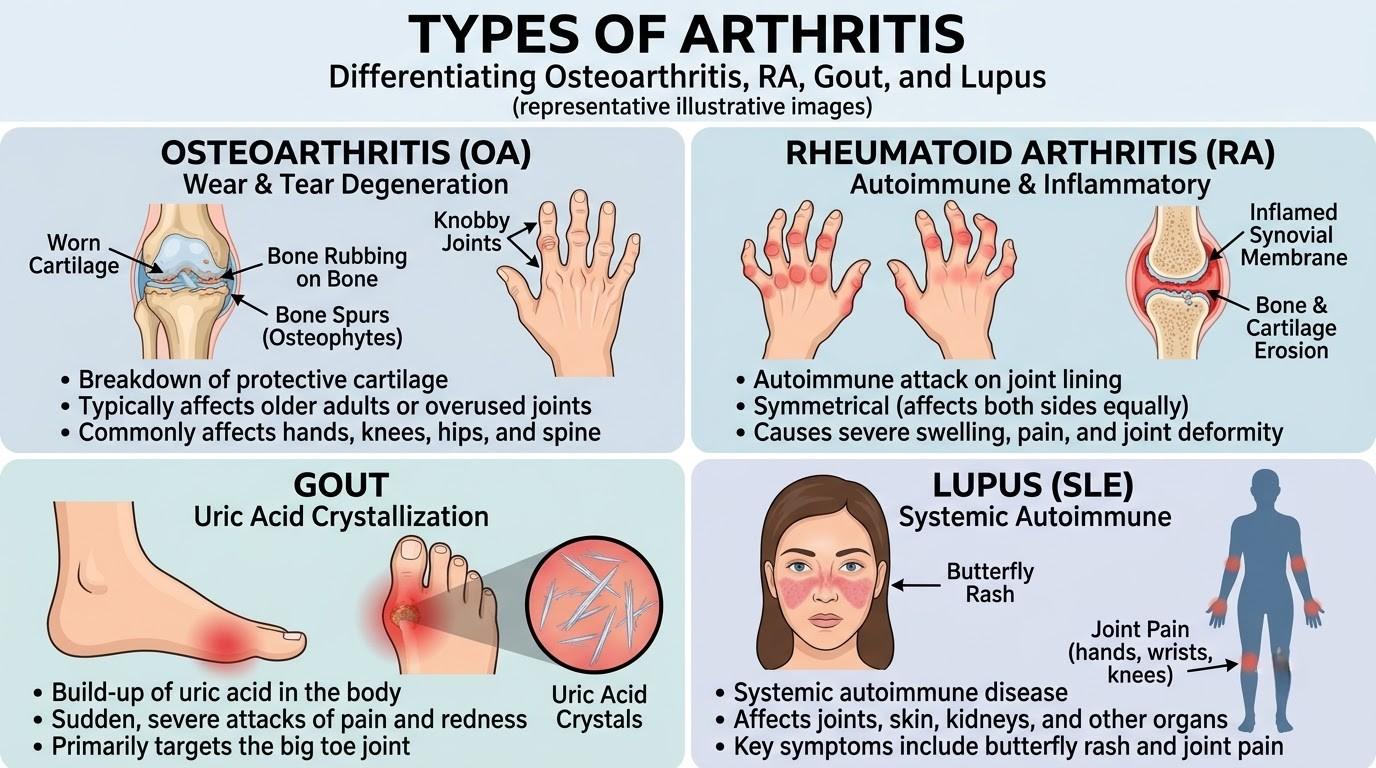
1. Osteoarthritis
This is related to degeneration of cartilage and other tissues within a joint. Commonly occurs in joints such as knees, hips, hands and the spine.
It often develops slowly and can be related to age, previous damage to the joint, joint alignment and other risk factors. However, it is not just a natural part of aging.
Common symptoms of osteoarthritis include:
- Pain during and/or after movement.
- Stiffness in the joint upon waking up or after prolonged periods of sitting.
- Swelling in the affected joint.
- Loss of flexibility.
- A crunching/grinding feeling.
- Difficulties with activities such as stair climbing or gripping.
Pain can often be felt more after activity but will often be eased by rest. Symptoms can vary. Often there is less than 30 minutes of morning stiffness.
2. Rheumatoid Arthritis
An autoimmune chronic disease. This causes the immune system to attack the joint lining causing inflammation. If left uncontrolled this can cause damage to the joint structures.
Often affects small joints in the hands, wrists and feet. Can affect several joints and often affects opposing joints on either side of the body.
Common symptoms of Rheumatoid arthritis include:
- Constant pain and swelling in multiple joints.
- Stiffness upon waking which often lasts more than 30 minutes.
- Warmth and tenderness in the affected joints.
- Difficulties making a fist or gripping.
- Fatigue.
- Pain can often come and go. Sometimes in flare ups.
Rheumatoid arthritis can cause damage to other parts of the body such as the eyes, lungs and heart. It is important to get assessed early as continued inflammation can cause damage to the joints.
3. Gout
Gout is an inflammatory arthritis caused by a build up of monosodium urate crystals in and around joints. Although urate levels can raise and cause crystal formation, this cannot be diagnosed from a blood test looking at uric acid levels.
Attacks of gout often happen suddenly – sometimes overnight. Common joints affected include the large joint within the big toe, however it can affect joints such as the ankle, knee, wrist and fingers.
Symptoms of gout can include:
- A sudden severe pain in the joint(s).
- Swelling and warmness.
- Redness around the joint.
- Severe sensitivity to touch – sometimes even light touch can be painful.
- Difficulty walking or using the joint.
The flare can subside over time but symptoms can return. Frequent attacks can cause a build up of urate crystals in the body known as tophi and cause more long term issues in the joints.
4. Arthritis associated with Lupus
Systemic lupus erythematosus (SLE) is a chronic autoimmune disease which can cause damage to multiple areas of the body. Pain and inflammation in the joints can be a symptom.
As well as affecting joints, lupus can affect many areas of the body including the skin, kidneys, blood cells, heart, lung and nervous system.
Symptoms may include:
- Pain, swelling and stiffness in the joints.
- Constant fatigue.
- Unexplained fever.
- Rashes on the skin – some people develop a butterfly rash across their cheeks and nose.
- Loss of hair.
- Sores in the mouth or nose.
- Sensitivity to the sun.
- Color changes in the fingers and toes.
Symptoms may come and go in episodes known as flares. Not everyone will have the same symptoms.
Lupus is not just another type of arthritis. It is a systemic autoimmune disease which can cause symptoms in the joints including pain and inflammation.
Arthritis Symptoms: Comparison Table
The following table provides a general comparison of the four conditions. It is an educational guide, not a diagnostic checklist.
| Feature | Osteoarthritis | Rheumatoid arthritis | Gout | Lupus-related arthritis |
| Underlying process | Changes in cartilage and joint tissues | Autoimmune joint inflammation | Urate crystal deposition | Systemic autoimmune inflammation |
| Typical onset | Usually gradual | Often gradual, sometimes faster | Often sudden attacks | Variable; symptoms may come and go |
| Common joint areas | Knees, hips, hands and spine | Hands, wrists, feet and other joints | Big toe, ankle, knee and other joints | Hands, wrists and other joints |
| Joint swelling | May occur | Common | Often prominent during attacks | May occur |
| Morning stiffness | Often brief | Often prolonged | Variable | Variable |
| Other features | Pain with activity, reduced movement | Fatigue, warmth and tenderness | Sudden severe pain and redness | Fatigue, rashes, fever or other organ symptoms |
The pattern of arthritis symptoms can help a clinician decide which conditions to investigate. However, overlap is common, and more than one condition can sometimes be present.
Morning Stiffness: How Long Does It Last in Different Types of Arthritis?
Morning stiffness is an important detail when assessing joint problems. Its duration, location and associated symptoms can provide useful information.
| Condition | General morning stiffness pattern |
| Osteoarthritis | Often 30 minutes or less, particularly after waking or resting |
| Rheumatoid arthritis | Frequently longer than 30 minutes; may last an hour or more |
| Gout | Variable; stiffness may occur during or after an inflammatory attack |
| Lupus-related arthritis | Variable; may occur with other inflammatory or systemic symptoms |
Why does morning stiffness matter?
Stiffness in osteoarthritis can often be worsened by lack of activity but gets better when moving. In rheumatoid arthritis inflammation can cause stiffness that lasts for longer, particularly in the mornings.
This isn’t a strict rule. Some people will have longer stiffness in osteoarthritis. People with inflammatory arthritis may also have different patterns. Gout and lupus will also vary.
If you are having long lasting morning stiffness, particularly if there is visible swelling at your joints or difficulty using your hands, talk to a health care professional.
How Are Different Types of Arthritis Diagnosed?
There is no single test to help determine what kind of arthritis you have. A rheumatologist will take into account your medical history, physical examination, blood tests, imaging and other tests.
1. Medical History + Physical Examination
Your doctor or rheumatologist may ask:
- When did your pain start?
- Was it a sudden or gradual onset?
- Where are you experiencing pain? Which joints?
- How long do you have morning stiffness for?
- Does your pain settle with movement or rest?
- Have you had any other symptoms such as a fever, tiredness, rashes?
- Are they intermittent symptoms?
They may also carry out a physical examination to look for swelling, redness, soreness, range of movement and function of the joints.
2. Blood Tests
Depending on what condition your doctor thinks you may have they may perform:
- Inflammatory markers such as ESR and CRP.
- Rheumatoid factor (RF) and anti-CCP antibodies if they suspect RA.
- Urate levels if they think you may have gout.
- ANA and specific antibody tests if they suspect lupus.
- Bloods such as full blood count, kidney function and liver function if indicated.
There is no single blood test that can confirm a diagnosis. For example, just because you have a positive ANA doesn’t mean you have lupus. Or that you don’t have gout if you have normal uric acid levels in an acute attack.
3. Imaging
An X-ray may be performed to help identify joint space changes, bony damage or other findings. An ultrasound/MRI may be performed to help identify inflammatory changes and soft tissue changes in certain cases.
4. Joint Aspiration
If Gout or joint infection is suspected a small amount of fluid may be taken from your joint with a needle. This can help identify if there are any urate crystals or evidence of infection.
How Are Arthritis Conditions Managed?
The type of treatment you receive will depend on your diagnosis, how severe your symptoms are, the joints affected and your individual requirements.
Osteoarthritis : – Exercise, muscle strengthening, weight loss if applicable, pain relief and joint replacement can all be used as a treatment for osteoarthritis.
Rheumatoid arthritis : – Disease modifying anti rheumatoid drugs (DMARDs) can be used, alongside other medications, monitoring and rehabilitation. Treatment will be aimed at controlling the inflammation in early stages of the disease.
Gout : – Acute attacks can be treated. Long term lowering of urate levels can be offered to appropriate patients. The decision to use medication will take into consideration your kidney function, any other health issues and your medical history.
Lupus : – Treatment will depend on which organs are involved and how active your disease is. Inflammation and Immune system controlling medications can be used. Regular monitoring would also be required.
Don’t start/stop/change any medications prescribed by your online article. A suitable treatment plan should be discussed with your clinician.
When Should You Consult a Rheumatologist?
See your doctor if you have:
- Persistent or recurrent joint pain or swelling
- Stiffness on waking that lasts longer than half an hour
- Swelling of several joints (especially in your hands and feet)
- Recurrent episodes of sudden severe joint pain
- Joint problems accompanied by unexplained tiredness, fever and/or skin rashes
- Difficulties with walking, gripping or carrying out everyday tasks
If a joint becomes very painful, red and swollen suddenly see your doctor urgently. If you have a fever, chills or generally feel unwell then you should seek urgent care. Joint infections can mimic an inflammatory arthritis flare and so should be assessed promptly.
Conclusion
There are many different causes of joint pain. Osteoarthritis, rheumatoid arthritis, gout and lupus related arthritis all cause pain and stiffness to the joints.
Noting when your symptoms started, which joints have been affected, how long your morning stiffness lasts for and if there are any other symptoms can be helpful.
Whilst understanding what symptoms you may have with arthritis is important, trying to self diagnose can delay you getting the right treatment. Having a clinical assessment will help find out what is causing your arthritis and will help to create an individual management plan.
Frequently Asked Questions
1. What are the most common symptoms of arthritis?
Pain, stiffness, swelling, tenderness and loss of movement in joints are very common. Some may also get tiredness, fever, skin rash and flare-ups of intense inflammatory symptoms.
2. What is the difference between osteoarthritis and rheumatoid arthritis?
Osteoarthritis affects cartilage and other tissues within the joint whereas rheumatoid arthritis is an autoimmune disorder causing inflammation of the joint lining. The pattern of pain, stiffness and swelling can be different between the
3. Which arthritis causes morning stiffness?
There are a number of conditions that can cause morning stiffness. It is usually short lived in osteoarthritis and may last longer in rheumatoid arthritis. Stiffness can also occur with lupus related arthritis, although the pattern may vary in gout.
4. Is it always gout if you have a high uric acid?
Not necessarily. A high serum urate does not mean you have gout. Clinical assessment is needed along with joint fluid analysis (if appropriate) and other investigations.
5. Can lupus cause joint pain?
Yes. Joint pain, swelling and stiffness can occur with lupus. It can also cause skin, kidney, blood cell and other organ involvement.