Medically reviewed by: Dr. Pallavi Sharma
Qualification: MBBS — Batch Topper, MD Psychiatry
Specialty: Consultant Psychiatrist at Fortis Escorts Hospital, New Delhi and StepUp Joints, Lajpat Nagar 4. With over 6 years of clinical experience
Clinic: StepUp Joints, Lajpat Nagar, South Delhi
Last reviewed: [31 October 2026]
Doctor Statement
“Sleep problems can affect energy, concentration, mood, and daily safety. Occasional poor sleep is common, but persistent difficulty sleeping, excessive daytime sleepiness, loud snoring with breathing pauses, or sudden sleep attacks should be assessed by a qualified healthcare professional. The right evaluation depends on the pattern of symptoms, medical history, medicines, and lifestyle factors.”
Summary
This guide provides general information about common sleep disorders, their symptoms, possible causes, and when to consult a healthcare professional.
The inability to initiate or maintain sleep may be due to a variety of factors. Sleep disorders may exist when someone has a series of symptoms that affect their everyday life and occur frequently. The following symptoms may be indicative of a sleep disorder.
Common Signs of a Sleep Disorder
- Difficulty falling asleep
- Waking up frequently
- Waking up too early
- Feeling unrefreshed after sleeping
- Excessive sleepiness during the day
- Difficulty concentrating or remembering
- Sleep attacks
- Weakness of the muscles
- Unusual behaviors or movements while sleeping
- Restlessness or an urge to move the legs
- Talking or walking in your sleep
1. Insomnia
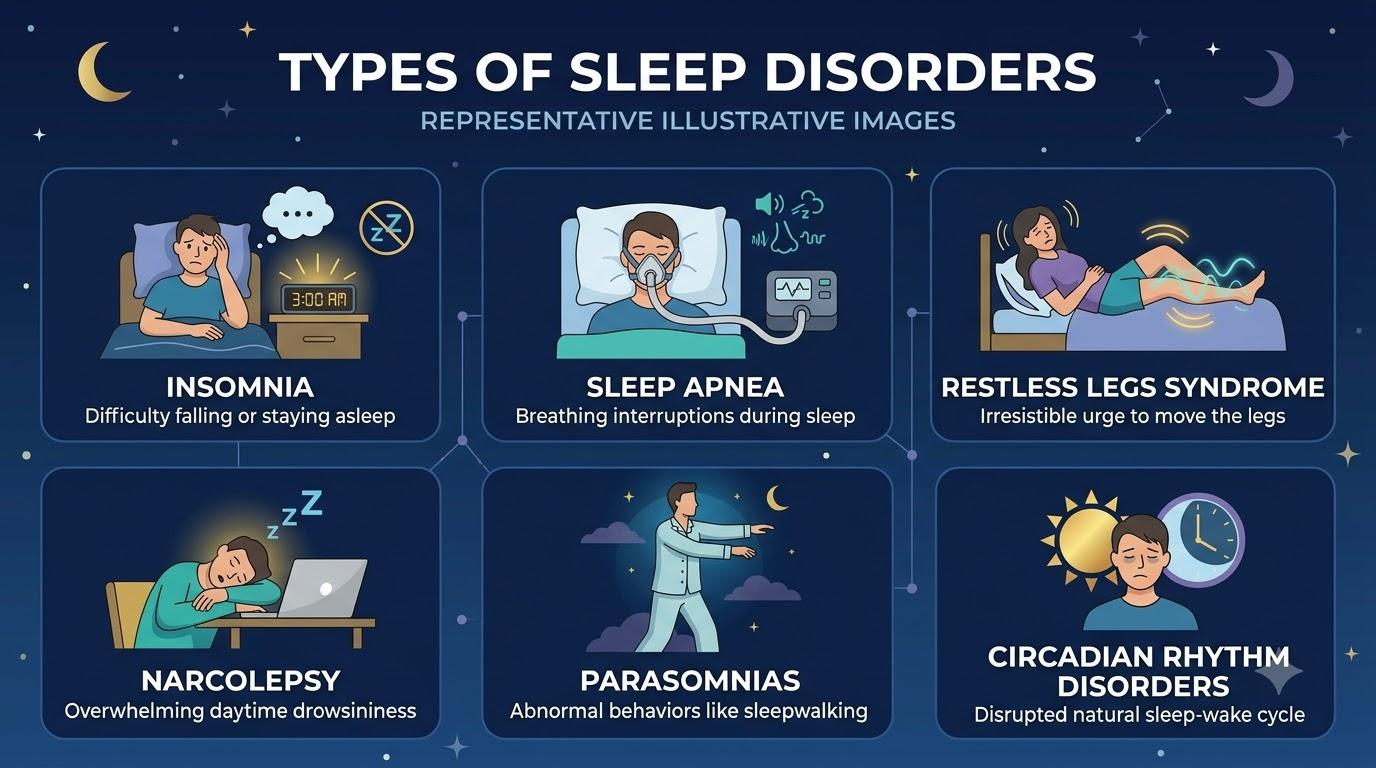
There are many factors that contribute to insomnia. Insomnia can be characterized as a difficulty falling asleep, waking up too early, or frequently waking up during the night.
Symptoms
- Falling asleep too slowly
- Frequent waking during the night
- Waking too early
- Feeling unrefreshed after a sleep
- Excessive daytime sleepiness
- Fatigue, low energy, and irritability.
- Depressed or anxious feelings.
- Difficulty with concentration.
- Worry and anxiety about not being able to sleep.
Causes
Insomnia can occur because of stress, anxiety, or depression, as well as through physical illness, injury, or pain. It can also occur from work or school schedules (shift work), changes from time zones (jet lag), caffeine, alcohol, medication, irregular bedtime routines and routines, use of screens before bed, or other factors.
When to seek help
Regular or persistent insomnia, which lasts for several weeks or months and affects your everyday life, should be brought to the attention of your healthcare professional.
2. Obstructive Sleep Apnoea
Obstructive sleep apnoea (OSA) occurs when the airways repeatedly narrow or close during sleep. This can cause disturbed or shallow breathing and sometimes, stoppages in breathing.
- Signs and symptoms
- Loud snoring.
- Breathing stoppages observed by a partner.
- Gasping for air during the night.
- Choking or snorting.
- Dry mouth or headaches in the morning.
- Excessive daytime sleepiness.
- Irritability.
- Poor concentration.
- Frequent waking during the night.
Not everyone who snores has OSA, but those with loud snoring, gasping for air, and observed breathing stoppages need to be further assessed.
Causes and risk factors
Obstructive sleep apnea is associated with being overweight, certain anatomies of the airway, alcohol use, smoking, certain medical conditions, and sleeping in certain positions. Central sleep apnea is less common and is due to problems with the brain’s signaling to the breathing muscles.
When to seek help
Loud snoring with pauses in breathing, gasping during snoring, sleepiness during the day, morning headaches, and difficulty staying awake are symptoms of sleep apnea. Seek medical attention for any of these symptoms.
3. Restless Leg Syndrome
Restless legs syndrome (RLS) is a disorder that causes an urge to move your legs. The urge and discomfort are typically felt when you are relaxed or lying down, for example when sitting or lying in bed. Symptoms are often worse in the evening. Discomfort is described as pulling, tingling, crawling, aching or burning. The urge to move provides only short term relief and discomfort returns when you stop moving. This can cause problems when you are trying to fall asleep. Some people with RLS have no known cause. Other causes can include iron deficiency, certain medications, kidney disease, pregnancy, family history, and some nerve disorders. RLS can be assessed by a physical exam, review of your symptoms and your family history, and possibly blood tests to check your levels of certain vitamins and minerals.
When to seek help
See your doctor if symptoms of RLS are frequent, worsening, or affecting your quality of life.
4. Narcolepsy
Narcolepsy is a disorder affecting the region of the brain responsible for regulation of sleep and wakefulness. People with narcolepsy have a predisposition to fall asleep suddenly and uncontrollably during the day, and often report a sensation of “sleep attack.”
- Symptoms
- Excessive daytime sleepiness
- Sudden spontaneous loss of muscle tone (cataplexy) caused by extreme emotions (i.e. laugher, surprise, anger, etc.)
- Sleep attacks
- Sleep paralysis
- Hallucinations (hypnagogic)
When to see a doctor
You should see a doctor if you experience episodes of muscle weakness, sudden and/or uncontrollable urge to sleep, and/or fall asleep during the day with no known reason or cause.
5. Circadian Rhythm Sleep-Wake Disorders
Circadian rhythm sleep-wake disorders are conditions characterized by misalignment between the body’s internal biological clock and the desired/required external sleep-wake schedule.
Types
Delayed phase sleep disorder: Falling asleep naturally later at night and waking up later in the morning
Advanced phase sleep disorder: Falling asleep naturally earlier in the evening and waking up earlier in the morning
Shift work disorder: Sleep difficulties associated with working night shifts
Jet lag disorder: Temporary sleep disruption due to trans-meridian (time zone) travel
Symptoms
- Difficulty falling asleep at the desired time
- Waking at the wrong time
- Sleep attacks
- Difficulty concentrating
- Impaired social and occupational functioning
- Possible causes
Working shifts, frequent travel, irregular sleeping patterns, nighttime screen exposure, and genetic differences in the body’s clock may play a role in the development of these disorders.
When to seek help
If sleep timing issues impact your work and/or study, and adjusting your schedule does not help, see a health care professional. They can assist you in determining if the issue is a circadian rhythm sleep disorder, or if it is caused by something else, such as insomnia.
6. Parasomnias
Parasomnias are undesirable physical or experiential phenomena that occur during the process of falling asleep, in the sleep state, and upon waking.
- Common examples
- Sleepwalking
- Sleep talking
- Night terrors
- Sleep related eating
- Nightmare disorder
REM sleep behavior disorder, which involves enacting out dreams.
Symptoms
- Ambulating, talking, or eating during sleep
- Violent physical behaviors, such as kicking or punching, during sleep
- Confusion upon waking
- Disturbing or vivid dreams
- Injury due to lack of awareness during the behavior
When to seek help
Seek medical care if episodes occur frequently, put you or others at risk, or disrupt your daily living. Keep in mind that if you, as an adult, have recently started experiencing parasomnias, this may indicate an underlying neurological disorder, and therefore should be further assessed.
- Other Sleep-Related Problems
- Hypersomnia
- Sleep-related movement disorders
- Anxiety and depression-related sleep issues
- Sleep-related issues related to pain, reflux, asthma, heart and lung conditions
- Medicine and alcohol-related sleep issues
- Caffeine-related issues
- Age-related sleep issues
Sleep issues may be caused by mental, physical, genetic, environmental and social factors. Sometimes, the reason is not known.
When to See a Doctor
You may want to see a doctor if you have one or more of the following:
- Sleep problems that occur 3 or more nights a week.
- Symptoms that last for weeks or months.
- Daytime sleepiness that impacts your work, school, or driving.
- Severe snoring that is accompanied by pauses in your breathing and is then followed by gasping or choking.
- Morning headaches or if you feel unrefreshed when you wake up, even if you spent enough time in bed.
- Leg discomfort or the urge to move your legs that is not relieved by changing your position that occurs at night.
- Sudden attacks of sleep that occur at unexpected times or episodes of unexpected muscle weakness.
- Bouts of sleepwalking that include violent or aggressive movements, or that lead to injury.
- Emotional problems like anxiety, stress, or depression that make it hard for you to sleep.
Get Emergency Medical Help if you have any of the following:
- Sudden collapse.
- Chest pain.
- Difficulty breathing.
Neurological problems that include the loss of function on one side of your body, problems speaking, or seizures.
What Happens During a Sleep Assessment?
Your doctor may ask you about the following:
- Your sleeping schedule.
- The quality of your sleep.
- How long your symptoms have been present.
- How sleepy you feel during the day.
- How well you concentrate during the day.
- How well you remember things.
- If you snore or make strange noises while you sleep.
- If you have pauses in your breathing while you sleep.
- If you have restless legs while you sleep.
- Stress and anxiety.
- How well you are able to manage your pain.
- Other medical conditions.
Other people’s observations of you while you sleep, if any.
The doctor may have you do any of the following, based upon the suspected condition:
- Recommend sleep diaries.
- Give you blood tests.
- Refer you to a sleep specialist.
Recommend a sleep study to monitor your breathing, movement, and sleep stages.
Sleep Hygiene: General Measures That May Help
- Keeping a regular sleep schedule may help you sleep better.
- Try to go to bed at the same time every night and to wake up at the same time every morning.
- Keep your bedroom quiet, dark and comfortable.
- Avoid caffeine, alcohol and heavy meals before bed.
- Avoid using screens before bed.
- Get regular exercise, but avoid vigorous exercise before bed.
- Avoid taking long daytime naps.
- Use your bed only for sleeping and not for work or other activities.
If you can’t sleep after 20-30 minutes, get out of bed. Come back to bed when you are tired enough to sleep.
Many healthcare providers will suggest these strategies along with CBT-I.
When to see a doctor immediately
- Go to the emergency room right away if you suddenly have weakness on one side of your body, slur your speech, and have trouble understanding other people’s speech.
- Go to the emergency room right away if you have chest pain or trouble breathing.
- Go to the emergency room right away if you have a severe headache.
- Go to the emergency room right away if you have symptoms of stroke or faint/pass out.
- Do not take sleeping pills without medical advice if you have any of these symptoms.
Conclusion
There are many different kinds of sleep disorders. Some of them include insomnia, sleep apnea, restless leg syndrome, narcolepsy, circadian rhythm disorders and parasomnias. Some of the signs of these disorders may include trouble sleeping, trouble focusing and irritability.
Not being able to sleep sometimes is normal. If you have persistent trouble sleeping, talk to your doctor. They may suggest behavioral therapy, lifestyle changes, treatment for your conditions and/or suggest that you see a sleep specialist.
Frequently Asked Questions
1.How do I know if I have insomnia?
If you find you regularly have issues with falling or staying asleep and it affects your daily life, this could be insomnia. This needs to be assessed by a medical professional.
2.Can snoring mean sleep apnea?
Snoring can be benign, but if you have heavy snoring with pauses in your breathing and you find yourself gagging, choking, or feeling very sleepy during the day, these could be signs of sleep apnea and should be assessed.
3.What is the difference between tiredness and sleepiness?
Tiredness is just having a lack of energy. Sleepiness is feeling like you need to sleep even if you have had enough time in bed. Sleepiness can also mean you are not functioning properly during the day, and this is also something that should be assessed.
4.Can stress be the cause of sleep problems?
Yes, many things can contribute to not being able to fall or stay asleep, such as stress, anxiety, pain, irregular schedules, stimulants or depressants, and using screens before bed.
5.What do I do if I have sleeping problems?
You should see a doctor if your sleeping problems happen a lot, last a long time, affect your daily life, or include snoring with pauses in breathing, gasping, extreme sleepiness, restless legs, or sudden sleep attacks.
6.Are sleeping disorders treatable?
Yes. There are many ways to control sleeping disorders. The type of treatment is determined by the diagnosis. This treatment may include behavioral changes, getting treatment for the underlying condition, and the use of a CPAP for sleep apnea, among others.